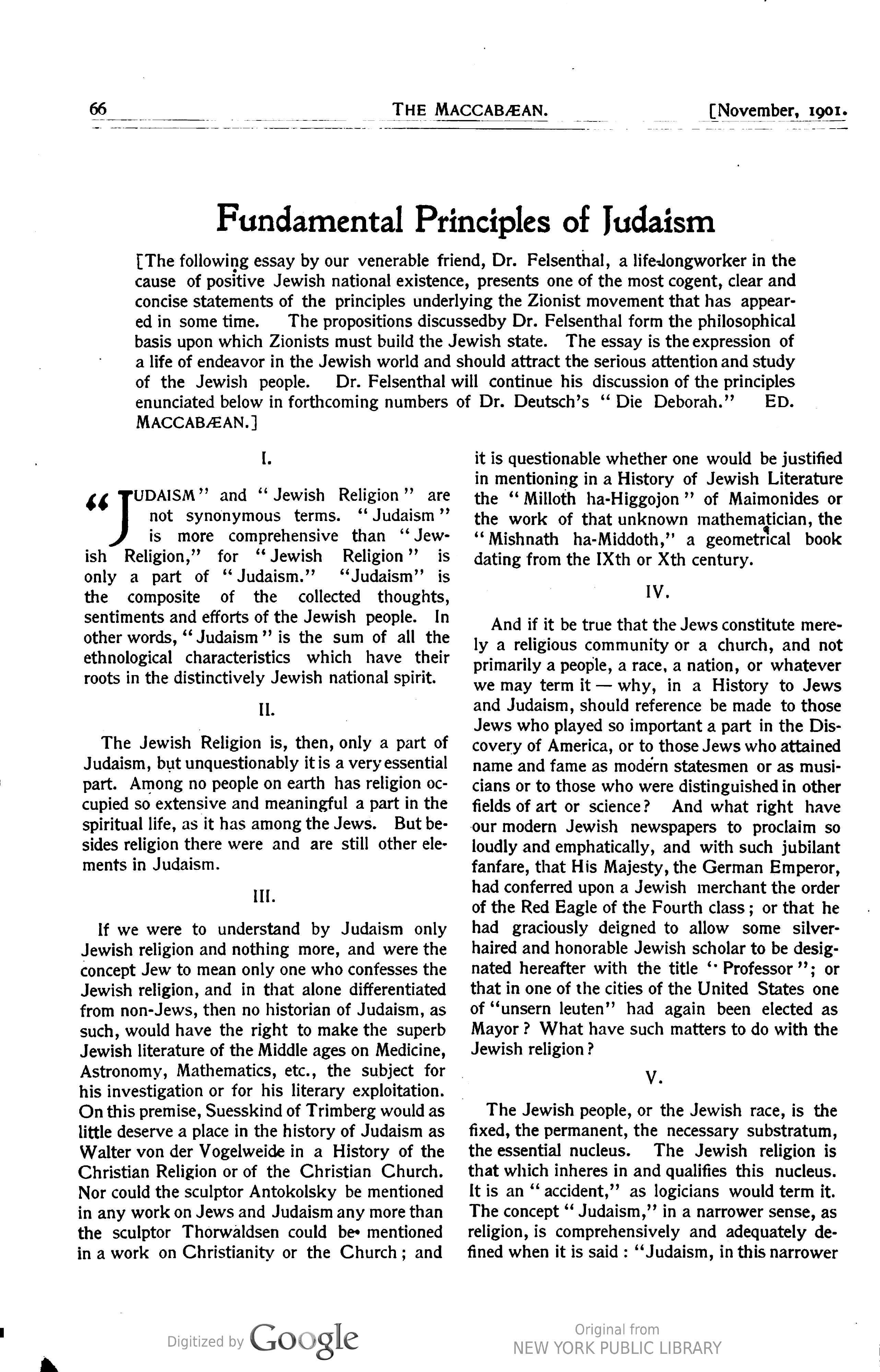
Fundamental Principles of Judaism
[The following essay by our venerable friend, Dr. Felsenthal, a life-longworker in the cause of positive Jewish national existence, presents one of the most cogent, clear and concise statements of the principles underlying the Zionist movement that has appeared in some time. The propositions discussedby Dr. Felsenthal form the philosophical basis upon which Zionists must build the Jewish state. The essay is the expression of a life of endeavor in the Jewish world and should attract the serious attention and study of the Jewish people. Dr. Felsenthal will continue his discussion of the principles enunciated below in forthcoming numbers of Dr. Deutsch's "Die Deborah." ED. MACCABÆAN.]
L.
“JUDAISM” and “Jewish Religion” are not synonymous terms. “Judaism” is more comprehensive than “Jewish Religion,” for “Jewish Religion” is only a part of “Judaism.” “Judaism” is the composite of the collected thoughts, sentiments and efforts of the Jewish people. In other words, “Judaism” is the sum of all the ethnological characteristics which have their roots in the distinctively Jewish national spirit.
II.
The Jewish Religion is, then, only a part of Judaism, but unquestionably it is a very essential part. Among no people on earth has religion occupied so extensive and meaningful a part in the spiritual life, as it has among the Jews. But besides religion there were and are still other elements in Judaism.
III.
If we were to understand by Judaism only Jewish religion and nothing more, and were the concept Jew to mean only one who confesses the Jewish religion, and in that alone differentiated from non-Jews, then no historian of Judaism, as such, would have the right to make the superb Jewish literature of the Middle ages on Medicine, Astronomy, Mathematics, etc., the subject for his investigation or for his literary exploitation. On this premise, Suesskind of Trimberg would as little deserve a place in the history of Judaism as Walter von der Vogelweide in a History of the Christian Religion or of the Christian Church. Nor could the sculptor Antokolsky be mentioned in any work on Jews and Judaism any more than the sculptor Thorwäldsen could be mentioned in a work on Christianity or the Church ; and
it is questionable whether one would be justified in mentioning in a History of Jewish Literature the “Milloth ha-Higgojon” of Maimonides or the work of that unknown mathematician, the “Mishnath ha-Middoth,” a geometrical book dating from the IXth or Xth century.
IV.
And if it be true that the Jews constitute merely a religious community or a church, and not primarily a people, a race, a nation, or whatever we may term it — why, in a History to Jews and Judaism, should reference be made to those Jews who played so important a part in the Discovery of America, or to those Jews who attained name and fame as modern statesmen or as musicians or to those who were distinguished in other fields of art or science? And what right have our modern Jewish newspapers to proclaim so loudly and emphatically, and with such jubilant fanfare, that His Majesty, the German Emperor, had conferred upon a Jewish merchant the order of the Red Eagle of the Fourth class; or that he had graciously deigned to allow some silver-haired and honorable Jewish scholar to be designated hereafter with the title “Professor”; or that in one of the cities of the United States one of “unsern leuten” had again been elected as Mayor? What have such matters to do with the Jewish religion?
V.
The Jewish people, or the Jewish race, is the fixed, the permanent, the necessary substratum, the essential nucleus. The Jewish religion is that which inheres in and qualifies this nucleus. It is an “accident,” as logicians would term it. The concept “Judaism,” in a narrower sense, as religion, is comprehensively and adequately defined when it is said: “Judaism, in this narrower