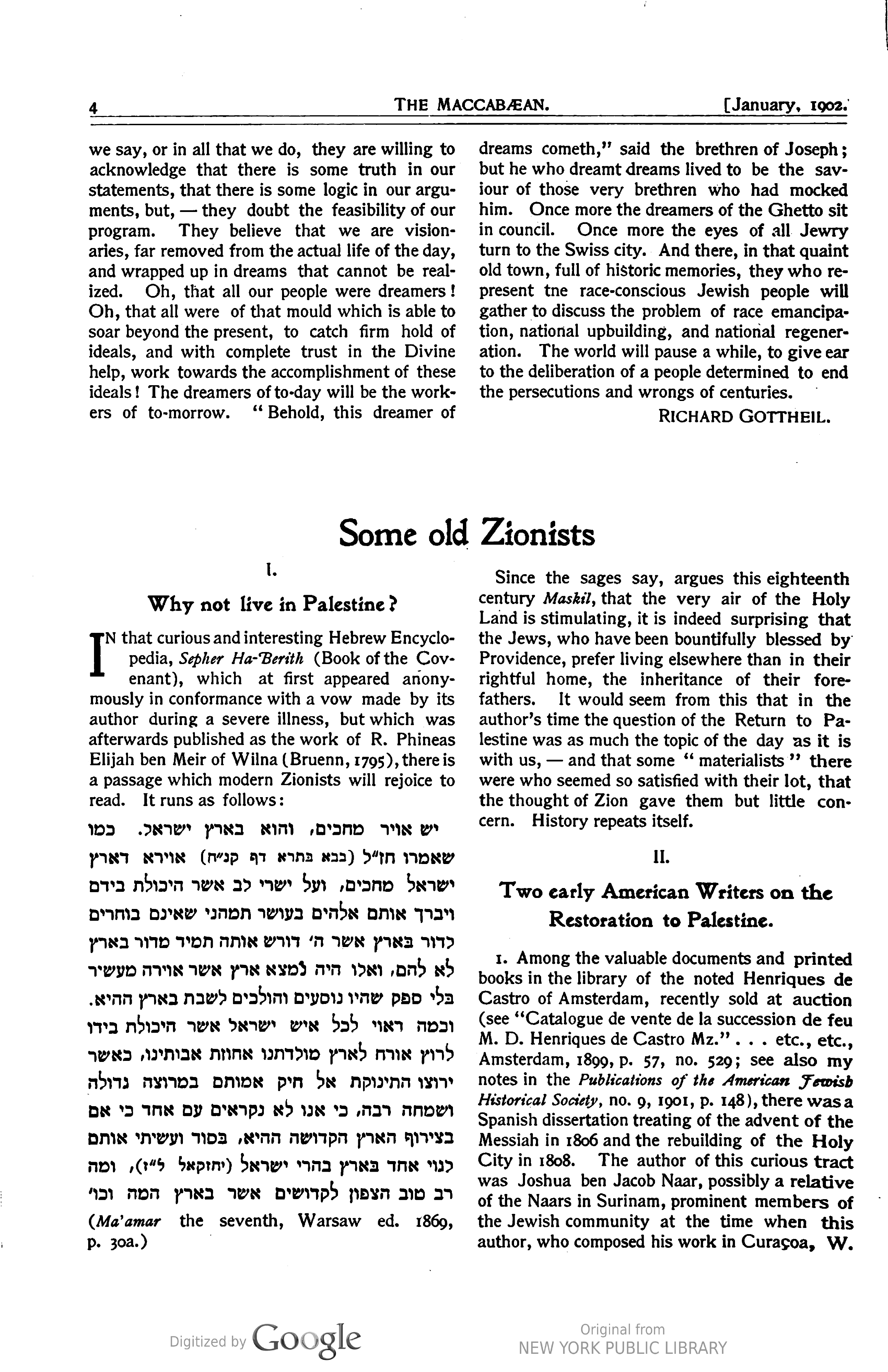
we say, or in all that we do, they are willing to acknowledge that there is some truth in our statements, that there is some logic in our arguments, but, — they doubt the feasibility of our program. They believe that we are visionaries, far removed from the actual life of the day, and wrapped up in dreams that cannot be realized. Oh, that all our people were dreamers! Oh, that all were of that mould which is able to soar beyond the present, to catch firm hold of ideals, and with complete trust in the Divine help, work towards the accomplishment of these ideals! The dreamers of to-day will be the workers of to-morrow. "Behold, this dreamer of
dreams cometh,” said the brethren of Joseph; but he who dreamt dreams lived to be the saviour of those very brethren who had mocked him. Once more the dreamers of the Ghetto sit in council. Once more the eyes of all Jewry turn to the Swiss city. And there, in that quaint old town, full of historic memories, they who represent tne race-conscious Jewish people will gather to discuss the problem of race emancipation, national upbuilding, and national regeneration. The world will pause a while, to give ear to the deliberation of a people determined to end the persecutions and wrongs of centuries.
RICHARD GOTTHEIL.
Some old Zionists
L.
Why not live in Palestine?
IN that curious and interesting Hebrew Encyclopedia, Sepher Ha-Berith (Book of the Covenant), which at first appeared anonymously in conformance with a vow made by its author during a severe illness, but which was afterwards published as the work of R. Phineas Elijah ben Meir of Wilna (Bruenn, 1795), there is a passage which modern Zionists will rejoice to read. It runs as follows:
יש אויר מחכים, והוא בארץ ישראל. כמו שאמרו חז"ל (בבא בתרא דף קני"ת) אוירא דארץ ישראל מחכים, ועל ישרי לב אשר היכולת בידם ויברך אותם אלהים בעושר תמהני שאינם בוחרים כדור בארץ אשר ה' דורש אותה תמיד מדור בארץ לא להם, ואלו היה למצא ארץ אשר אוירה מעשיר בלי ספק שהיו נוסעים והולכים לשבת בארץ ההיא. וכמה ראוי לכל איש ישראל אשר היכולת בידו לרוץ אורח לארץ מולדתנו אחוז אחוז אבותינו, כאשר ירוצו התינוקת אל חיק אמותם במרוצה גדולה ושמחה רבה, כי אנו לא נקראים עם אחד כי אם בצירוף הארץ הקדושה ההיא, בסוד ועשיתי אותם לנוי אחד בארץ בהרי ישראל (יחזקאל ל"ז), ומה רב טוב הצפון לקדושים אשר בארץ המה וכו' (Ma'amar the seventh, Warsaw ed. 1869, p. 30a.)
Since the sages say, argues this eighteenth century Maskil, that the very air of the Holy Land is stimulating, it is indeed surprising that the Jews, who have been bountifully blessed by Providence, prefer living elsewhere than in their rightful home, the inheritance of their forefathers. It would seem from this that in the author's time the question of the Return to Palestine was as much the topic of the day as it is with us, — and that some "materialists" there were who seemed so satisfied with their lot, that the thought of Zion gave them but little concern. History repeats itself.
II.
Two early American Writers on the Restoration to Palestine.
I. Among the valuable documents and printed books in the library of the noted Henriques de Castro of Amsterdam, recently sold at auction (see "Catalogue de vente de la succession de feu M. D. Henriques de Castro Mz." . . . etc., etc., Amsterdam, 1899, p. 57, no. 529; see also my notes in the Publications of the American Jewish Historical Society, no. 9, 1901, p. 148), there was a Spanish dissertation treating of the advent of the Messiah in 1806 and the rebuilding of the Holy City in 1808. The author of this curious tract was Joshua ben Jacob Naar, possibly a relative of the Naars in Surinam, prominent members of the Jewish community at the time when this author, who composed his work in Curaçoa, W.