Jewish Art and Artists
WHAT is Jewish art? is a question which we will not attempt to answer. Art itself is a term which is variously defined by thoughtful men of our time. Tolstoy has defined it as the expression of an emotion which is transmitted to and awakened in another. But Tolstoy is in disagreement with the recognized esthetologists of our day. "Jewish art" is involved in even more difficulties. Josef Israels, Mark Antokolsky, Munkasky, Nossig, to mention but a few, come to mind when we think of Jewish art, and we often declare with a confidence that no one will contradict us when we say, that such and such a painting is imbued with "Jewish feeling"; but when closely questioned we are really at a loss to explain what we mean when we make the statement. A definition of Jewish art is yet to come, although we seem to know specimens of that art when they are brought to our attention.
In a recent number of the "Ost und West" Herr E. M. Lilien, the artist who has developed a distinctively Jewish artistic expression, discusses the relation of wealthy Jews to the art which is vaguely known as Jewish art. A brother artist, not Jewish, remarked to him: "You are to be congratulated; you are a Jewish artist. I suppose your works are purchased by rich Jews as soon as finished. You are in great demand, find support; and are thus enabled to devote yourself to your art and work well with a light heart."
To which Herr Lilien replied: "Where did you get that notion? Do you seriously think that my wealthy brethren concern themselves with Jewish artists—have you ever seen the works of Jewish artists on the walls of a Jewish salon, — for example, the works of a Hirzenberg, a Struck or a Lesser Ury? How many scholarships can you mention that were founded by Jews for Jews?
The fact of the matter is that they are not interested in a Jewish artist until he has died and become a Jewish antiquity, perhaps less compromising than the cuneiform inscriptions on the stones of El-Amarna. Do you think that our large newspapers, so called 'Judenblaetter,' are open to a distinctively Jewish talent? Just those Jews who are so prominent on the stock exchange, paragons of luxurious living, who delight to be considered art Maecenases, are the most anxious to keep out of their mansion pictures of a Jewish interest, lest they remind them of a prosaic ancestry and a mean past."
This attitude on the part of those who could support Jewish art has blighted the life of many a promising Jewish spirit who, filled to the brim with artistic instinct, perished on the road to technical perfection because of lack of sustenance. Such spirits have been encountered by Herr Lilien.
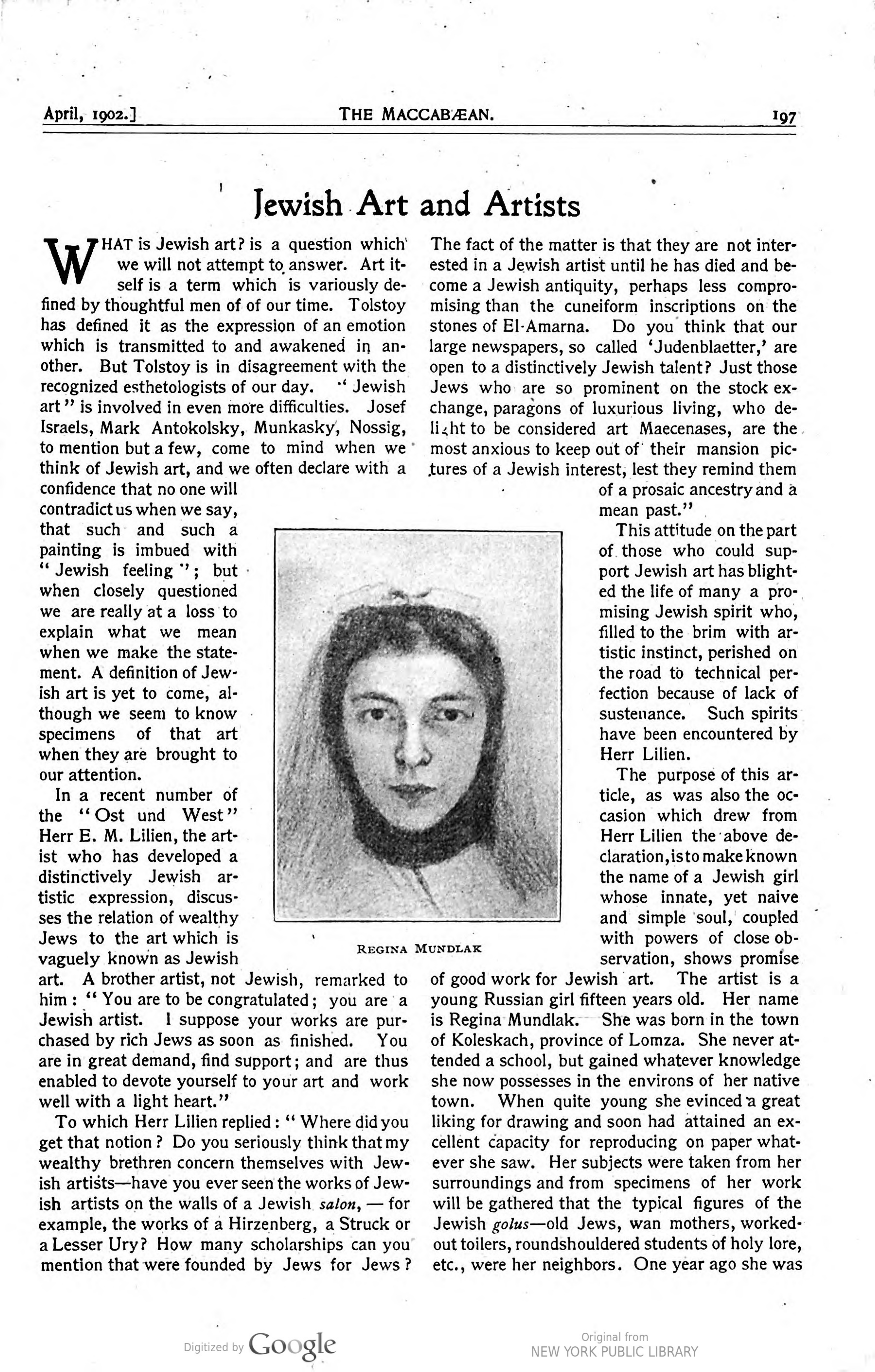
MUNDLAK The purpose of this article, as was also the occasion which drew from Herr Lilien the above declaration, is to make known the name of a Jewish girl whose innate, yet naive and simple soul, coupled with powers of close observation, shows promise of good work for Jewish art. The artist is a young Russian girl fifteen years old. Her name is Regina Mundlak. She was born in the town of Koleskach, province of Lomza. She never attended a school, but gained whatever knowledge she now possesses in the environs of her native town. When quite young she evinced a great liking for drawing and soon had attained an excellent capacity for reproducing on paper whatever she saw. Her subjects were taken from her surroundings and from specimens of her work will be gathered that the typical figures of the Jewish golus—old Jews, wan mothers, worked- out toilers, roundshouldered students of holy lore, etc., were her neighbors. One year ago she was