drawn to Berlin, where her talent was recognized by Max Lieberman,who contributed largely to the expense of her education for one year. But the girl has father and mother dependent upon her and requires more than the mere education. To this end Herr Lilien has made an appeal to our Berlin Jewry asking that the girl's future should be provided for.
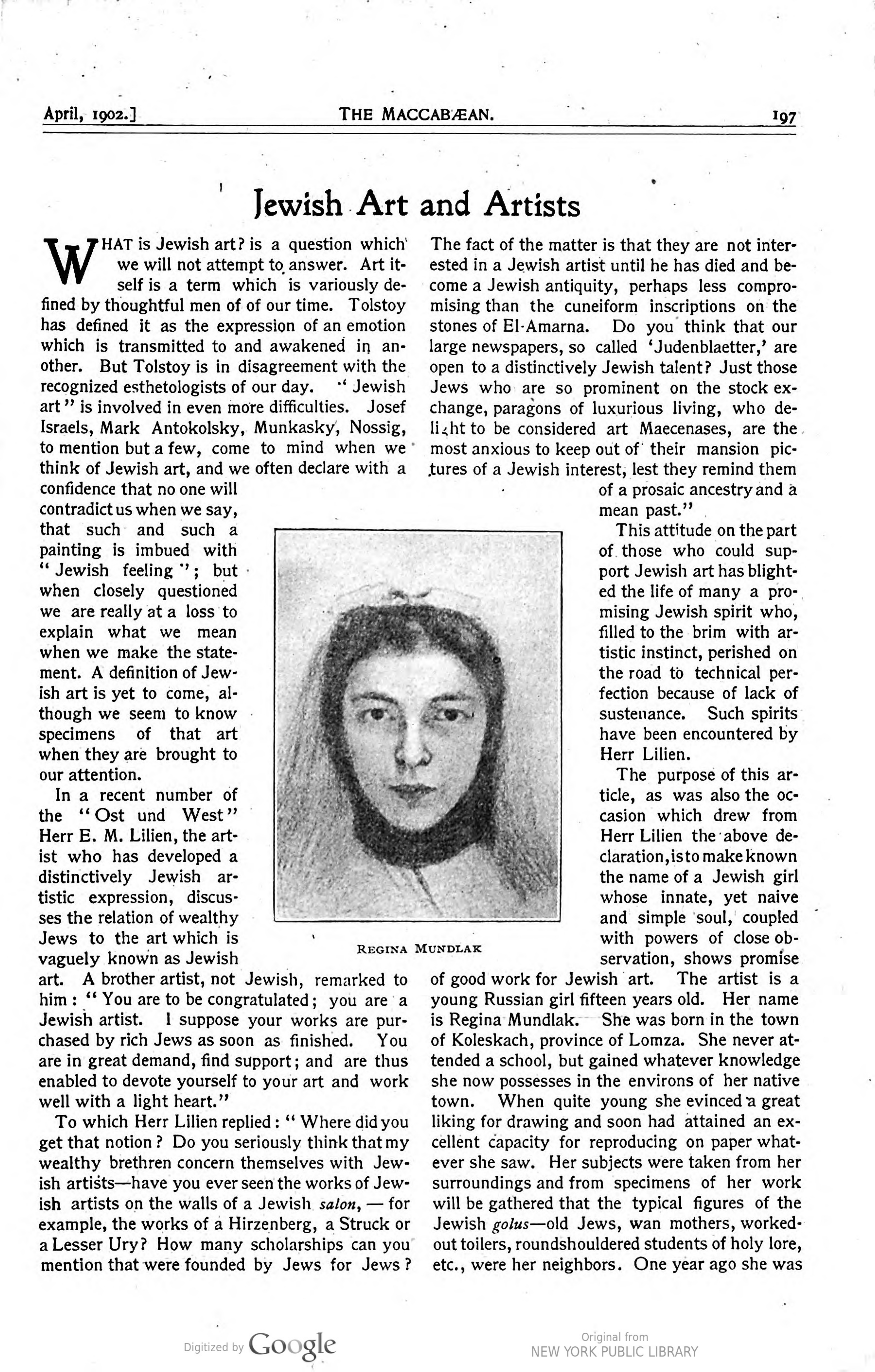
The "Ost und West" publishes a few specimens of Regina Mundlak's work. They show unquestionable skill in draughtmanship. It is not necessary to wait until Jewish art is defined before such undoubted specimens of art are recognized as Jewish and the artist whose feeling they express is enabled to perfect herself in her profession. The portrait of Miss Mundlak which we reproduce is the work of the young artist herself.
Jewish Literature and Science
WITH the awakening of Jewish self-consciousness a deep feeling for our distinctive intellectual characteristics manifests itself once again; a strong impulse toward knowledge is stirring, which should throw light into the innermost depths of our being. It would be lamentably stupid to allow the cares of everyday life to thrust aside the great problems of the Jewish soul, or to resolve them into allegories. They rise to the surface, whether we will it or not; they dominate with an elemental force from which the endeavor to force oneself is fruitless. We stand on the ground of national intelligence, and we receive our spiritual nourishment from the historic traditions and the moral culture of our race. From this point of view, examining it with unclouded eyes, we see the science of Judaism, even though removed from the bustle of ordinary affairs, in the light of a vital, national problem. I should like to treat this great subject full earnestly, and before all, a definition must be given, in order to do it ample justice in its depth and scope.
Science of Judaism! What does it signify?Does it imply a power, vital, impelling, leaven-ing? The term has been sadly misused. Anyone who may have picked up a few neglectedgrains from the storehouse of Judaism, or mayhave gathered together some forgotten material,or may have printed some old, frequently insignificant manuscript, boasts freely of the "scienceof Judaism," and endangers the reputation of theexcellent term. Such work is nothing more norless than archæology. On the other hand, thereare some who scornfully gainsay the very existence of such a science. Many a modern Jewconsiders all the talk about a Jewish science tobe a figment of the brain, and from his point ofview he is right. Since his thought and feeling
do not bring him into direct contact with any part of this science, he does not perceive the least vestiges of it. As is well known, theology and jurisprudence in general are denied the character of a science, on the ground that the material of both is fixed and in the shape of strict formulas to be handled systematically; at the very utmost, critically. Thus the greatest concession made them is a scientific treatment. But methodology and criticism, though part of, are not equivalent to, science. Judaism, however, is not a theology and not a system of jurisprudence, even if it includes both. Every science presupposes something fixed, that is, its subject. The natural sciences have certain well-defined subjects within the province of their treatment. Is Judaism a fixed conception? The answer is not new: Judaism is a great historic phenomenon; it has undergone steady development; it has its great phases, Mosaism, Prophetism, Talmudism, Rabbinism, and its participation in modern civilized life. Moreover, Judaism has maintained in constant evolution a great content of ideas and has realized these ideas in law and justice, in the life of a people, and thus, in the life of a great portion of the human kind. Even at its inception and in its earliest documents, Judaism appeared, not as a creed, nor as a system of jurisprudence, but as the varied phenomenon that I have described, and it has preserved its many-sided character to the present day. From this point of view it is entirely fit to be the subject of a science which must treat it as a living organism. If Judaism consisted merely of a collection of doctrines and legal regulations, then it would not be the fit subject of a science; and systematic or critical treatment would fall far short of giving it the character of a science. Knowledge, however great, is not science. Science is the investiga-