The Russian Censor's Decoration
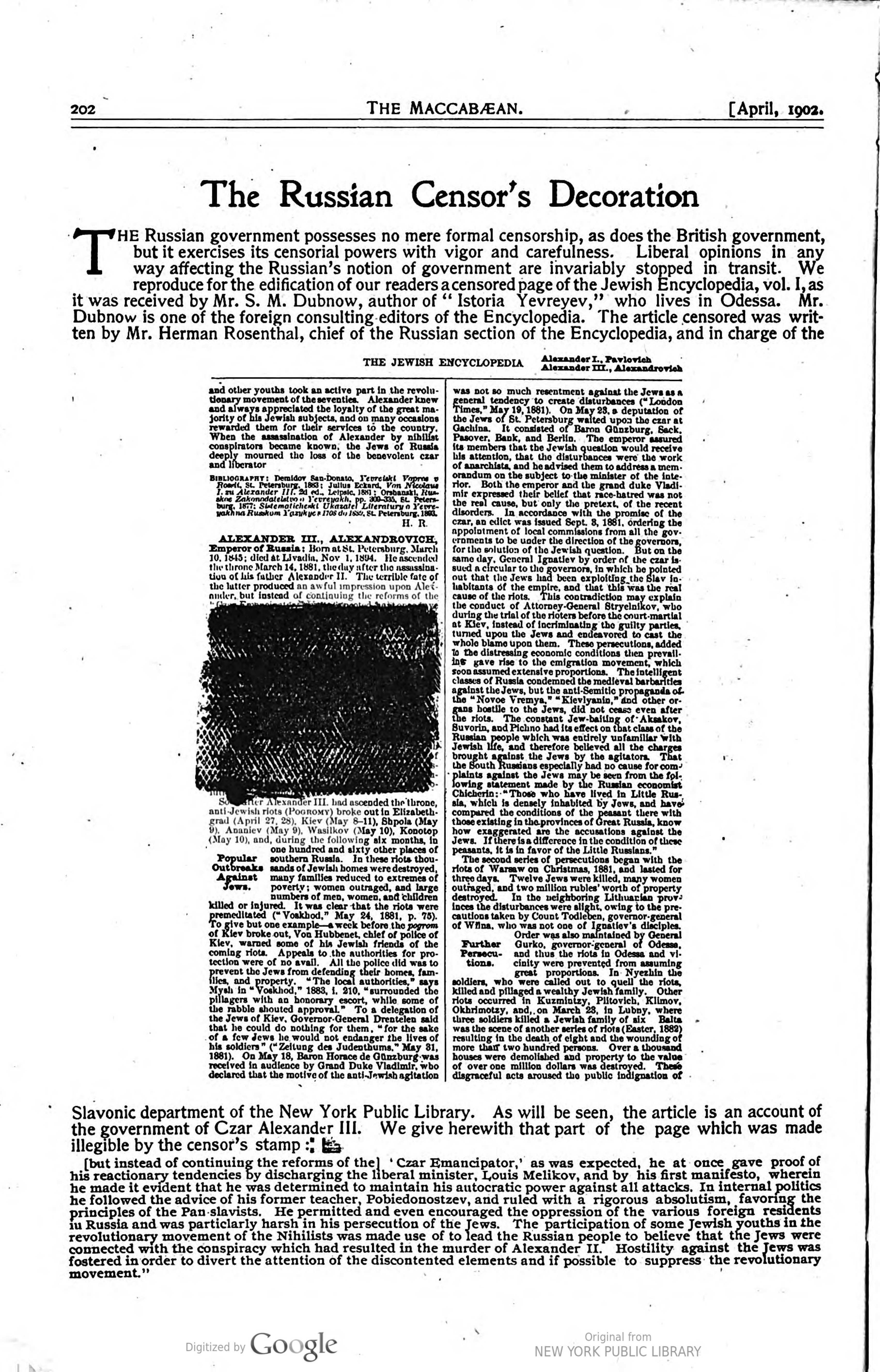
THE Russian government possesses no mere formal censorship, as does the British government, but it exercises its censorial powers with vigor and carefulness. Liberal opinions in any way affecting the Russian's notion of government are invariably stopped in transit. We reproduce for the edification of our readers a censored page of the Jewish Encyclopedia, vol. I, as it was received by Mr. S. M. Dubnow, author of "Istoria Yevreyev," who lives in Odessa. Mr. Dubnow is one of the foreign consulting editors of the Encyclopedia. The article censored was written by Mr. Herman Rosenthal, chief of the Russian section of the Encyclopedia, and in charge of the
and other youths took an active part in the revolutionary movement of the seventies. Alexander knew and always appreciated the loyalty of the great majority of his Jewish subjects, and on many occasions rewarded them for their services to the country. When the assassination of Alexander by nihilist conspirators became known, the Jews of Russia deeply mourned the loss of the benevolent czar and liberator.
BIBLIOGRAPHY: Demidov San-Donato, Yevreiski Vopros v Rossii, St. Petersburg, 1883; Julius Eckard, Von Nicolaus I. zu Alexander III. 2d ed., Leipsic, 1881; Orshanski, Russkoe Zakonodatelstvo o Yevreyakh, pp. 300-335, St. Petersburg, 1877; Sistematicheski Ukazatel Literatury o Yevreyakh na Russkom Yazykye s 1708 do 1880, St. Petersburg, 1880. H. R.
ALEXANDER III., ALEXANDROVICH, Emperor of Russia : Born at St. Petersburg, March 10, 1845; died at Livadia, Nov. 1, 1894. He ascended the throne March 14, 1881, the day after the assassination of his father Alexander II. The terrible fate of the latter produced an awful impression upon Ale-ander, but instead of continuing the reforms of the
So after Alexander III. had ascended the throne,anti-Jewish riots (POGROMY) broke out in Elizabethgrad (April 27, 28), Kiev (May 8-11), Shpola (May9), Ananiev (May 9), Wasilkov (May 10), Konotop(May 10), and, during the following six months, in
one hundred and sixty other places of Popular southern Russia. In these riots thou- Outbreaks sands of Jewish homes were destroyed, Against many families reduced to extremes of Jews. poverty; women outraged, and large numbers of men, women, and children killed or injured. It was clear that the riots were premeditated ("Voskhod," May 24, 1881, p. 75). To give but one example—a week before the pogrom of Kiev broke out, Von Hubbenet, chief of police of Kiev, warned some of his Jewish friends of the coming riots. Appeals to the authorities for protection were of no avail. All the police did was to prevent the Jews from defending their homes, families, and property. "The local authorities," says Mysh in "Voskhod," 1883, i. 210, "surrounded the pillagers with an honorary escort, while some of the rabble shouted approval." To a delegation of the Jews of Kiev, Governor-General Drentelen said that he could do nothing for them, "for the sake of a few Jews he would not endanger the lives of his soldiers" ("Zeitung des Judenthums," May 31, 1881). On May 18, Baron Horace de Günzburg was received in audience by Grand Duke Vladimir, who declared that the motive of the anti-Jewish agitation
THE JEWISH ENCYCLOPEDIA Alexander I., Pavlovich Alexander III., Alexandrovich
was not so much resentment against the Jews as a general tendency to create disturbances ("London Times," May 19, 1881). On May 23, a deputation of the Jews of St. Petersburg waited upon the czar at Gachina. It consisted of Baron Günzburg, Sack, Pasover, Bank, and Berlin. The emperor assured its members that the Jewish question would receive his attention, that the disturbances were the work of anarchists, and he advised them to address a memorandum on the subject to the minister of the interior. Both the emperor and the grand-duke Vladimir expressed their belief that race-hatred was not the real cause, but only the pretext, of the recent disorders. In accordance with the promise of the czar, an edict was issued Sept. 8, 1881, ordering the appointment of local commissions from all the governments to be under the direction of the governors, for the solution of the Jewish question. But on the same day, General Ignatiev by order of the czar issued a circular to the governors, in which he pointed out that the Jews had been exploiting the Slav inhabitants of the empire, and that this was the real cause of the riots. This contradiction may explain the conduct of Attorney-General Stryelnikov, who during the trial of the rioters before the court-martial at Kiev, instead of incriminating the guilty parties, turned upon the Jews and endeavored to cast the whole blame upon them. These persecutions, added to the distressing economic conditions then prevailing gave rise to the emigration movement, which soon assumed extensive proportions. The intelligent classes of Russia condemned the medieval barbarities against the Jews, but the anti-Semitic propaganda of the "Novoe Vremya," "Kievlyanin," and other organs hostile to the Jews, did not cease even after the riots. The constant Jew-baiting of Aksakov, Suvorin, and Pichno had its effect on that class of the Russian people which was entirely unfamiliar with Jewish life, and therefore believed all the charges brought against the Jews by the agitators. That the South Russians especially had no cause for complaints against the Jews may be seen from the following statement made by the Russian economist Chicherin: "Those who have lived in Little Russia, which is densely inhabited by Jews, and have compared the conditions of the peasant there with those existing in the provinces of Great Russia, know how exaggerated are the accusations against the Jews. If there is a difference in the condition of these peasants, it is in favor of the Little Russians."
peasants, it is in favor of the Little Russians." The second series of persecutions began with the riots of Warsaw on Christmas, 1881, and lasted for three days. Twelve Jews were killed, many women outraged, and two million rubles' worth of property destroyed. In the neighboring Lithuanian provinces the disturbances were slight, owing to the precautions taken by Count Todleben, governor-general of Wilna, who was not one of Ignatiev's disciples. Order was also maintained by General Further Gurko, governor-general of Odessa, Persecu- and thus the riots in Odessa and vi- tions. cinity were prevented from assuming great proportions. In Nyezhin the soldiers, who were called out to quell the riots, killed and pillaged a wealthy Jewish family. Other riots occurred in Kuzmintzy, Plitovich, Klimov, Okhrimotzy, and, on March 23, in Lubny, where three soldiers killed a Jewish family of six. Balta was the scene of another series of riots (Easter, 1882) resulting in the death of eight and the wounding of more than two hundred persons. Over a thousand houses were demolished and property to the value of over one million dollars was destroyed. These disgraceful acts aroused the public indignation of
Slavonic department of the New York Public Library. As will be seen, the article is an account of the government of Czar Alexander III. We give herewith that part of the page which was made illegible by the censor's stamp :
[but instead of continuing the reforms of the] 'Czar Emancipator,' as was expected, he at once gave proof of his reactionary tendencies by discharging the liberal minister, Louis Melikov, and by his first manifesto, wherein he made it evident that he was determined to maintain his autocratic power against all attacks. In internal politics he followed the advice of his former teacher, Pobiedonostzev, and ruled with a rigorous absolutism, favoring the principles of the Pan-slavists. He permitted and even encouraged the oppression of the various foreign residents in Russia and was particularly harsh in his persecution of the Jews. The participation of some Jewish youths in the revolutionary movement of the Nihilists was made use of to lead the Russian people to believe that the Jews were connected with the conspiracy which had resulted in the murder of Alexander II. Hostility against the Jews was fostered in order to divert the attention of the discontented elements and if possible to suppress the revolutionary movement.