A Hebrew Poet . . . Ezekiel Lewitt
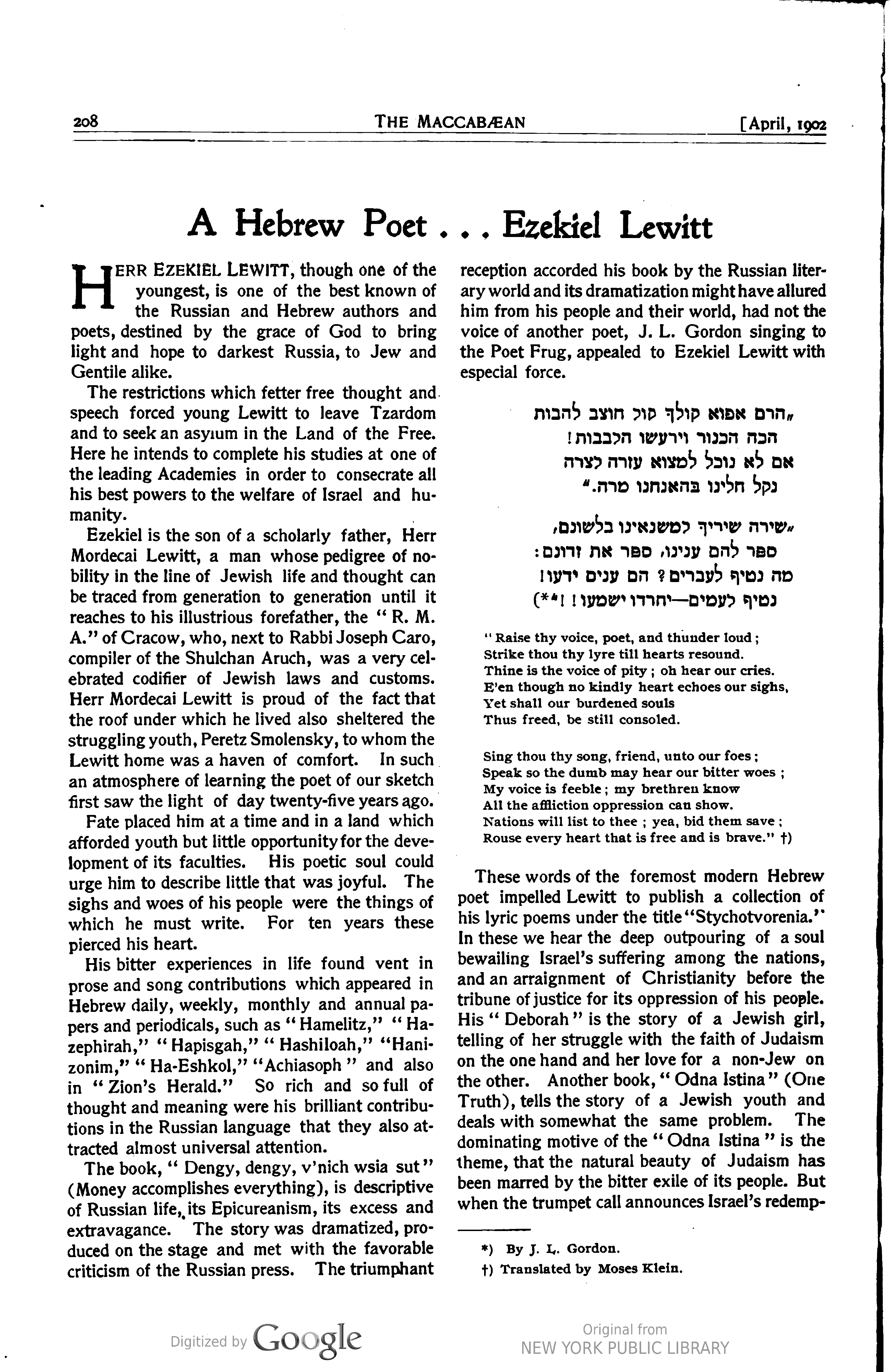
HERR EZEKIEL LEWITT, though one of the youngest, is one of the best known of the Russian and Hebrew authors and poets, destined by the grace of God to bring light and hope to darkest Russia, to Jew and Gentile alike.
The restrictions which fetter free thought and speech forced young Lewitt to leave Tzardom and to seek an asylum in the Land of the Free. Here he intends to complete his studies at one of the leading Academies in order to consecrate all his best powers to the welfare of Israel and humanity.
Ezekiel is the son of a scholarly father, Herr Mordecai Lewitt, a man whose pedigree of nobility in the line of Jewish life and thought can be traced from generation to generation until it reaches to his illustrious forefather, the "R. M. A." of Cracow, who, next to Rabbi Joseph Caro, compiler of the Shulchan Aruch, was a very celebrated codifier of Jewish laws and customs. Herr Mordecai Lewitt is proud of the fact that the roof under which he lived also sheltered the struggling youth, Peretz Smolensky, to whom the Lewitt home was a haven of comfort. In such an atmosphere of learning the poet of our sketch first saw the light of day twenty-five years ago.
Fate placed him at a time and in a land which afforded youth but little opportunity for the development of its faculties. His poetic soul could urge him to describe little that was joyful. The sighs and woes of his people were the things of which he must write. For ten years these pierced his heart.
His bitter experiences in life found vent in prose and song contributions which appeared in Hebrew daily, weekly, monthly and annual papers and periodicals, such as “Hamelitz,” “Ha- zephirah,” “Hapisgah,” “Hashiloah,” “Hani- zonim,” “Ha-Eshkol,” “Achiasoph” and also in “Zion’s Herald.” So rich and so full of thought and meaning were his brilliant contributions in the Russian language that they also attracted almost universal attention.
The book, "Dengy, dengy, v'nich wsia sut" (Money accomplishes everything), is descriptive of Russian life, its Epicureanism, its excess and extravagance. The story was dramatized, produced on the stage and met with the favorable criticism of the Russian press. The triumphant
reception accorded his book by the Russian literary world and its dramatization might have alluredhim from his people and their world, had not thevoice of another poet, J. L. Gordon singing tothe Poet Frug, appealed to Ezekiel Lewitt withespecial force.
הרם אפוא קולך סוכ חוצב להבות הכה הכנור וירעשו הכבבות! אם לא נוכל למצוא עזרה לצרה נקל חלינו בהאנחנו מרה.
"שירה שיריך למשנאינו בלשונם, ספר להם ענינו, ספר את זרונם: מה נמיף לעברים? הם ענים ידעו! נמיף לעמים—יהרדו ישמעו!" (*)
" Raise thy voice, poet, and thunder loud ; Strike thou thy lyre till hearts resound. Thine is the voice of pity ; oh hear our cries. E'en though no kindly heart echoes our sighs, Yet shall our burdened souls Thus freed, be still consoled.
Sing thou thy song, friend, unto our foes ; Speak so the dumb may hear our bitter woes ; My voice is feeble ; my brethren know All the affliction oppression can show. Nations will list to thee ; yea, bid them save ; Rouse every heart that is free and is brave." †)
These words of the foremost modern Hebrew poet impelled Lewitt to publish a collection of his Iyric poems under the title‘“Stychotvorenia.’' In these we hear the deep outpouring of a soul bewailing Israel’s suffering among the nations, and an arraignment of Christianity before the tribune of justice for its oppression of his people. His ‘“ Deborah ” is the story of a Jewish girl, telling of her struggle with the faith of Judaism on the one hand and her love for a non-Jew on the other. Another book, “ Odna Istina” (One Truth), tells the story of a Jewish youth and deals with somewhat the same problem. The dominating motive of the “‘ Odna Istina ” is the theme, that the natural beauty of Judaism has been marred by the bitter exile of its people. But when the trumpet call announces Israel’s redemp-
*) By J. L. Gordon. †) Translated by Moses Klein.