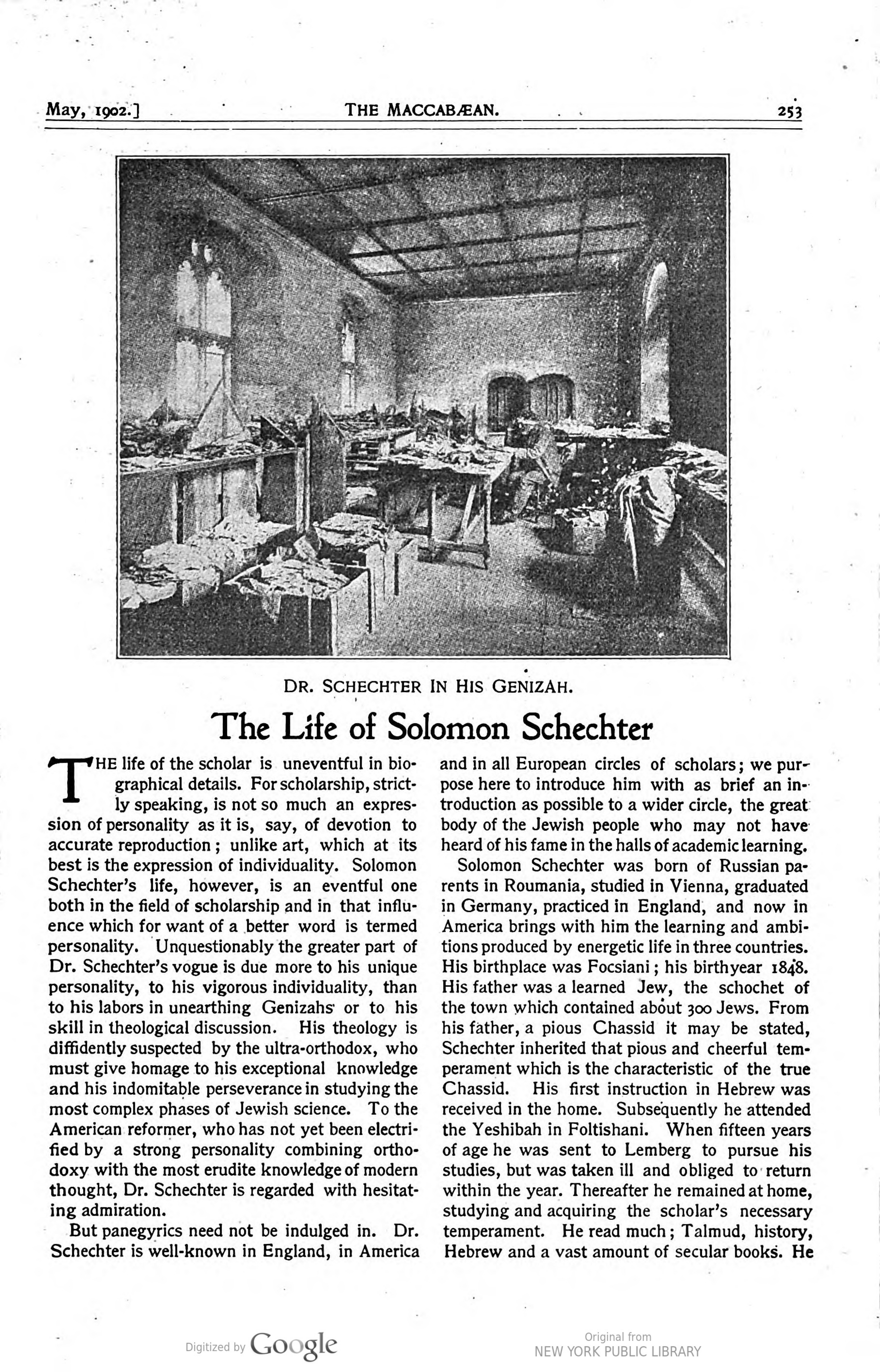
The Life of Solomon Schechter
THE life of the scholar is uneventful in biographical details. For scholarship, strictly speaking, is not so much an expression of personality as it is, say, of devotion to accurate reproduction; unlike art, which at its best is the expression of individuality. Solomon Schechter's life, however, is an eventful one both in the field of scholarship and in that influence which for want of a better word is termed personality. Unquestionably the greater part of Dr. Schechter's vogue is due more to his unique personality, to his vigorous individuality, than to his labors in unearthing Genizahs or to his skill in theological discussion. His theology is diffidently suspected by the ultra-orthodox, who must give homage to his exceptional knowledge and his indomitable perseverance in studying the most complex phases of Jewish science. To the American reformer, who has not yet been electrified by a strong personality combining orthodoxy with the most erudite knowledge of modern thought, Dr. Schechter is regarded with hesitating admiration.
But panegyrics need not be indulged in. Dr. Schechter is well-known in England, in America
and in all European circles of scholars; we purpose here to introduce him with as brief an introduction as possible to a wider circle, the great: body of the Jewish people who may not have heard of his fame in the halls of academic learning.
Solomon Schechter was born of Russian parents in Roumania, studied in Vienna, graduated in Germany, practiced in England, and now in America brings with him the learning and ambitions produced by energetic life in three countries. His birthplace was Focsiani ; his birthyear 1848. His father was a learned Jew, the schochet of the town which contained about 300 Jews. From his father, a pious Chassid it may be stated, Schechter inherited that pious and cheerful temperament which is the characteristic of the true Chassid. His first instruction in Hebrew was received in the home. Subsequently he attended the Yeshibah in Foltishani. When fifteen years of age he was sent to Lemberg to pursue his studies, but was taken ill and obliged to return within the year. Thereafter he remained at home, studying and acquiring the scholar’s necessary temperament. He read much; Talmud, history, Hebrew and a vast amount of secular books. He