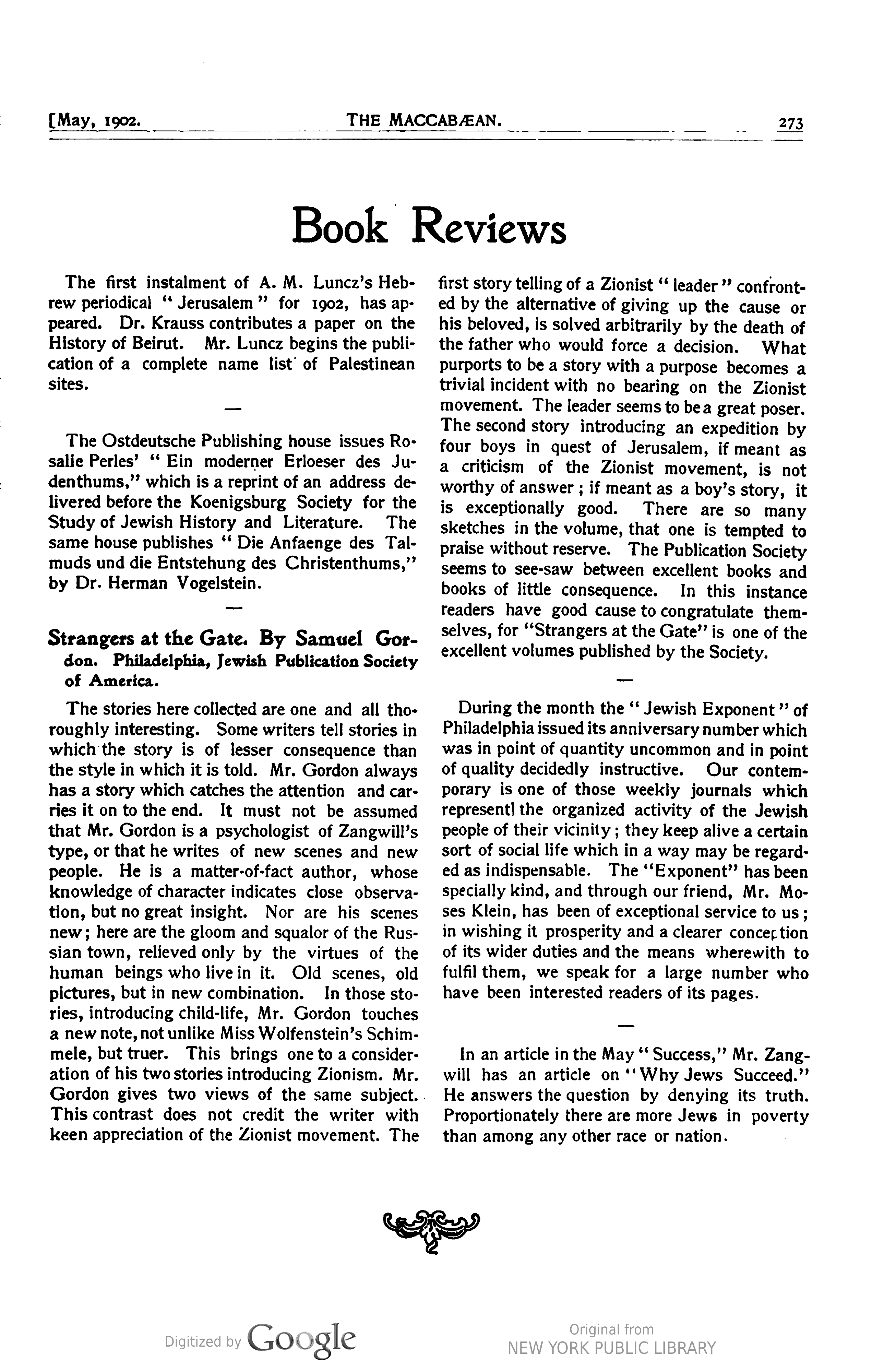
Book Reviews
The first instalment of A. M. Luncz's Hebrew periodical "Jerusalem" for 1902, has appeared. Dr. Krauss contributes a paper on the History of Beirut. Mr. Luncz begins the publication of a complete name list of Palestinean sites.
The Ostdeutsche Publishing house issues Rosalie Perles' "Ein moderner Erloeser des Judenthums," which is a reprint of an address delivered before the Koenigsburg Society for the Study of Jewish History and Literature. The same house publishes "Die Anfaenge des Talmuds und die Entstehung des Christenthums," by Dr. Herman Vogelstein.
Strangers at the Gate. By Samuel Gordon. Philadelphia, Jewish Publication Society of America.
The stories here collected are one and all thoroughly interesting. Some writers tell stories in which the story is of lesser consequence than the style in which it is told. Mr. Gordon always has a story which catches the attention and carries it on to the end. It must not be assumed that Mr. Gordon is a psychologist of Zangwill's type, or that he writes of new scenes and new people. He is a matter-of-fact author, whose knowledge of character indicates close observation, but no great insight. Nor are his scenes new; here are the gloom and squalor of the Russian town, relieved only by the virtues of the human beings who live in it. Old scenes, old pictures, but in new combination. In those stories, introducing child-life, Mr. Gordon touches a new note, not unlike Miss Wolfenstein's Schimmele, but truer. This brings one to a consideration of his two stories introducing Zionism. Mr. Gordon gives two views of the same subject. This contrast does not credit the writer with keen appreciation of the Zionist movement. The
first story telling of a Zionist "leader" confronted by the alternative of giving up the cause or his beloved, is solved arbitrarily by the death of the father who would force a decision. What purports to be a story with a purpose becomes a trivial incident with no bearing on the Zionist movement. The leader seems to be a great poser. The second story introducing an expedition by four boys in quest of Jerusalem, if meant as a criticism of the Zionist movement, is not worthy of answer; if meant as a boy's story, it is exceptionally good. There are so many sketches in the volume, that one is tempted to praise without reserve. The Publication Society seems to see-saw between excellent books and books of little consequence. In this instance readers have good cause to congratulate themselves, for "Strangers at the Gate" is one of the excellent volumes published by the Society.
During the month the “Jewish Exponent” of Philadelphia issued its anniversary number which was in point of quantity uncommon and in point of quality decidedly instructive. Our contemporary is one of those weekly journals which represent the organized activity of the Jewish people of their vicinity; they keep alive a certain sort of social life which in a way may be regarded as indispensable. The “Exponent” has been specially kind, and through our friend, Mr. Moses Klein, has been of exceptional service to us; in wishing it prosperity and a clearer conception of its wider duties and the means wherewith to fulfil them, we speak for a large number who have been interested readers of its pages.
In an article in the May “Success,” Mr. Zangwill has an article on “Why Jews Succeed.” He answers the question by denying its truth. Proportionately there are more Jews in poverty than among any other race or nation.