A Jewess as Artist.
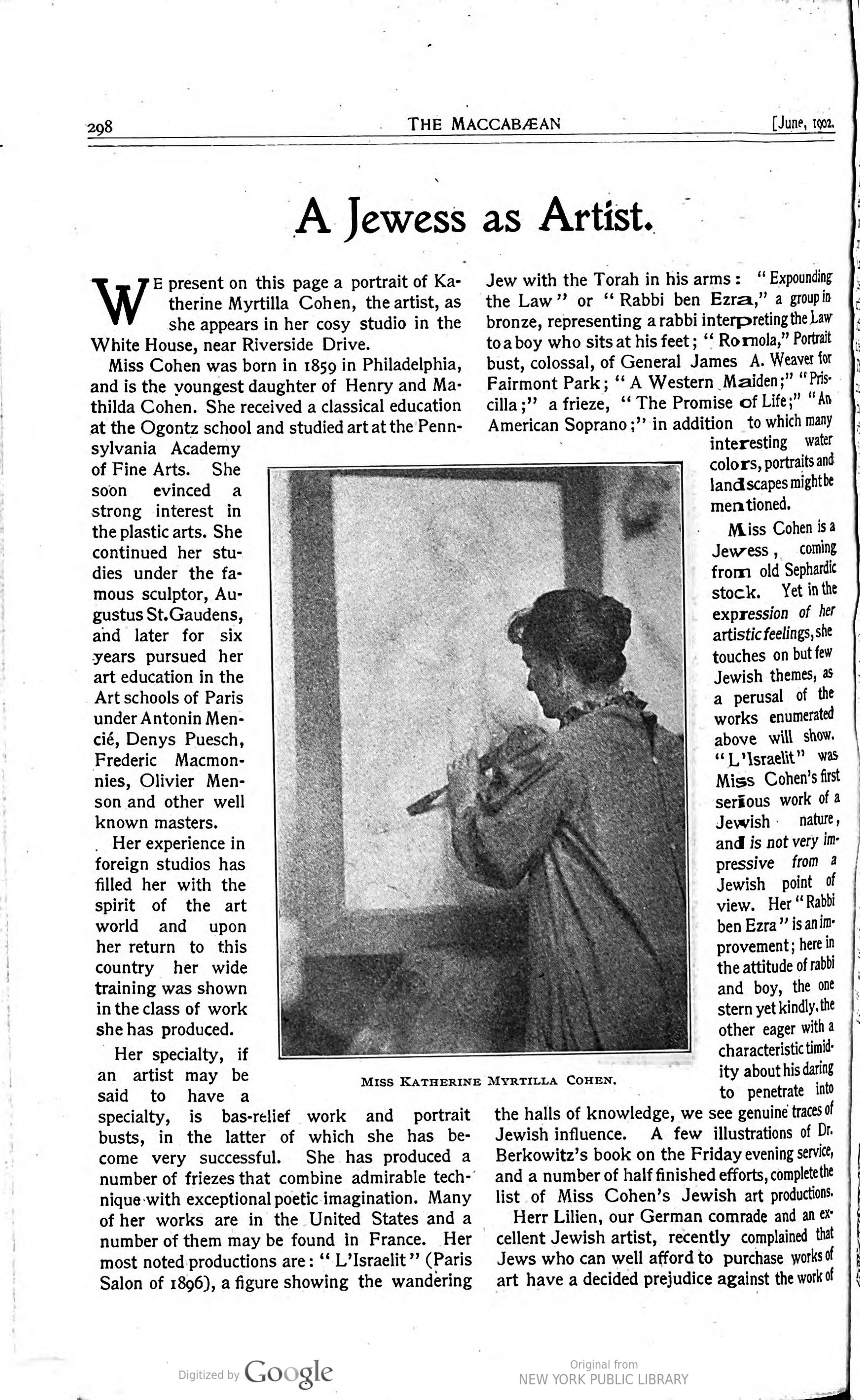
WE present on this page a portrait of Katherine Myrtilla Cohen, the artist, as she appears in her cosy studio in the White House, near Riverside Drive.
Miss Cohen was born in 1859 in Philadelphia,and is the youngest daughter of Henry and Mathilda Cohen. She received a classical educationat the Ogontz school and studied art at the Pennsylvania Academyof Fine Arts. Shesoon evinced astrong interest inthe plastic arts. Shecontinued her studies under the famous sculptor, Augustus St. Gaudens,and later for sixyears pursued herart education in theArt schools of Parisunder Antonin Men-cié, Denys Puesch,Frederic Macmon-nies, Olivier Menson and other wellknown masters.
Her experience in foreign studios has filled her with the spirit of the art world and upon her return to this country her wide training was shown in the class of work she has produced.
Her specialty, if an artist may be said to have a specialty, is bas-relief work and portrait busts, in the latter of which she has become very successful. She has produced a number of friezes that combine admirable technique with exceptional poetic imagination. Many of her works are in the United States and a number of them may be found in France. Her most noted productions are: "L'Israelit" (Paris Salon of 1896), a figure showing the wandering
Jew with the Torah in his arms : "Expounding the Law" or "Rabbi ben Ezra," a group in bronze, representing a rabbi interpreting the Law to a boy who sits at his feet; "Romola," Portrait bust, colossal, of General James A. Weaver for Fairmont Park; "A Western Maiden;" "Priscilla;" a frieze, "The Promise of Life;" "An American Soprano;" in addition to which many interesting water colors, portraits and landscapes might be mentioned.
Miss Cohen is a Jewess, coming from old Sephardic stock. Yet in the expression of her artistic feelings, she touches on but few Jewish themes, as a perusal of the works enumerated above will show. “L’Israelit” was Miss Cohen’s first serious work of a Jewish nature, and is not very impressive from a Jewish point of view. Her “Rabbi ben Ezra” is an improvement; here in the attitude of rabbi and boy, the one stern yet kindly, the other eager with a characteristic timidity about his daring to penetrate into
the halls of knowledge, we see genuine traces of Jewish influence. A few illustrations of Dr. Berkowitz's book on the Friday evening service, and a number of half finished efforts, complete the list of Miss Cohen's Jewish art productions.
Herr Lilien, our German comrade and an excellent Jewish artist, recently complained that Jews who can well afford to purchase works of art have a decided prejudice against the work of