The failure of his success appealed to Heine's sense of humor. After laughing much at others, he concluded that he himself was a fine subject for his sarcasm—nor did he spare himself. He looked his own faults straight in the face and expected as much from all his fellow writers, for there was nothing that his soul loathed more than hypocrisy.
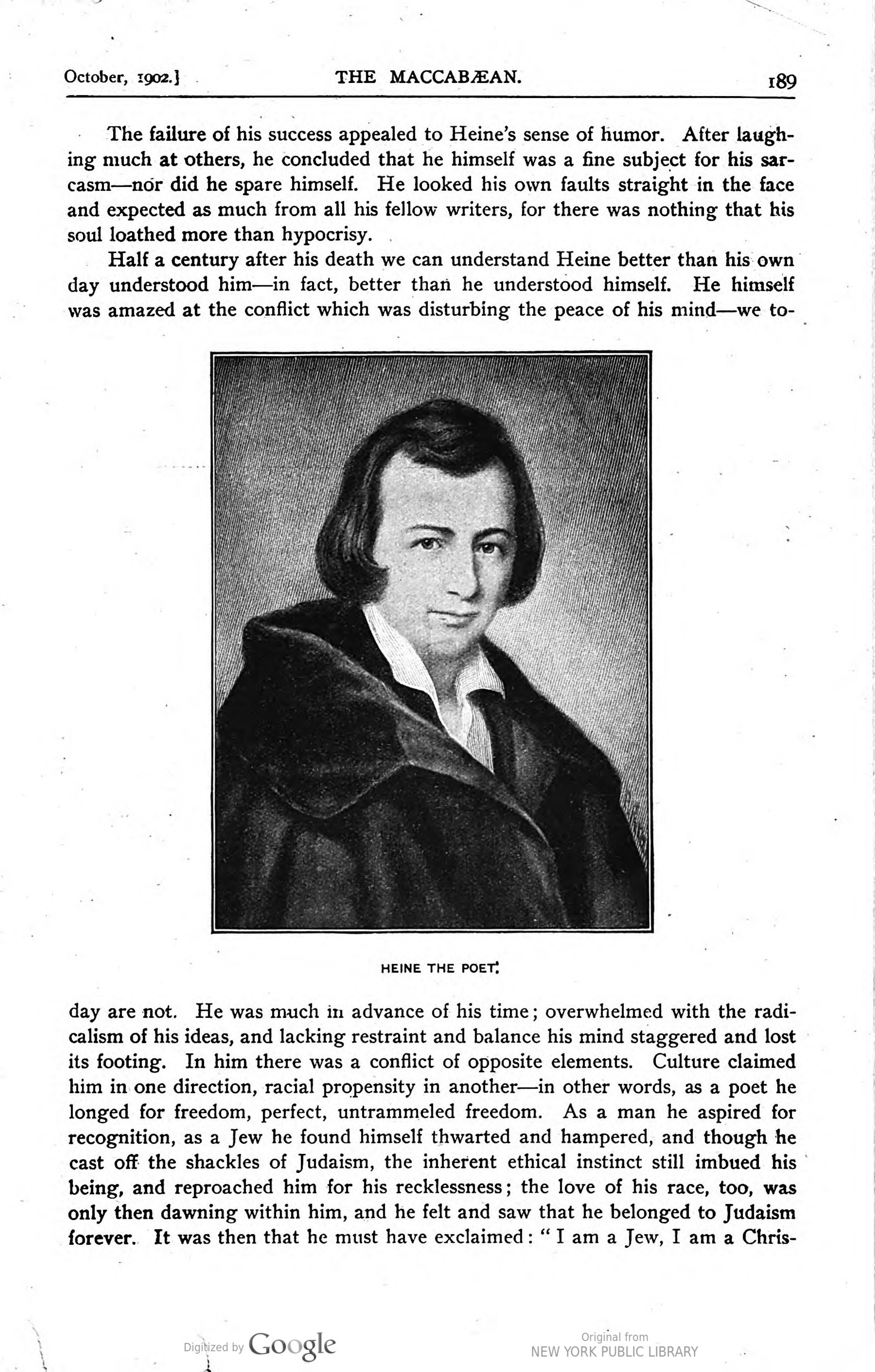
Half a century after his death we can understand Heine better than his own day understood him—in fact, better than he understood himself. He himself was amazed at the conflict which was disturbing the peace of his mind—we to-
day are not. He was much in advance of his time; overwhelmed with the radicalism of his ideas, and lacking restraint and balance his mind staggered and lost its footing. In him there was a conflict of opposite elements. Culture claimed him in one direction, racial propensity in another—in other words, as a poet he longed for freedom, perfect, untrammeled freedom. As a man he aspired for recognition, as a Jew he found himself thwarted and hampered, and though he cast off the shackles of Judaism, the inherent ethical instinct still imbued his being, and reproached him for his recklessness; the love of his race, too, was only then dawning within him, and he felt and saw that he belonged to Judaism forever. It was then that he must have exclaimed: “I am a Jew, I am a Chris-