tian, I am a Hebrew, I am a Greek. I am goodness and evil, demon and angel.”This awakening came to him when it was too late, when all his powers hadalready been spent in the service of strangers, strangers who scorned him.When his heart did return to his people it brought him broken in spirit andbody.
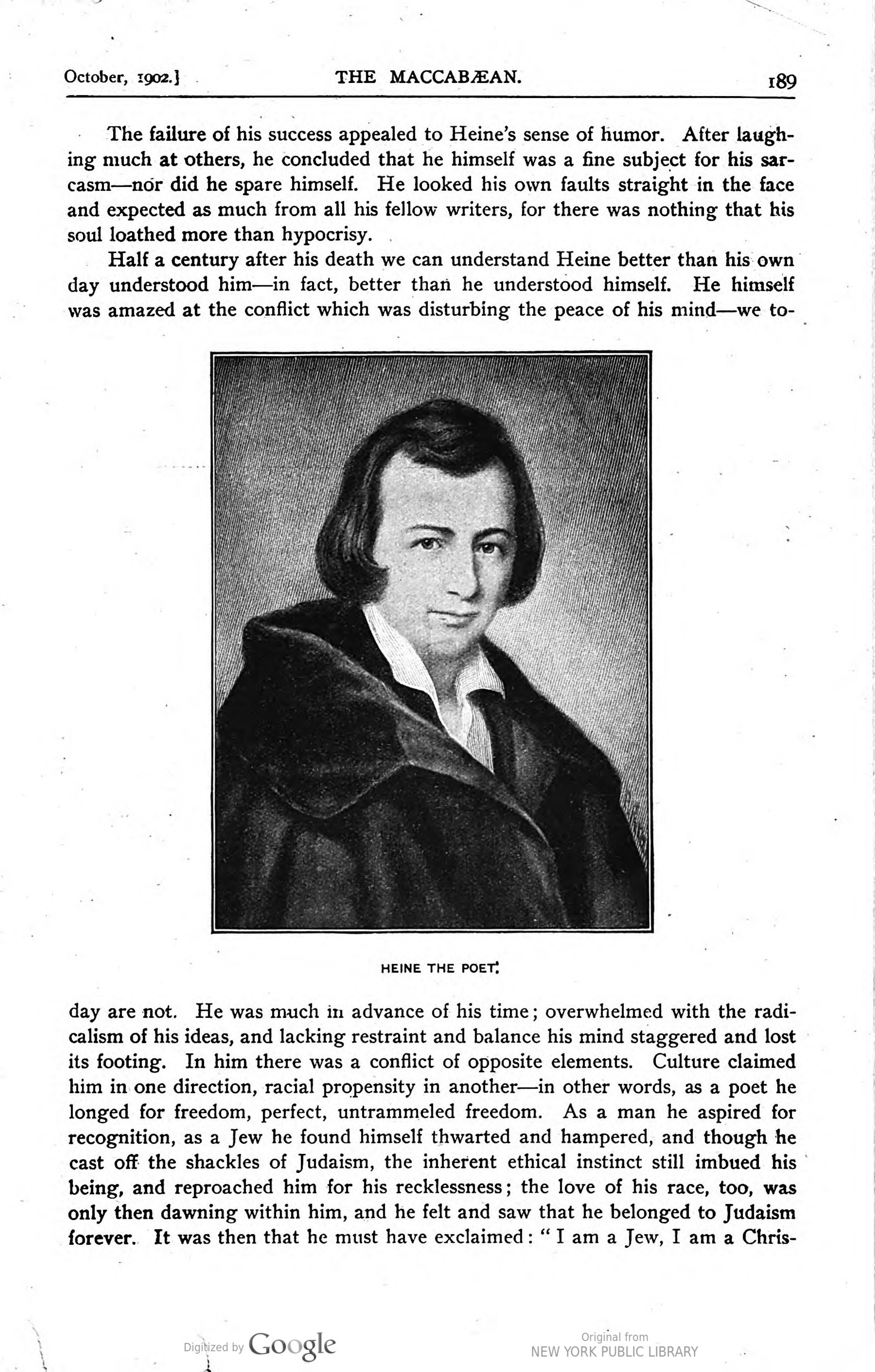
The youthful Heine had neither the martyr spirit nor the submissiveness of the Hebrew race. He would not meekly accept the decree of destiny. He believed he could master fate. He evidently had little of that sublime faith in the ultimate good of things which makes idealists and dreamers of poets. His eyes were wide open to the stern realities of fact. Nor was he the mere verse maker. He had the foresight of a seer and reformer. He admonished and criticised right and left. It must be added, to his credit, that even after he apostatized the faith of his fathers, he would not suffer the least prejudice against his people to go unchallenged. Of his attitude to Christianity, after his adoption of it, 'twere better to say nothing. One thing is certain—with his nominal acceptance of Christianity, his heart and soul attached themselves to Judaism. Indifferent at first to the state of his people, but no sooner did he leave the fold than the Jewish spirit was born in his soul. From a deserter he became a champion. At first unmoved by the grandeur of the old faith—even exclaiming once in a moment of recklessness: "Das Judenthum ist keine Religion —es ist ein Unglück!" A little later you see him glowing with enthusiasm at the thought of his Hebrew birth. "A descendant of Moses, the great lawgiver!" A new pride possessed him as he dwelt upon the nobility of his ancestry.
Then even his bitterness passes away. The defiance of his tone is softened to gentleness, and his indignation against the world is mollified. There dawns in him a new man—he is a Jew—a Jew with his burden and hopefulness—his pride and submission, his determination, and his reverence for tradition. “Heine the Greek” and “Heine the Christian” are forgotten phrases; it is “Heine the Jew” forever.
It is not saying too much to aver that Christianity, after winning Heine, succeeded in leading him back to the bosom of Judaism. It was liberty, liberty, he sought, not a new faith. But the new faith which seemed likely to aid his passage to liberty still held many pitfalls for him. And so he was left out in the cold, estranged from his own, rejected, too, by those whose favor he sought at the price of his conscience. On both sides scorned, his life was a symbol of the tragedy of the Jew.
The last days of Heine belong to the Jews. During the eight years of leisure and suffering on a "mattress grave" he championed the cause of his people. On all occasions when their enemies attacked and reviled them, he lifted his voice in mighty protest, and at the point of his pen he fought valiantly in the ranks of the downtrodden Jew. He made the world blush for its little-mindedness; his countrymen especially felt the poignancy of his humor. Even Ludwig Börne, who was thought wholly lost to Judaism, drew inspiration from Heine's awakened Jewish sympathies and linked himself with the latter for the