The Jewish Colonial Trust
ITS HISTORY, AIM AND OBJECTS, IN BRIEF
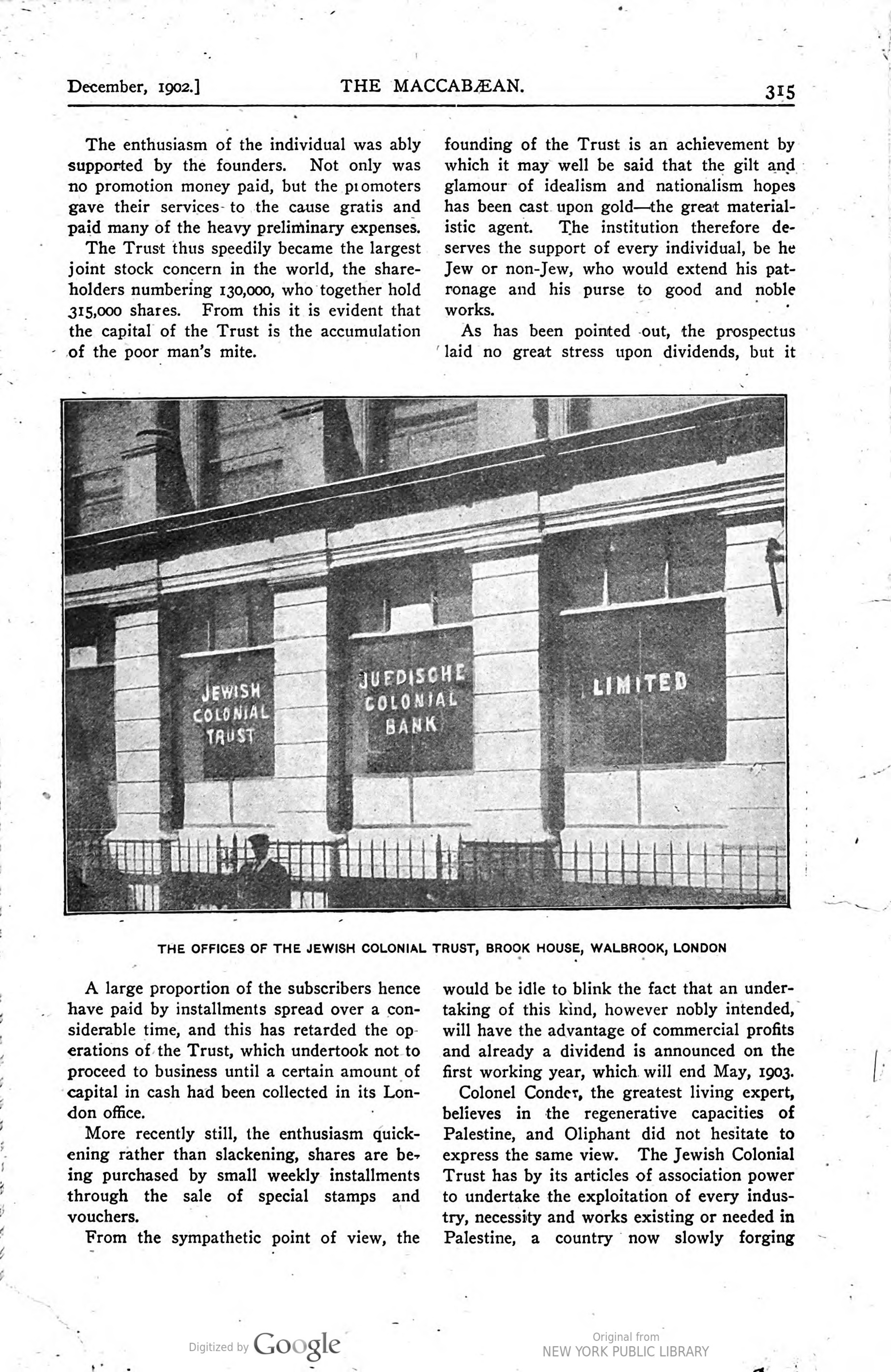
NECESSITY driving the wheels of idealism has considerably helped to create the modern Zionist movement, which aims at resettling in Palestine that element among the Jews which has either not been permitted or has not desired to assimilate with the world at large. The idealists, in their turn driven to fashion an instrument suitable to their purpose, have created as a financial instrument of their movement an English limited liability company, the Jewish Colonial Trust, with a capital of £2,000,000 sterling divided into £1 shares. Unique among joint stock concerns, this institution merits the interest and support of all those who desire in the best interests of humanity to see a nationality revived, or who from religious and sentimental motives believe that the desolation of Zion should have an end and that Palestine should be restored to the fruitfulness and prosperity which were its pride and glory two thousand years ago.
The idea of utilizing the best known means of modern enterprise for such a movement already arose at the time when the idea of the return was first mooted as within the range of practical affairs. George Eliot as a writer, Lawrence Oliphant as a political worker, proposed joint stock concerns for this purpose, and agra (agricultural loan) banks were mooted as soon as the existing Palestinean colonies showed the first signs of progress. The Zionist movement, established on the sound basis of a worldwide co-operative effort among the Jews, discovered that it needed a financial instrument of the same character, and a bank scheme was mooted at the first Congress held in 1897.
In the May of 1898, a small committee was formed with its headquarters at Cologne and
provisional promises invited. So widespread and so enthusiastic was the response that the second Congress, held during the same year, sanctioned the scheme. Despite the difficulties natural to a scheme governed by representatives living in all parts of the world, the Jewish Colonial Trust (Juedische Colonial Bank) was registered as a limited liability' concern early in 1899, and the prospectus issued during the Passover (Easter) week of that year. The immediate result gave remarkable proof that the national conscience of the Jews and the sympathy of many friends had been aroused.
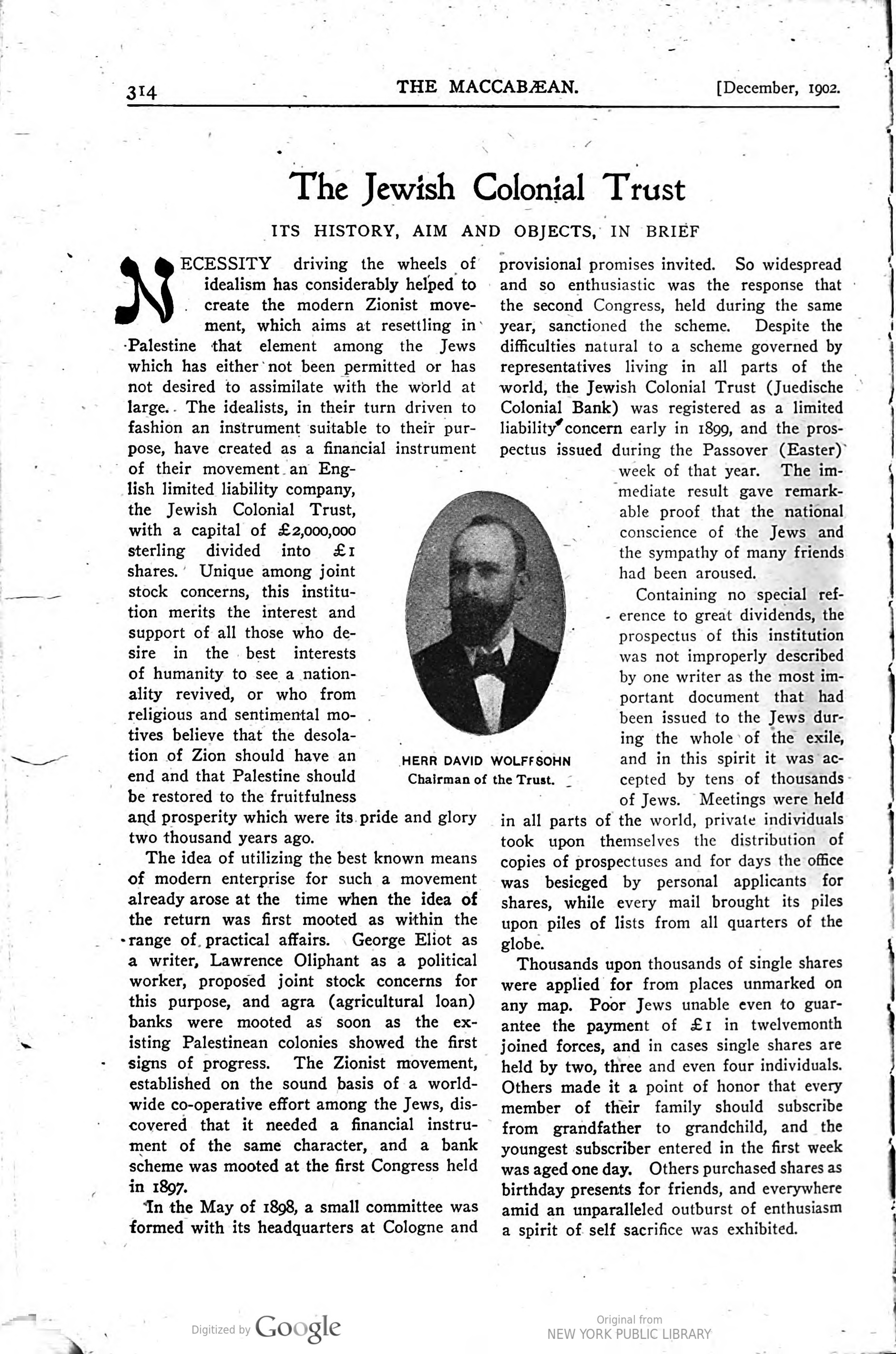
WOLFFSOHN the Trust. Containing no special reference to great dividends, the prospectus of this institution was not improperly described by one writer as the most important document that had been issued to the Jews during the whole of the exile, and in this spirit it was accepted by tens of thousands of Jews. Meetings were held in all parts of the world, private individuals took upon themselves the distribution of copies of prospectuses and for days the office was besieged by personal applicants for shares, while every mail brought its piles upon piles of lists from all quarters of the globe.
Thousands upon thousands of single shares were applied for from places unmarked on any map. Poor Jews unable even to guarantee the payment of £1 in twelvemonth joined forces, and in cases single shares are held by two, three and even four individuals. Others made it a point of honor that every member of their family should subscribe from grandfather to grandchild, and the youngest subscriber entered in the first week was aged one day. Others purchased shares as birthday presents for friends, and everywhere amid an unparalleled outburst of enthusiasm a spirit of self sacrifice was exhibited.