“God helped us,” said the elder Litvak, and added a Hebrew phrase.
"God helped us," said the elder Litvak, and added a Hebrew phrase.The Rev. Hopkins recalled to his clerical colleagues the Easters of otherages, and how many quarrels had ended and peace had been made. To-nightthey, as Christians, could sit at ease in the house of a Jew, and were not hurt bythe religious customs of others. The spring of humanity had come.
“Truly it is the spring of the human race,” said the priest from Sepphoris.
(To be continued.)
The History of the Jewish Theological Seminary
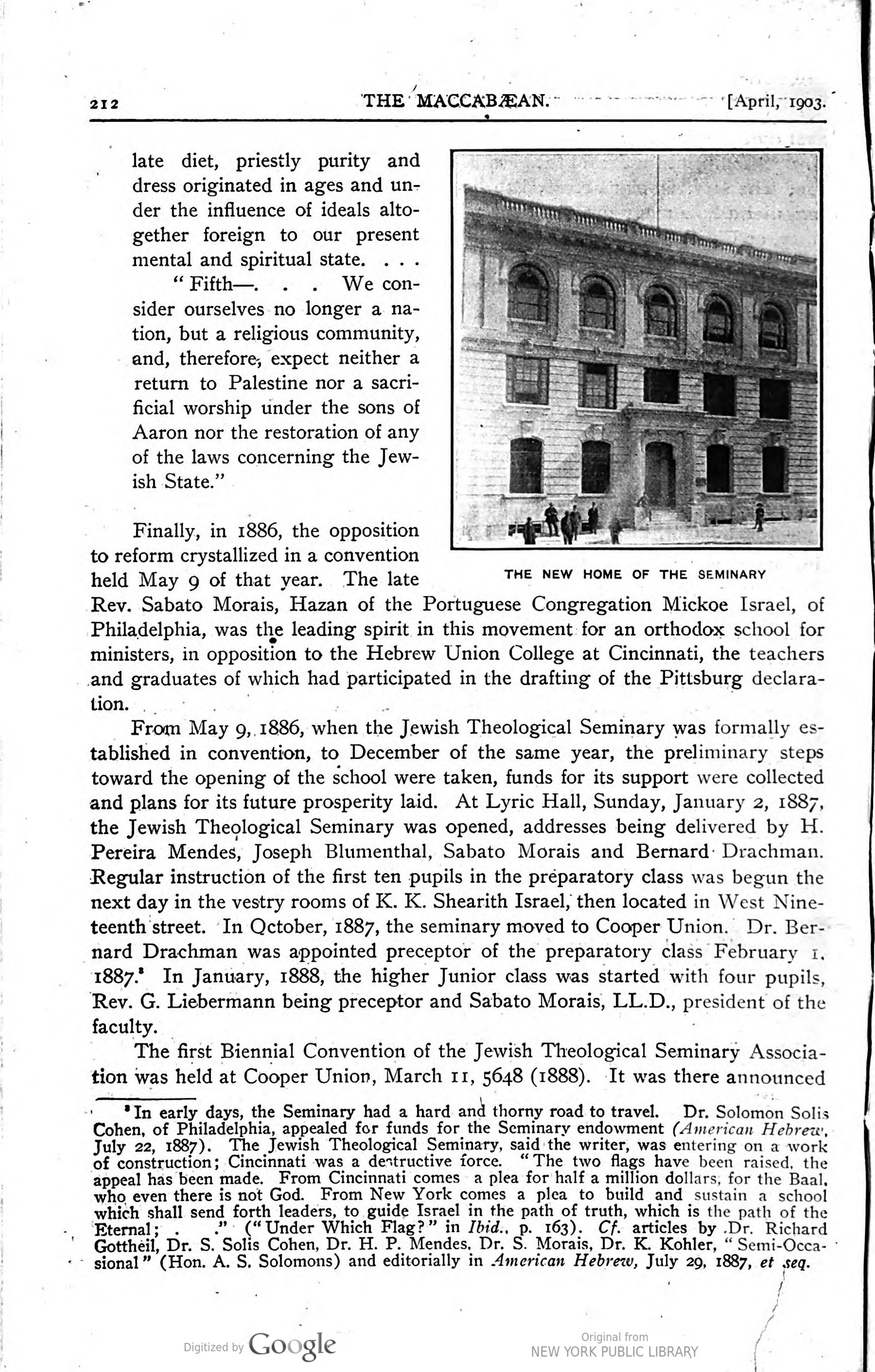
THE history of the Jewish Theological Seminary is the history of orthodox Judaism in America during the years from 1886 to 1902. For, while the Jewish Theological Seminary of America is conservative in its religious standpoint, the parent institution directly represented historical Judaism, prospered as long as the cause of orthodoxy flowered, decayed when the leaders of the traditional school had passed away. To-day, of course, the older institution has been restored to life again, as it were, in the shape of the new Seminary, that promises a foundation to realize all that the founders had thought out in dreams, a decade and more ago.
The Jewish Theological Seminary was the direct outcome of the celebrated Rabbinic Conference which met at Pittsburg, Pa., November 16 to 18, 1885, as the result of a call issued by the Rev. Dr. Kaufmann Kohler, of New York, November 1, 1885. Dr. Isaac M. Wise presided over the sessions of the Conference, and the “Declaration of Principles,” then and there adopted, proved particularly offensive to all those who believed in the claims and merits of historical Judaism in America.1
The orthodox Jews objected especially to the following portions of the Pittsburg resolutions:²
“Second—. . . . We hold that the modern discoveries of scientific researches in the domains of nature and history are not antagonistic to the doctrines of Judaism, the Bible reflecting the primitive ideas of its own age and at times clothing its conception of Divine Providence and justice in dealing with man in miraculous narratives.
“Third—We recognize in the Mosaic legislation, a system of training the Jewish people for its mission during its national life in Palestine, and today we accept as binding only the moral laws and maintain only such ceremonies as elevate and sanctify our lives, but reject all such as are inadapted to the views and habits of modern civilization.
“Fourth—We hold that all such Mosaic and Rabbinical laws as regu-
¹ Jos. Krauskopf, “Half a Century of Judaism in the United States,” in American Jews’ Annual for 5648, p. 87 et seq. Cf. Dr. K. Kohler and Miss Henrietta Szold in American Hebrew, Dec. 30, 1887.
'Krauskopf, op. cit., p. 88.