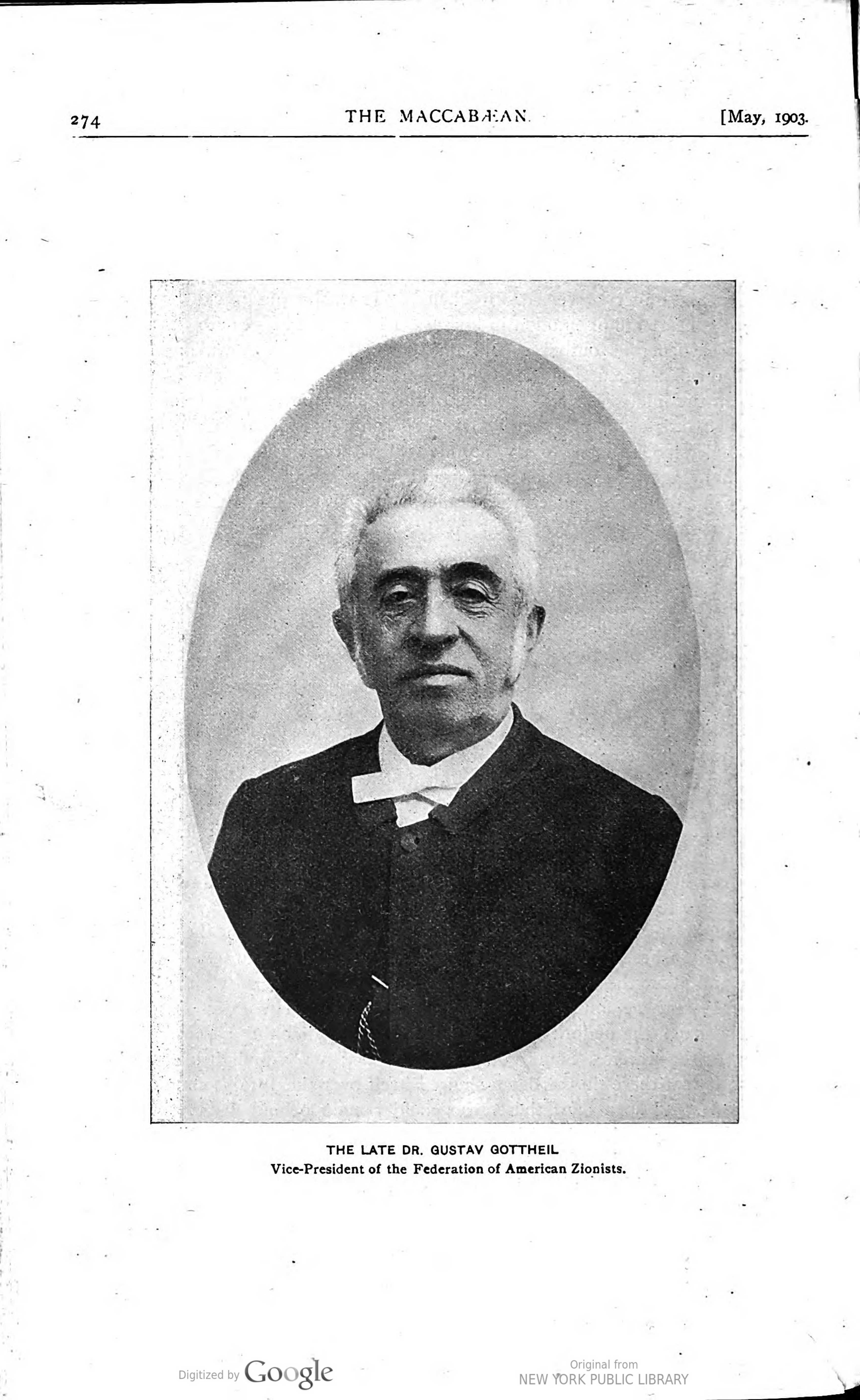
Gustav Gottheil, Zionist
ANOTHER sand glass has run its course, and neither common glass nor common sand, but one that was great among the time-markers that have made this Western Jewry, and to the last ebbed away, to that bourne where neither time is marked nor sand seen, with that same energy that made manhood's years, and the heyday of a teaching and a doctrine.
By the death of Gustav Gottheil this Jewry has lost one of its pioneers, hewer with chisel and hammer for Reform, molder of the metal that makes the modern national Jewish movement. There is no room and no need here for all the incidents, petty and great, that filled three score and sixteen years of a life that was begun in Germany, passed through England and spent its vital powers in New York. The man stands out of the narrow confines of community and temple to defined by his own contrasts, compelling us to see into a soul and realize what life can sometimes be.
For ten years, the writer, casting a fugitive and inquisitive eye each week on the newspapers that are said to depict American Jewish life, saw this name, Dr. Gustav Gottheil, figuring here and there, a strident voice amongst the cymbal playing of consecrations and inaugurations, a strong figure amongst the mixture of clerics that assemble at the representative gatherings of New York life, a personality of newspaper reports, of jubilees and the like, to be loved, revered and admired.
In Manchester, too, he had oft seen the synagogue which Gustav Gottheil had quitted because the Jews of Cottonopolis refused to be kindled to the fire of Reform. And here, seeing for the first time and at the first impression, how three corners of a long and narrow city stand apart from one, and visiting then the temple situated on a street whose pavements are trod preferably by millionaires, it was a matter of wonder; what manner of man was he who had set up a fane of Israel hard by where the giant houses reach and align themselves that all humanity may see to what girth vanity and prosperity can attain. Fifth Avenue and a temple! He who has peered into the squalor of European Ghettos can realize what the conjunction suggests.
Yet it was not to the rabbi we went, but to an old Jew who had looked overthe shoulder of Time, and seeing far backward, saw by reflection as far forward,and felt for himself the brotherhood of the Jewish nation, and became a humbleand devoted follower of the leader of the Zionist movement. He was an old,beardless Jew, with a softly wrinkled face and aged eyes, who held out with sòmevigòr a shaking hand, who spoke and thought as one full of vitality, and strongwith the faith of life. We met fairly often to take Sabbath afternoon strolls, thewriter to listen and suggest, the old man to pour out a stream of varying thoughton the new evidence of the national Jewish consciousness and information pickedup here and there on the conditions of Palestine, to discuss the Jewry of other landsand to speak always with a great charity and admiration for the score of men who