How Can We Promote the Study of the Hebrew Language?
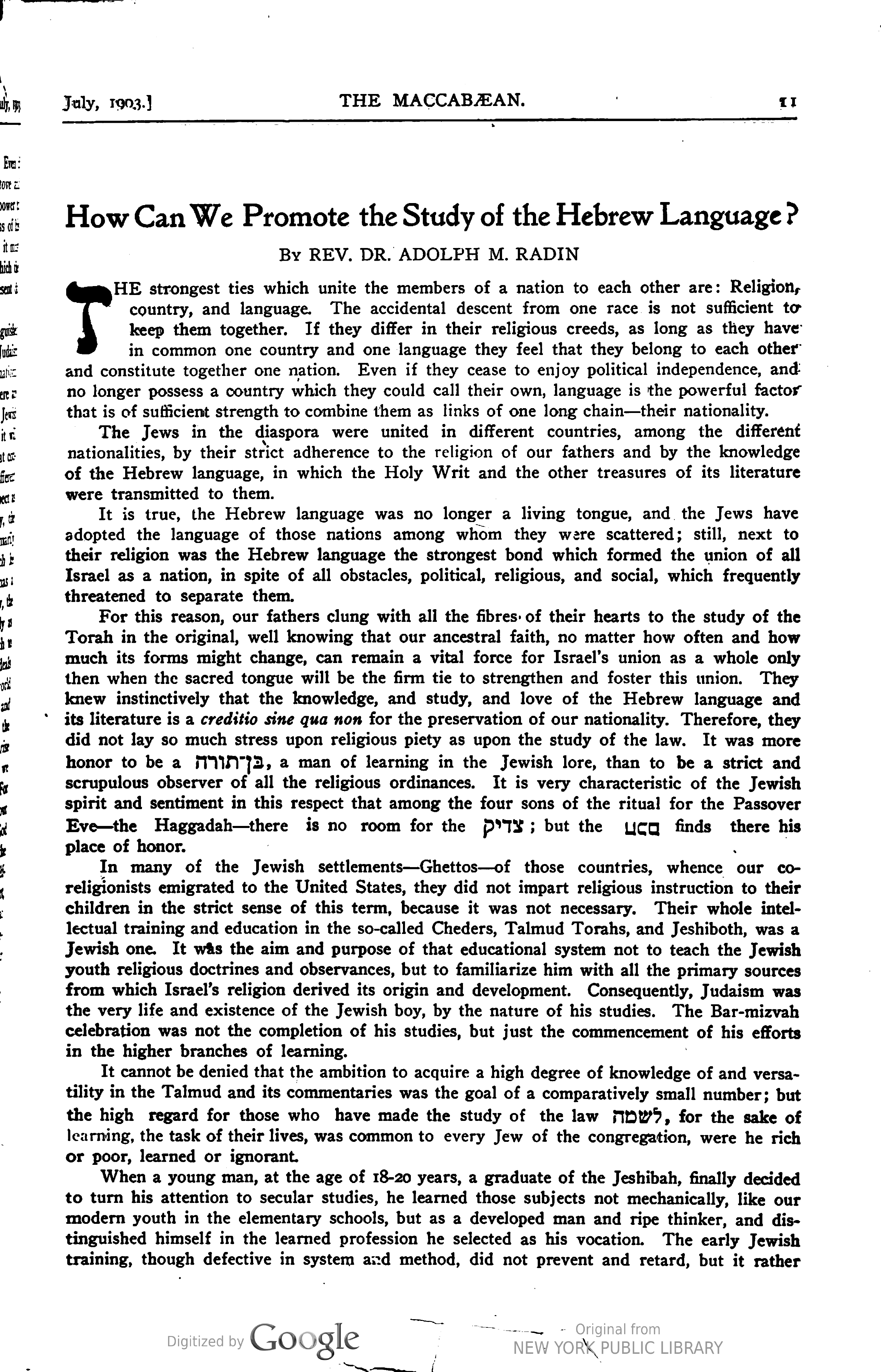
THE strongest ties which unite the members of a nation to each other are: Religion, country, and language. The accidental descent from one race is not sufficient to keep them together. If they differ in their religious creeds, as long as they have in common one country and one language they feel that they belong to each other and constitute together one nation. Even if they cease to enjoy political independence, and no longer possess a country which they could call their own, language is the powerful factor that is of sufficient strength to combine them as links of one long chain—their nationality.
The Jews in the diaspora were united in different countries, among the different nationalities, by their strict adherence to the religion of our fathers and by the knowledge of the Hebrew language, in which the Holy Writ and the other treasures of its literature were transmitted to them.
It is true, the Hebrew language was no longer a living tongue, and the Jews have adopted the language of those nations among whom they were scattered; still, next to their religion was the Hebrew language the strongest bond which formed the union of all Israel as a nation, in spite of all obstacles, political, religious, and social, which frequently threatened to separate them.
For this reason, our fathers clung with all the fibres of their hearts to the study of the Torah in the original, well knowing that our ancestral faith, no matter how often and how much its forms might change, can remain a vital force for Israel's union as a whole only then when the sacred tongue will be the firm tie to strengthen and foster this union. They knew instinctively that the knowledge, and study, and love of the Hebrew language and its literature is a creditio sine qua non for the preservation of our nationality. Therefore, they did not lay so much stress upon religious piety as upon the study of the law. It was more honor to be a בַּר תּוֹרָה, a man of learning in the Jewish lore, than to be a strict and scrupulous observer of all the religious ordinances. It is very characteristic of the Jewish spirit and sentiment in this respect that among the four sons of the ritual for the Passover Eve—the Haggadah—there is no room for the רָשָׁע; but the חָכָם finds there his place of honor.
In many of the Jewish settlements —Ghettos—of those countries, whence our co-religionists emigrated to the United States, they did not impart religious instruction to their children in the strict sense of this term, because it was not necessary. Their whole intellectual training and education in the so-called Cheders, Talmud Torahs, and Jeshiboth, was a Jewish one. It was the aim and purpose of that educational system not to teach the Jewish youth religious doctrines and observances, but to familiarize him with all the primary sources from which Israel's religion derived its origin and development. Consequently, Judaism was the very life and existence of the Jewish boy, by the nature of his studies. The Bar-mizvah celebration was not the completion of his studies, but just the commencement of his efforts in the higher branches of learning.
It cannot be denied that the ambition to acquire a high degree of knowledge of and versatility in the Talmud and its commentaries was the goal of a comparatively small number; but the high regard for those who have made the study of the law לשמה, for the sake of learning, the task of their lives, was common to every Jew of the congregation, were he rich or poor, learned or ignorant.
When a young man, at the age of 18-20 years, a graduate of the Jeshibah, finally decided to turn his attention to secular studies, he learned those subjects not mechanically, like our modern youth in the elementary schools, but as a developed man and ripe thinker, and distinguished himself in the learned profession he selected as his vocation. The early Jewish training, though defective in system and method, did not prevent and retard, but it rather