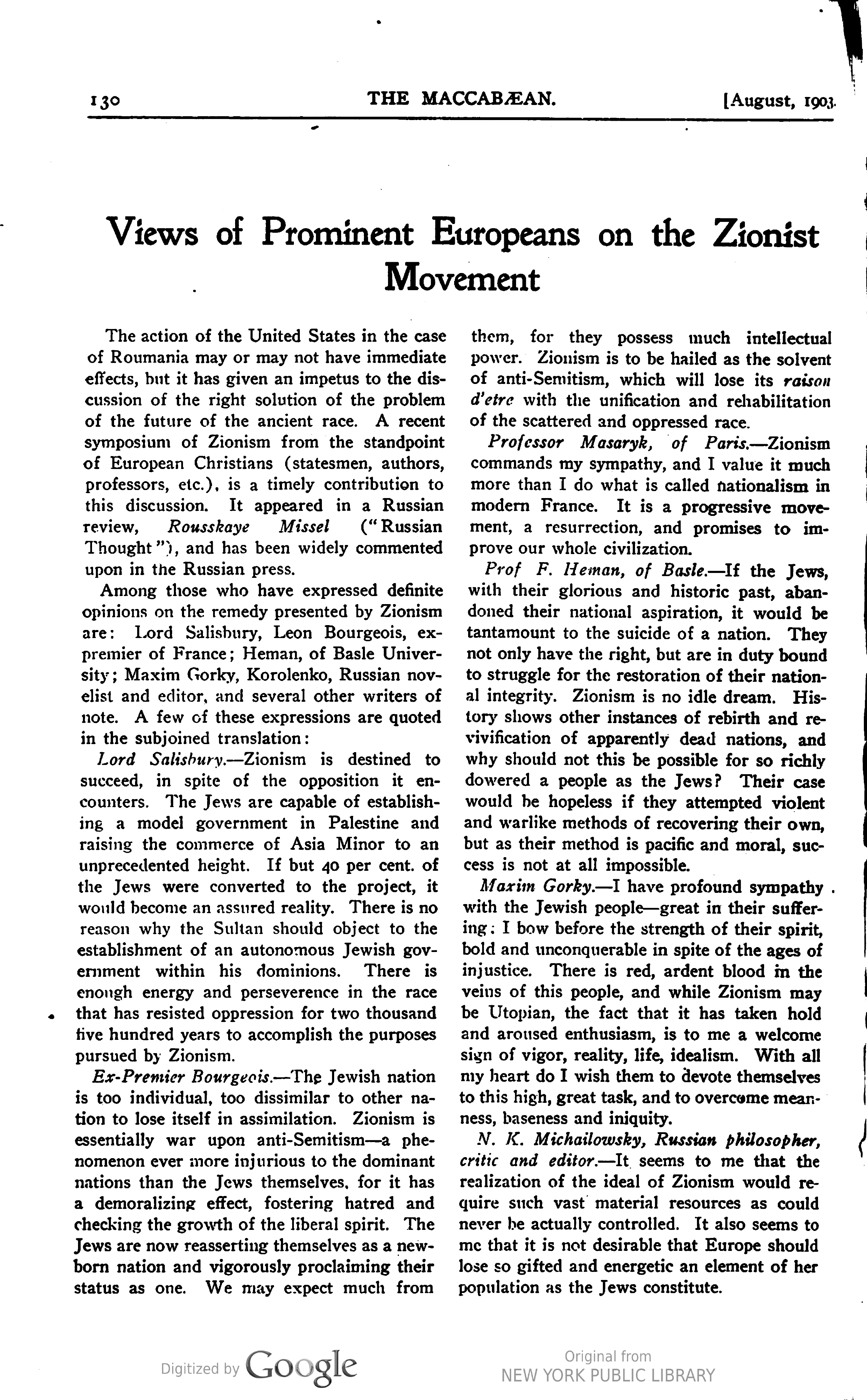
Views of Prominent Europeans on the Zionist Movement
The action of the United States in the case of Roumania may or may not have immediate effects, but it has given an impetus to the discussion of the right solution of the problem of the future of the ancient race. A recent symposium of Zionism from the standpoint of European Christians (statesmen, authors, professors, etc.), is a timely contribution to this discussion. It appeared in a Russian review, Rousskaye Missel ("Russian Thought"), and has been widely commented upon in the Russian press.
Among those who have expressed definite opinions on the remedy presented by Zionism are: Lord Salisbury, Leon Bourgeois, expremier of France; Heman, of Basle University; Maxim Gorky, Korolenko, Russian novelist and editor, and several other writers of note. A few of these expressions are quoted in the subjoined translation:
Lord Salisbury.—Zionism is destined to succeed, in spite of the opposition it encounters. The Jews are capable of establishing a model government in Palestine and raising the commerce of Asia Minor to an unprecedented height. If but 40 per cent. of the Jews were converted to the project, it would become an assured reality. There is no reason why the Sultan should object to the establishment of an autonomous Jewish government within his dominions. There is enough energy and perseverance in the race that has resisted oppression for two thousand five hundred years to accomplish the purposes pursued by Zionism.
Ex-Premier Bourgeois.—The Jewish nation is too individual, too dissimilar to other nation to lose itself in assimilation. Zionism is essentially war upon anti-Semitism—a phenomenon ever more injurious to the dominant nations than the Jews themselves, for it has a demoralizing effect, fostering hatred and checking the growth of the liberal spirit. The Jews are now reasserting themselves as a new-born nation and vigorously proclaiming their status as one. We may expect much from
them, for they possess much intellectual power. Zionism is to be hailed as the solvent of anti-Semitism, which will lose its raison d'etre with the unification and rehabilitation of the scattered and oppressed race.
Professor Masaryk, of Paris.—Zionism commands my sympathy, and I value it much more than I do what is called nationalism in modern France. It is a progressive movement, a resurrection, and promises to improve our whole civilization.
Prof F. Heman, of Basle.—If the Jews, with their glorious and historic past, abandoned their national aspiration, it would be tantamount to the suicide of a nation. They not only have the right, but are in duty bound to struggle for the restoration of their national integrity. Zionism is no idle dream. History shows other instances of rebirth and revivification of apparently dead nations, and why should not this be possible for so richly dowered a people as the Jews? Their case would be hopeless if they attempted violent and warlike methods of recovering their own, but as their method is pacific and moral, success is not at all impossible.
Maxim Gorky.—I have profound sympathy with the Jewish people—great in their suffering: I bow before the strength of their spirit, bold and unconquerable in spite of the ages of injustice. There is red, ardent blood in the veins of this people, and while Zionism may be Utopian, the fact that it has taken hold and aroused enthusiasm, is to me a welcome sign of vigor, reality, life, idealism. With all my heart do I wish them to devote themselves to this high, great task, and to overcome meanness, baseness and iniquity.
N. K. Michailowsky, Russian philosopher, critic and editor.—It seems to me that the realization of the ideal of Zionism would require such vast material resources as could never be actually controlled. It also seems to me that it is not desirable that Europe should lose so gifted and energetic an element of her population as the Jews constitute.