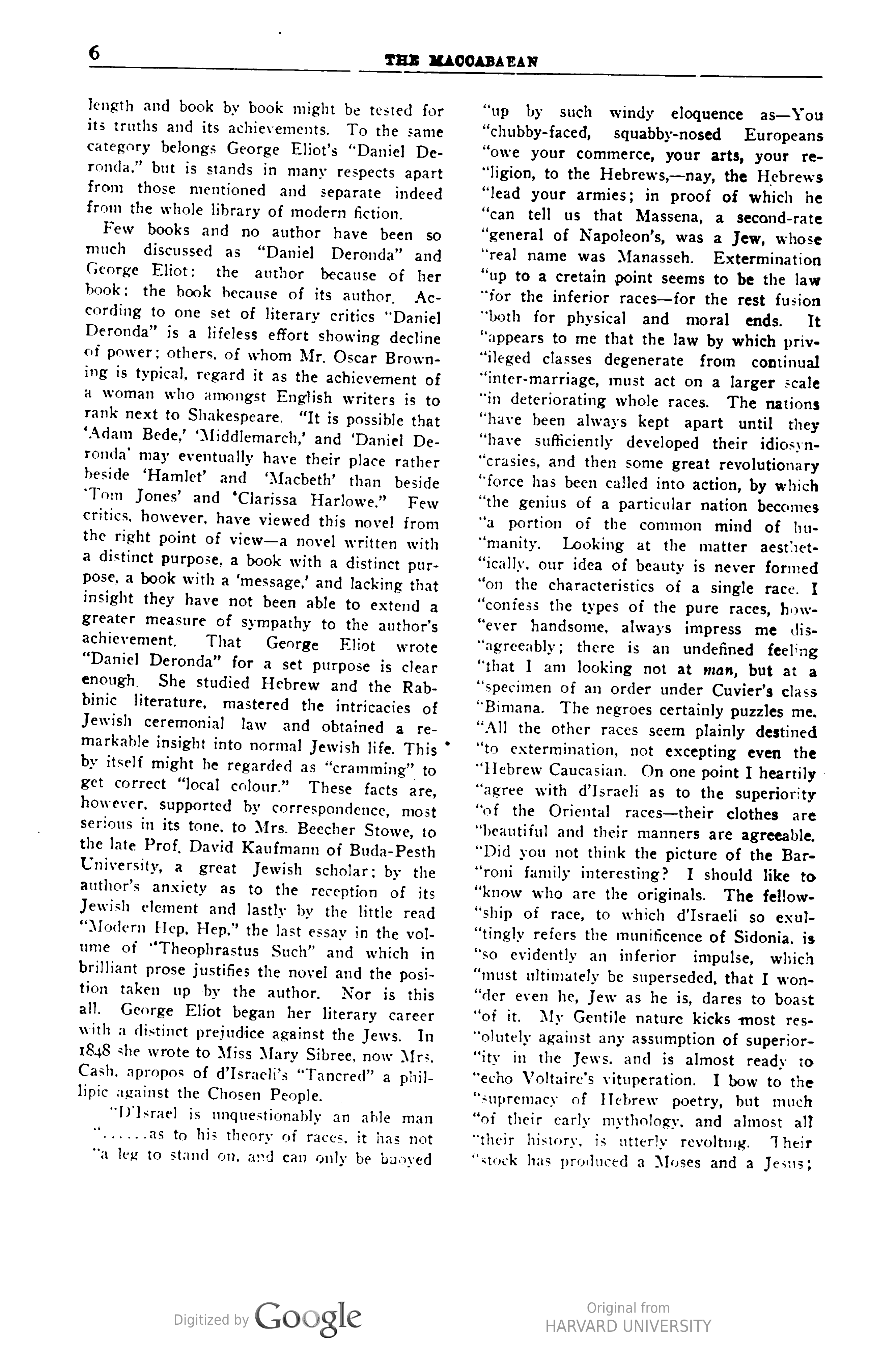
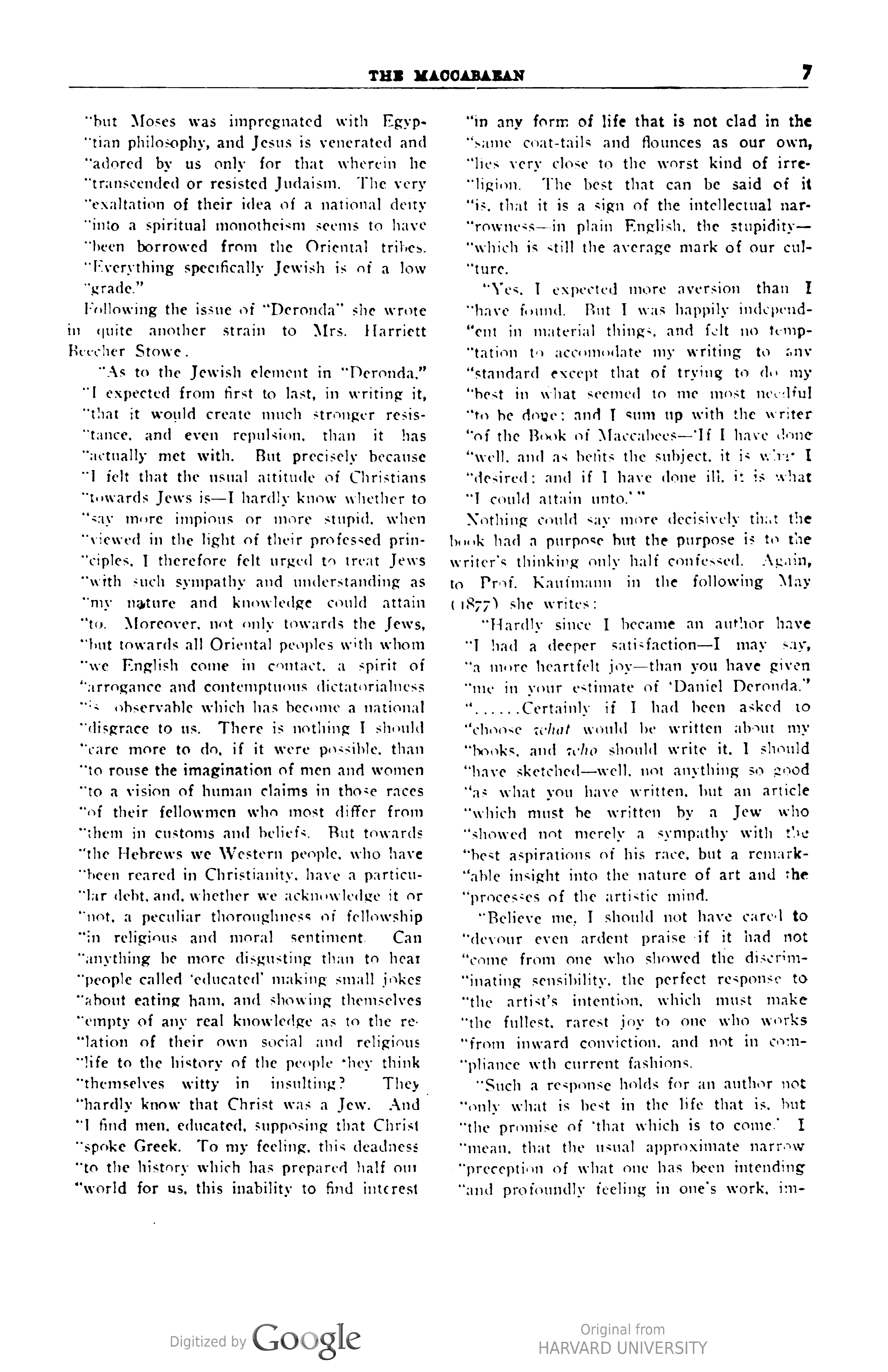
"but Moses was impregnated with Egyp- "tian philosophy, and Jesus is venerated and "adored by us only for that wherein he "transcended or resisted Judaism. The very "exaltation of their idea of a national deity "into a spiritual monotheism seems to have "been borrowed from the Oriental tribes. "Everything specifically Jewish is of a low "grade." Following the issue of "Deronda" she wrote in quite another strain to Mrs. Harriett Beecher Stowe.
"As to the Jewish element in "Deronda," "I expected from first to last, in writing it, "that it would create much stronger resis- "tance, and even repulsion, than it has "actually met with. But precisely because "I felt that the usual attitude of Christians "towards Jews is—I hardly know whether to "say more impious or more stupid, when "viewed in the light of their professed prin- "ciples, I therefore felt urged to treat Jews "with such sympathy and understanding as "my nature and knowledge could attain "to. Moreover, not only towards the Jews, "but towards all Oriental peoples with whom "we English come in contact, a spirit of "arrogance and contemptuous dictatorialness "is observable which has become a national "disgrace to us. There is nothing I should "care more to do, if it were possible, than "to rouse the imagination of men and women "to a vision of human claims in those races "of their fellowmen who most differ from "them in customs and beliefs. But towards "the Hebrews we Western people, who have "been reared in Christianity, have a particu- "lar debt, and, whether we acknowledge it or "not, a peculiar thoroughness of fellowship "in religious and moral sentiment. Can "anything be more disgusting than to hear "people called 'educated' making small jokes "about eating ham, and showing themselves "empty of any real knowledge as to the re- "lation of their own social and religious "life to the history of the people they think "themselves witty in insulting? They "hardly know that Christ was a Jew. And "I find men, educated, supposing that Christ "spoke Greek. To my feeling, this deadness "to the history which has prepared half our "world for us, this inability to find interest
"in any form of life that is not clad in the "same coat-tails and flounces as our own, "lies very close to the worst kind of irre- "ligion. The best that can be said of it "is, that it is a sign of the intellectual nar- "rowness—in plain English, the stupidity— "which is still the average mark of our cul- "ture.
"Yes. I expected more aversion than I have found. But I was happily independent in material things, and felt no temptation to accommodate my writing to any standard except that of trying to do my best in what seemed to me most needful to be done; and I sum up with the writer of the Book of Maccabees—'If I have done well, and as befits the subject, it is what I desired; and if I have done ill, it is what I could attain unto.'"
Nothing could say more decisively that the book had a purpose but the purpose is to the writer's thinking only half confessed. Again, to Prof. Kaufmann in the following May (1877) she writes:
"Hardly since I became an author have "I had a deeper satisfaction—I may say, "a more heartfelt joy—than you have given "me in your estimate of 'Daniel Deronda.'" "......Certainly if I had been asked to "choose what would be written about my "books, and who should write it, I should "have sketched—well, not anything so good "as what you have written, but an article "which must be written by a Jew who "showed not merely a sympathy with the "best aspirations of his race, but a remark- "able insight into the nature of art and the "processes of the artistic mind.
"Believe me, I should not have cared to "devour even ardent praise if it had not "come from one who showed the discrim- "inating sensibility, the perfect response to "the artist's intention, which must make "the fullest, rarest joy to one who works "from inward conviction, and not in com- "pliance with current fashions.
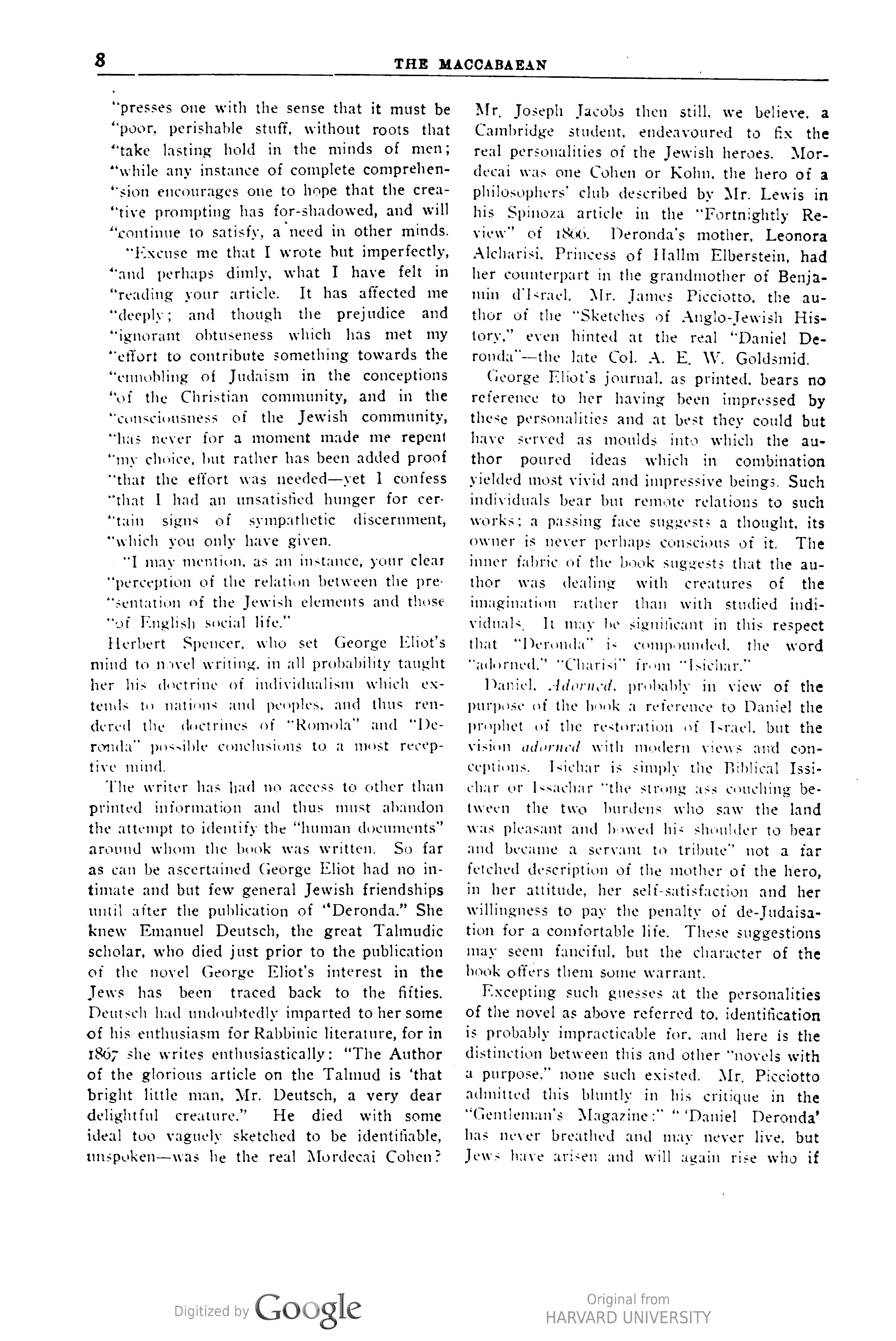
"Such a response holds for an author not "only what is best in the life that is, but "the promise of 'that which is to come.' I "mean, that the usual approximate narrow "preception of what one has been intending "and profoundly feeling in one's work, im-