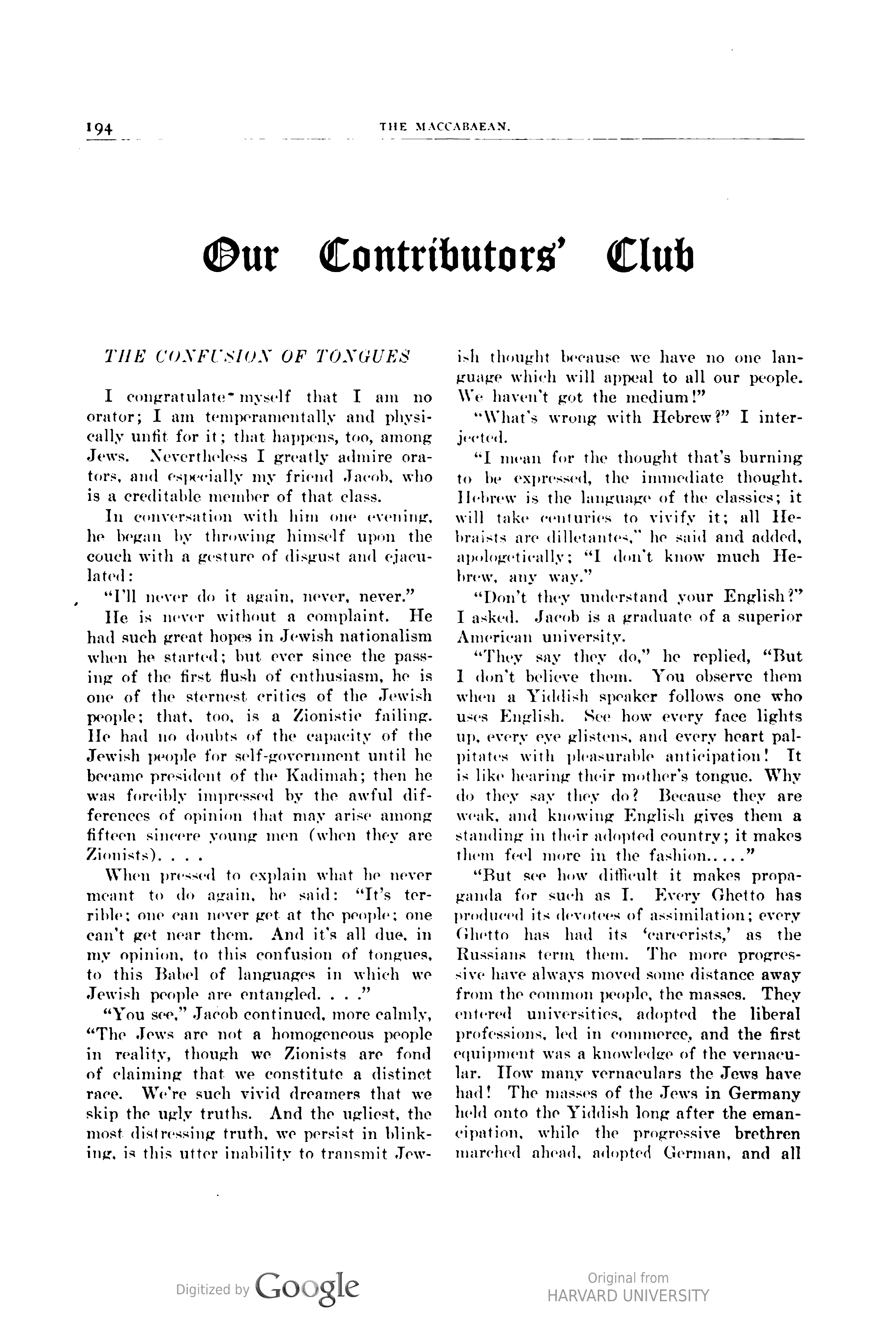
THE CONFUSION OF TONGUES
I congratulate myself that I am no orator; I am temperamentally and physically unfit for it; that happens, too, among Jews. Nevertheless I greatly admire orators, and especially my friend Jacob, who is a creditable member of that class.
In conversation with him one evening, he began by throwing himself upon the couch with a gesture of disgust and ejaculated:
"I'll never do it again, never, never."
He is never without a complaint. He had such great hopes in Jewish nationalism when he started; but ever since the passing of the first flush of enthusiasm, he is one of the sternest critics of the Jewish people; that, too, is a Zionistic failing. He had no doubts of the capacity of the Jewish people for self-government until he became president of the Kadimah; then he was forcibly impressed by the awful differences of opinion that may arise among fifteen sincere young men (when they are Zionists). . . .
When pressed to explain what he never meant to do again, he said: “It’s terrible; one can never get at the people; one can’t get near them. And it’s all due, in my opinion, to this confusion of tongues, to this Babel of languages in which we Jewish people are entangled. . . .”
"You see," Jacob continued, more calmly, "The Jews are not a homogeneous people in reality, though we Zionists are fond of claiming that we constitute a distinct race. We're such vivid dreamers that we skip the ugly truths. And the ugliest, the most distressing truth, we persist in blinking, is this utter inability to transmit Jew-
ish thought because we have no one language which will appeal to all our people. We haven't got the medium!"
“What’s wrong with Hebrew?” I interjected.
“I mean for the thought that's burning to be expressed, the immediate thought. Hebrew is the language of the classics; it will take centuries to vivify it; all Hebraists are dilletantes,” he said and added, apologetically; “I don't know much Hebrew, any way.”
"Don't they understand your English?" I asked. Jacob is a graduate of a superior American university.
"They say they do," he replied, "But I don't believe them. You observe them when a Yiddish speaker follows one who uses English. See how every face lights up, every eye glistens, and every heart palpitates with pleasurable anticipation! It is like hearing their mother's tongue. Why do they say they do? Because they are weak, and knowing English gives them a standing in their adopted country; it makes them feel more in the fashion...."
“But see how difficult it makes propaganda for such as I. Every Ghetto has produced its devotees of assimilation; every Ghetto has had its 'careerists,' as the Russians term them. The more progressive have always moved some distance away from the common people, the masses. They entered universities, adopted the liberal professions, led in commerce, and the first equipment was a knowledge of the vernacular. How many vernaculars the Jews have had! The masses of the Jews in Germany held onto the Yiddish long after the emancipation, while the progressive brethren marched ahead, adopted German, and all