twenty-six centuries shall again be enkindled in us. Then, and then only, will Israel become a blessing to mankind; the risen Servant of the Lord will spread the word of God to the farthest isles and be a light unto the nations; then, and then only, when a second revelation shall come unto us, when yashin'enu berahamaw shenith. by far transcending the first, and the cosmic evolution reach its goal, will the cause of the Lord prosper in his land; then, and then only, will the nation of the world speak a pure language, that they may all
Mendele Mocher Seforim
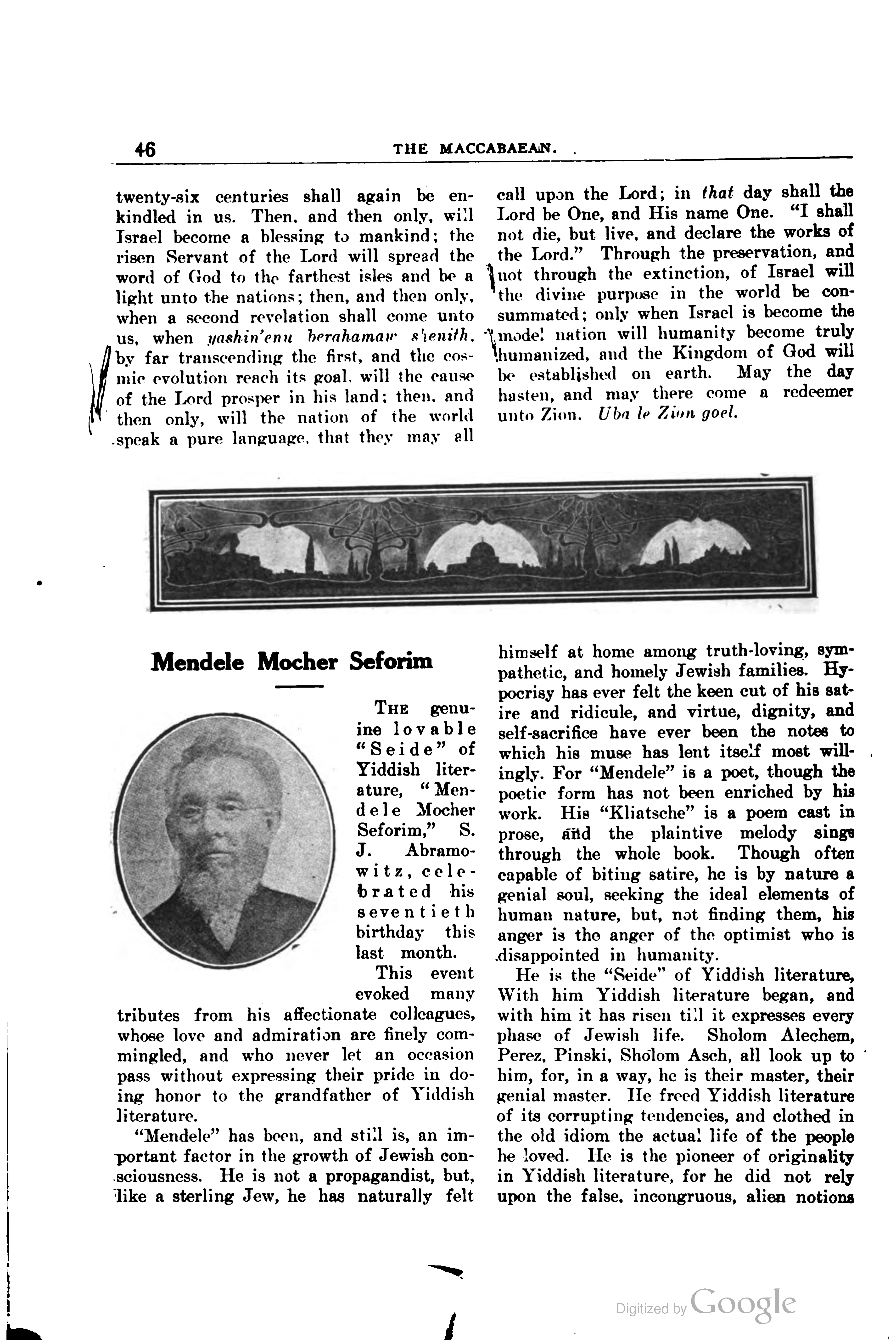
THE genuine lovable "Seide" of Yiddish literature, "Mendele Mocher Seforim," S. J. Abramowitz, celebrated his seventieth birthday this last month.
This event evoked many tributes from his affectionate colleagues, whose love and admiration are finely commingled, and who never let an occasion pass without expressing their pride in doing honor to the grandfather of Yiddish literature.
“Mendele” has been, and sti.l is, an important factor in the growth of Jewish con- ‚sciousness. He is not a propagandist, but, Jike a sterling Jew, he has naturally felt
call upon the Lord; in that day shall the Lord be One, and His name One. “I shall not die, but live, and declare the works of the Lord.” Through the preservation, and not through the extinction, of Israel will the divine purpose in the world be consummated; only when Israel is become the model nation will humanity become truly humanized, and the Kingdom of God will be established on earth. May the day hasten, and may there come a redeemer unto Zion. Uba le Zion goel.
himself at home among truth-loving, sym- pathetie, and homely Jewish families. Hypocrisy has ever felt the keen cut of his satire and ridicule, and virtue, dignity, and self-sacrifice have ever been the notes to which his muse has lent itse!f most willingly. For “Mendele” is a poet, though the poetic form has not been enriched by his work. His “Kliatsche” is a poem cast in prose, aid the plaintive melody sings through the whole book. Though often capable of biting satire, he is by nature a genial soul, seeking the ideal elements of human nature, but, not finding them, his anger is the anger of the optimist who is disappointed in humanity.
He is the "Seide" of Yiddish literature. With him Yiddish literature began, and with him it has risen till it expresses every phase of Jewish life. Sholom Alechem, Perez, Pinski, Sholom Asch, all look up to him, for, in a way, he is their master, their genial master. He freed Yiddish literature of its corrupting tendencies, and clothed in the old idiom the actual life of the people he loved. He is the pioneer of originality in Yiddish literature, for he did not rely upon the false, incongruous, alien notions