Solomon Buber, Jewish Scholar
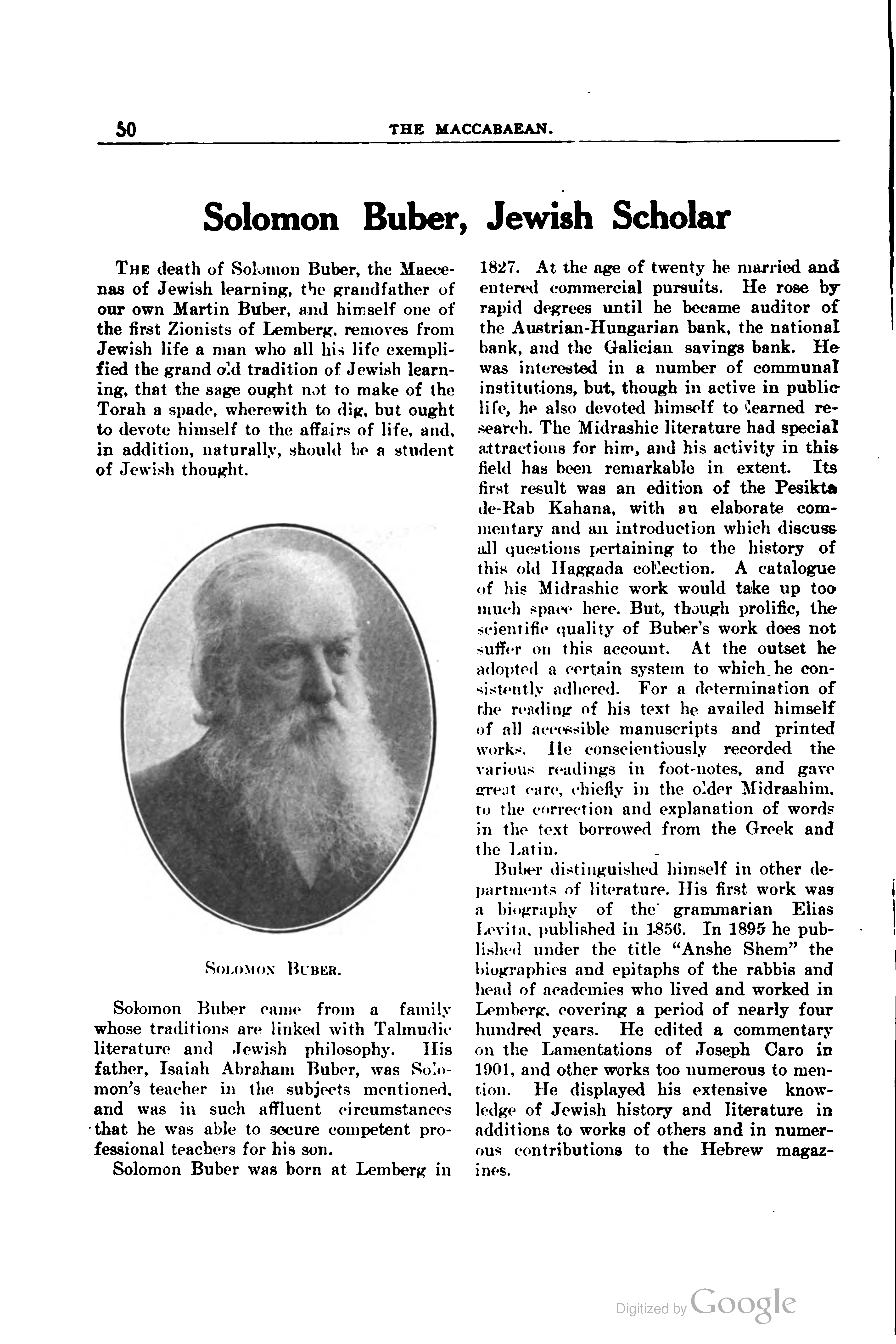
THE death of Solomon Buber, the Maecenas of Jewish learning, the grandfather of our own Martin Buber, and himself one of the first Zionists of Lemberg, removes from Jewish life a man who all his life exemplified the grand o'd tradition of Jewish learning, that the sage ought not to make of the Torah a spade, wherewith to dig, but ought to devote himself to the affairs of life, and, in addition, naturally, should be a student of Jewish thought.
Solomon Buber came from a family whose traditions are linked with Talmudic literature and Jewish philosophy. His father, Isaiah Abraham Buber, was Solomon's teacher in the subjects mentioned, and was in such affluent circumstances that he was able to secure competent professional teachers for his son.
Solomon Buber was born at Lemberg in
1827. At the age of twenty he married and entered commercial pursuits. He rose by rapid degrees until he became auditor of the Austrian-Hungarian bank, the national bank, and the Galician savings bank. He was interested in a number of communal institutions, but, though in active in public life, he also devoted himself to learned research. The Midrashic literature had special attractions for him, and his activity in this field has been remarkable in extent. Its first result was an edition of the Pesikta de-Rab Kahana, with an elaborate commentary and an introduction which discuss all questions pertaining to the history of this old Haggada collection. A catalogue of his Midrashic work would take up too much space here. But, though prolific, the scientific quality of Buber's work does not suffer on this account. At the outset he adopted a certain system to which he consistently adhered. For a determination of the reading of his text he availed himself of all accessible manuscripts and printed works. He conscientiously recorded the various readings in footnotes, and gave great care, chiefly in the older Midrashim, to the correction and explanation of words in the text borrowed from the Greek and the Latin.
Buber distinguished himself in other departments of literature. His first work was a biography of the grammarian Elias Levita, published in 1856. In 1895 he published under the title "Anshe Shem" the biographies and epitaphs of the rabbis and head of academies who lived and worked in Lemberg, covering a period of nearly four hundred years. He edited a commentary on the Lamentations of Joseph Caro in 1901, and other works too numerous to mention. He displayed his extensive knowledge of Jewish history and literature in additions to works of others and in numerous contributions to the Hebrew magazines.