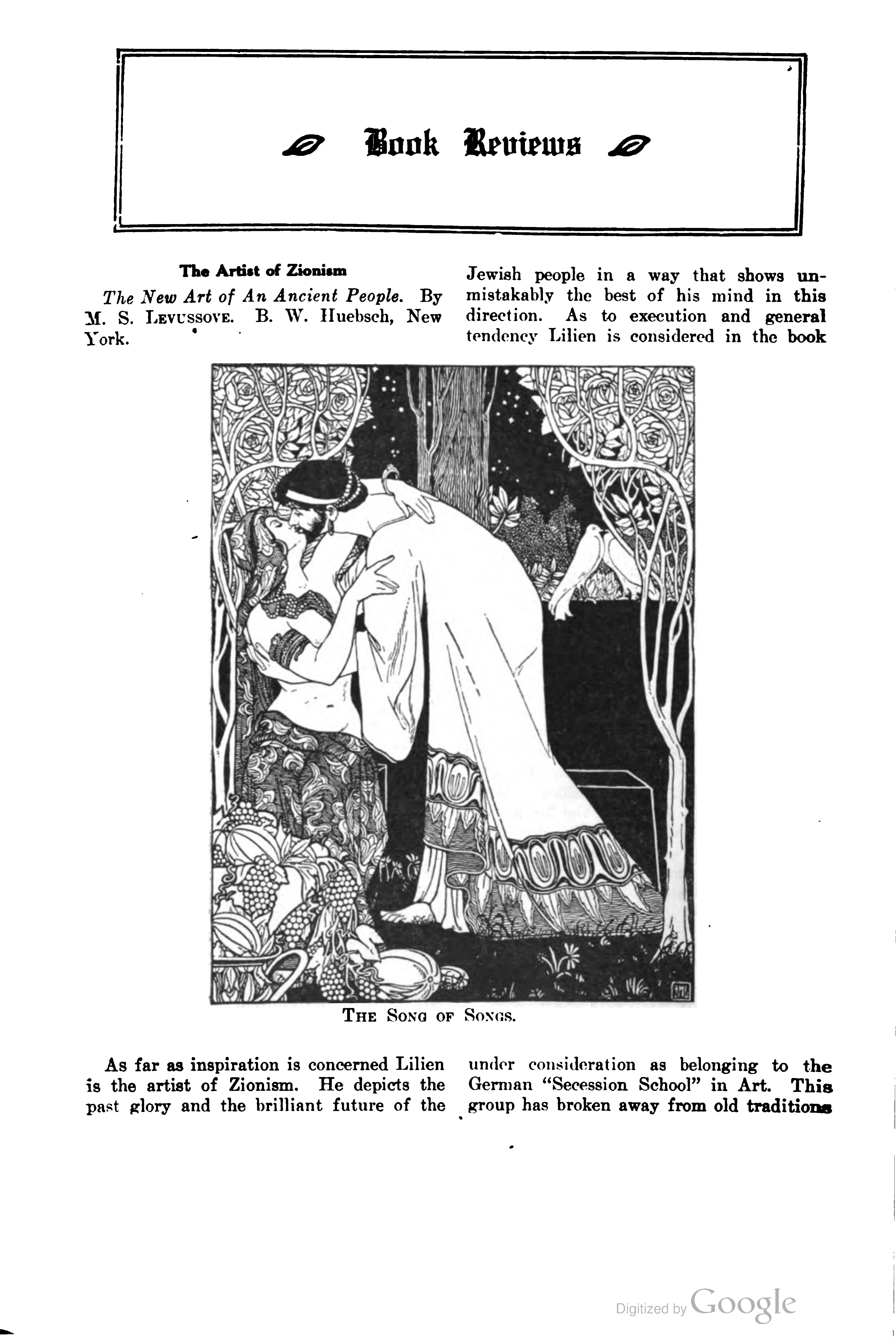
and endeavors to picture life in a vivid, refreshing and individual way, free from all the absolute mannerisms and antiquated notions that have been the common property of the artists of all times.
Mr. Levussove has written an appreciative and wholesome account of the art of Lilien. As this is, we believe, the first important notice of the work of Lilien that has thus far appeared in English, it deserves a cordial welcome. The book, however, is not as comprehensive and detailed as two similar works that have already been issued in Germany, those of Zweig and Regener.
Levussove's monograph contains some fifteen illustrations to fifty-one pages of text. The major portion of the book is devoted to a critical examination and description of the accompanying illustrations. The spirit in which Mr. Levussove regards the work of Lilien as an indication of the artistic possibilities of the Jewish Rennaissance may be gleaned from the following, with which the book closes:
"On the slope of one of the mountains of the Rockies, there peacefully and quietly flows a stream. At one point in its path it suddenly disappears, is completely and myteriously swallowed up, leaving no trace behind. Yet, miles beyond, this stream, which had apparently sunk into the bowels of the earth never to reappear, rises again, bubbles up, richer and stronger, laden with myriads of crystals, catching and reflecting the light of dawn in a thousand rainbow colors. Even so has the national spirit of the Jews again come to light. For two thousand years overwhelmed by the nation's woes, it was believed to have been completely swallowed up, giving no indication of existence, except in faint rumblings heard in the Talmudic disputations and the various mysticisms of the Middle Ages. To-day it reappears richer and fuller than ever, laden with newer gifts, reflecting the dawn of a new life in the thousand beautiful forms of a Jewish Art."
Old Chassidic Legends
Die Geschichte des Rabbi Nachman, ihm nacherzaehlt von MARTIN BUBER. Rutten & Loening, Frankfort A. M., 1906.
Martin Buber, as a Zionist, as a Jew interested in a peculiar expression of intense Jewish feeling, has set himself the task of interpreting the legends of the Chassidim to the modern world. Think of the magnitude of his undertaking: to fell a Christianized, rationalistic world, with goyische koepf, what the rebbi telis at the table; to take something out of a language in which it grew and put it into a language in which it could never have grown, from a language in which every third word is Hebrew and every tenth word simply saturated with Chassidic suggestion into a language which it resembles outwardly Just enough to make a satisfactory trans.ation—not a mere translation—almost impossible. The very words of the original are supposed by its Chassidie readers to have a mysterious meaning; they would not even dare to correct a word for fear the arrangement of the sodot be disturbed. And Buber translates this into elegant German, not as dead folklore of which he is to make a post mortem examination, but as living embodiments of Torah dressed in the latest European fashion. Need we wonder then if Chassi? dim, who knew the real article, complain of a lack of the flavor—the ta’am we-reach that they have a right to expect? Is it surprising, on the other hand, if the rationalist calls it Kinderspiel? At least we are confident that both will ultimately declare that Buber has chosen his stories and the details in them judiciously and retold them admirably. Therein lies the diffieulty; he has taken material from the crudest stage of a nation’s art and reset it in the most polished stage of that art.
It is as if an Euglishman were to take an old ballad that tells a superstitious tale about demons and make a modern short story of it without changing any more words than the difference in language renders absolutely necessary. In the early stage stories are really a mode of thinking pure and simple, a "haec fabula docet"