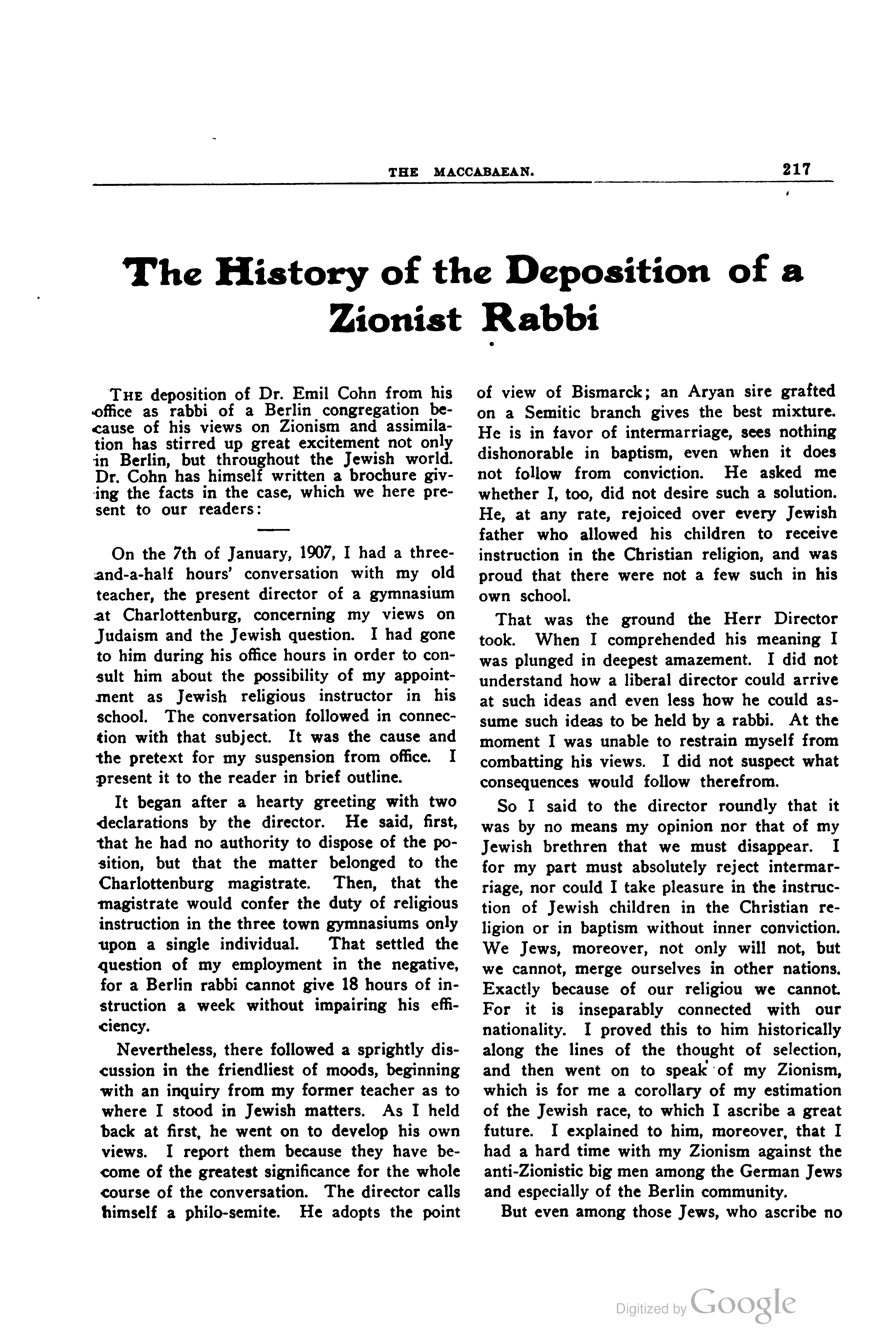
The History of the Deposition of a Zionist Rabbi
The deposition of Dr. Emil Cohn from his ofiice as rabbi of a Berlin congregation be- <ause of his views on Zionism and assimilation has stirred up great excitement not only in Berlin, but throughout the Jewish world. Dr. Cohn has himself written a brochure giving the facts in the case, which we here pre-eent+ tn niiır readers
On the 7th of January, 1907, I had a three-and-a-half hours' conversation with my old teacher, the present director of a gymnasium at Charlottenburg, concerning my views on Judaism and the Jewish question. I had gone to him during his office hours in order to consult him about the possibility of my appointment as Jewish religious instructor in his school. The conversation followed in connection with that subject. It was the cause and the pretext for my suspension from office. I present it to the reader in brief outline.
It began after a hearty greeting with two declarations by the director. He said, first, that he had no authority to dispose of the position, but that the matter belonged to the Charlottenburg magistrate.e Then, that the magistrate would confer the duty of religious instruction in the three town gymnasiums only upon a single individual. That settled the question of my employment in the negative, for a Berlin rabbi cannot give 18 hours of instruction a week without impairing his efh- ciency.
Nevertheless, there followed a sprightly discussion in the friendliest of moods, beginning with an inquiry from my former teacher as to where I stood in Jewish matters. As I held back at first, he went on to develop his own views. I report them because they have become of the greatest significance for the whole course of the conversation. The director calls himself a philo-semite. He adopts the point
of view of Bismarck; an Aryan sire grafted on a Semitic branch gives the best mixture. He is in favor of intermarriage, sees nothing dishonorable in baptism, even when it does not follow from conviction. He asked me whether I, too, did not desire such a solution. He, at any rate, rejoiced over every Jewish father who allowed his children to receive instruction in the Christian religion, and was proud that there were not a few such in his own school.
That was the ground the Herr Director took. When I comprehended his meaning I was plunged in deepest amazement. I did not understand how a liberal director could arrive at such ideas and even less how he could assume such ideas to be held by a rabbi. At the moment I was unable to restrain myself from combatting his views. I did not suspect what consequences would follow therefrom.
So I said to the director roundly that it was by no means my opinion nor that of my Jewish brethren that we must disappear. I for my part must absolutely reject intermarriage, nor could I take pleasure in the instruction of Jewish children in the Christian religion or in baptism without inner conviction. We Jews, moreover, not only will not, but we cannot, merge ourselves in other nations. Exactly because of our religiou we cannot. For it is inseparably connected with our nationality. I proved this to him historically along the lines of the thought of selection, and then went on to speak of my Zionism, which is for me a corollary of my estimation of the Jewish race, to which I ascribe a great future. I explained to him, moreover, that I had a hard time with my Zionism against the anti-Zionistic big men among the German Jews and especially of the Berlin community.
But even among those Jews, who ascribe no