THE MACCABÆAN
The First Period of Yiddish Drama*
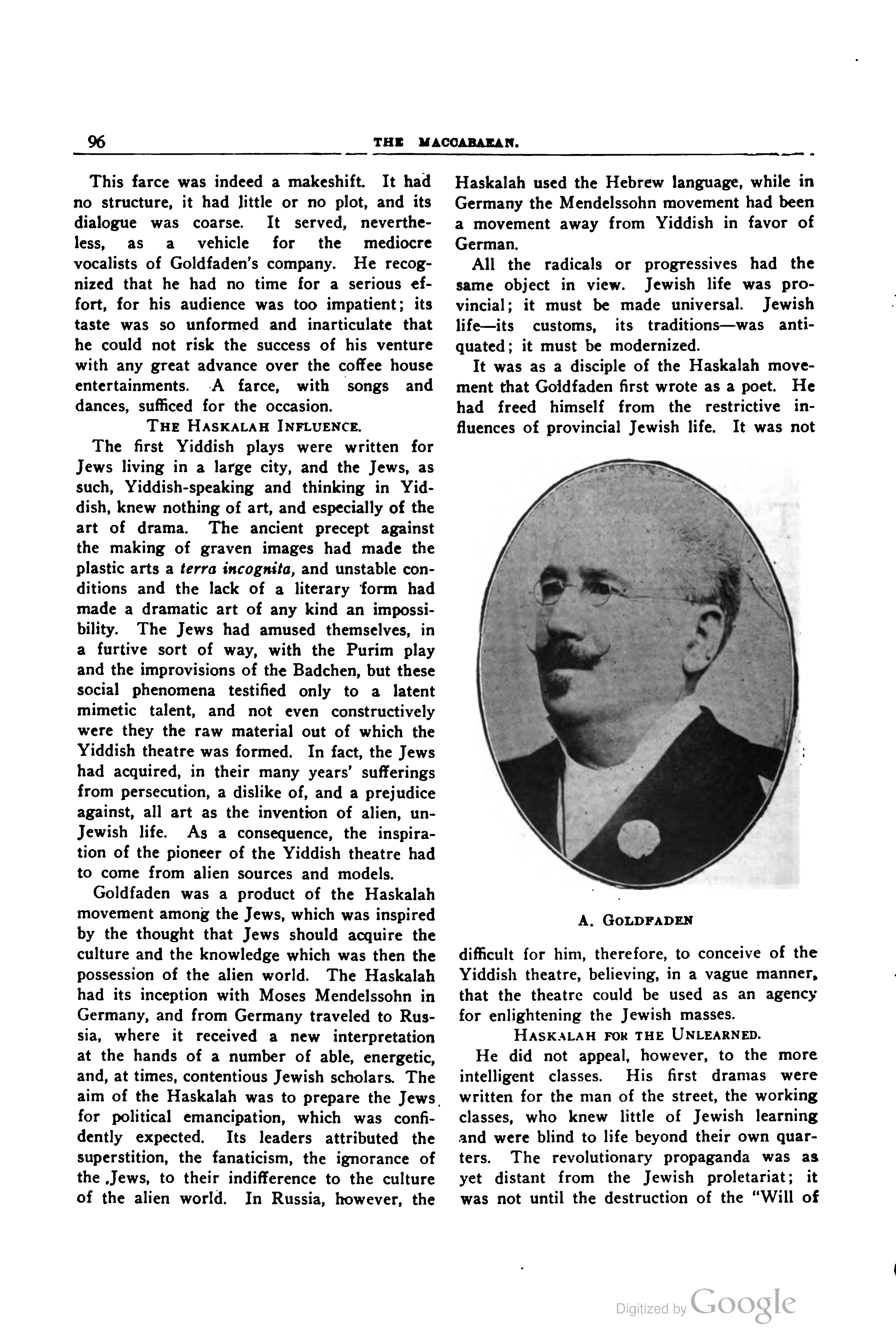
ABRAHAM GOLDFADEN.
THE first Yiddish theatre was opened in 1877, by Abraham Goldfaden, then a Yiddish ballad-writer, who, as a dramatist and theatre manager, maintained the Yiddish drama for a period of five years. In fact, the first period of the Yiddish drama centres about this one man's work.
Goldfaden was born in Starokonstantinov, in Russia, and received a good Hebrew education; he graduated in 1866 from the liberal rabbinical school of Zhitomir. For nine years he taught in government schools, first in Sim- fekgpol, and afterwards in Odessa. While at Zhitomir, Goldfaden published a volume of fairly good Hebrew poems. His first collection of Yiddish poems, Das Yuedele, appeared one year later. These ballads were written in a lyric style, .touched with homely sentiment and in rhymes that easily lent themselves to melodies,
In 1875 Goldfaden removed to Galicia, and while in Lemberg started the humorous weekly, Yisroelik, in conjunction with J. J. Lerner, subsequently also a dramatist, but the periodical lasted for only six months, when it was prohibited by the government. Goldfaden's next literary venture was the Israelitisches Volksblatt, which also had a brief existence. In none of his early work did Goldfaden give evidence of a superior talent. He had all the good and bad qualities of the badchen, but, in addition, Goldfaden had also acquired a few tricks of the pamphleteer, and an appreciation of theatrical effect.
*COPYRIGHT 1907 BY LOUIS LIPAKY
After the failure of the Volksblatt, Goldfaden was attracted by the favorable conditions of Jewish life in Roumania, and went over to Bucharest. The Russo-Turkish war was near its end, and the Roumanian cities were being used as stations for the discharge of Russian troops, among who were many Jews. In the wake of the war came an era of material prosperity. Diversion was the order of the day among the Jews, as well as among their gentile neighbors.
Goldfaden became a leading influence among the ballad singers, who entertained in the coffee house and often at social functions in Jewish homes. He wrote simple ballads and comic songs, composed or plagiarized melodies to fit them, and became quite a lion in Roumania as this form of entertainment prospered. The singers often traveled in pairs, and eventually duets and trios were written for them, and comic "patter" was interpolated in the manner of American vaudeville.
But soon the pleasure of these vaudevilles palled upon the frequenters of the coffee houses and they hungered for a novelty. Goldfaden then planned to use the singers for the presentation of complete acts, the lyrics being incidental to comic by-play. When he engaged a company, hired a hall and turned it into a theatre, he was not very sanguine of the success of his venture. Though he had published two farces a few years before, in 1872, he had little faith in them as popular attractions; as a consequence, he "wrote down" for his first production, "The Grandmother and Her Grandchild."