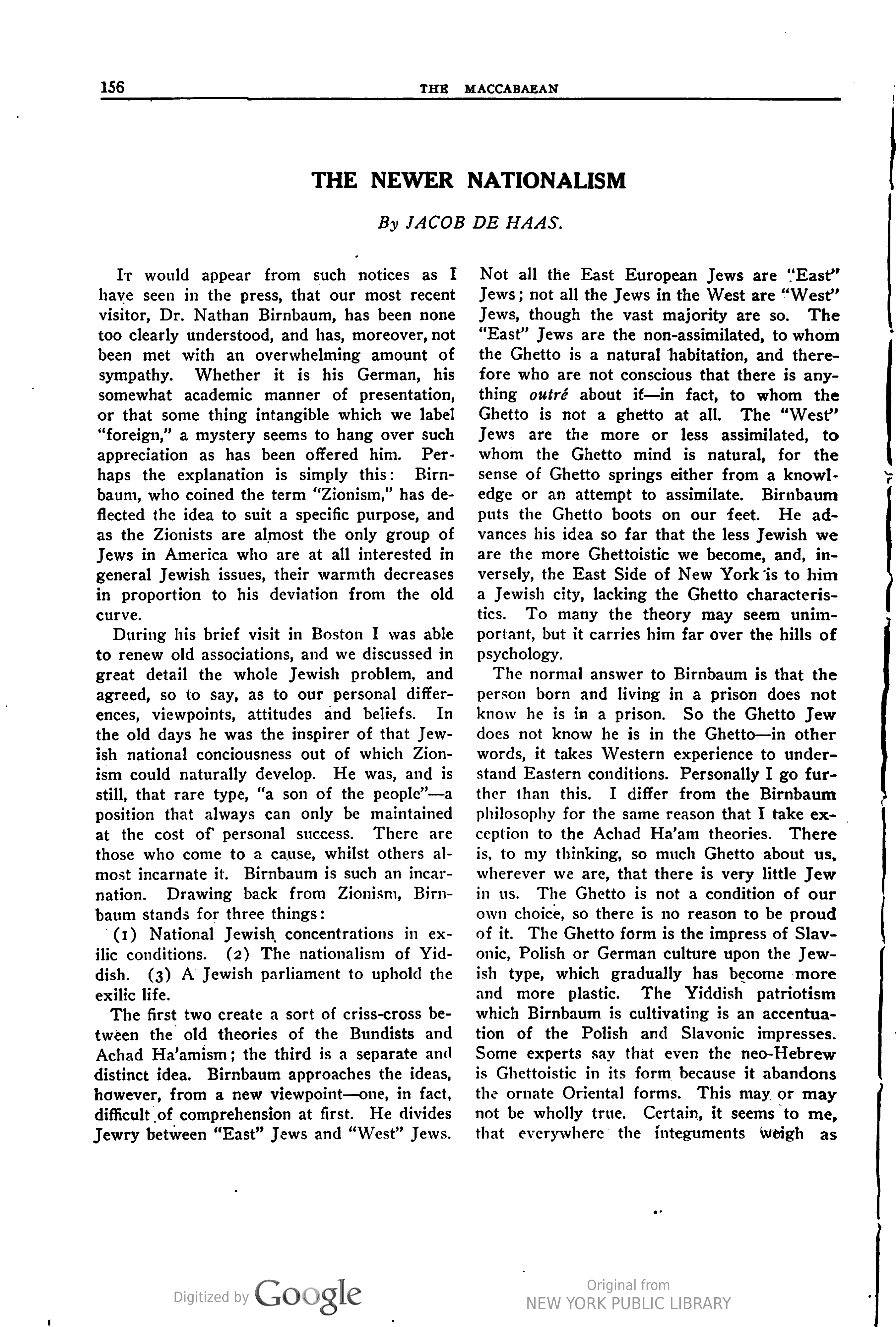
THE NEWER NATIONALISM
It would appear from such notices as I have seen in the press, that our most recent visitor, Dr. Nathan Birnbaum, has been none too clearly understood, and has, moreover, not been met with an overwhelming amount of sympathy. Whether it is his German, his somewhat academic manner of presentation, or that some thing intangible which we label “foreign,” a mystery seems to hang over such appreciation as has been offered him. Perhaps the explanation is simply this: Birnbaum, who coined the term “Zionism,” has deflected the idea to suit a specific purpose, and as the Zionists are almost the only group of Jews in America who are at all interested in general Jewish issues, their warmth decreases in proportion to his deviation from the old curve.
During his brief visit in Boston I was able to renew old associations, and we discussed in great detail the whole Jewish problem, and agreed, so to say, as to our personal differences, viewpoints, attitudes and beliefs. In the old days he was the inspirer of that Jewish national conciousness out of which Zionism could naturally develop. He was, and is still, that rare type, "a son of the people"—a position that always can only be maintained at the cost of personal success. There are those who come to a cause, whilst others almost incarnate it. Birnbaum is such an incarnation. Drawing back from Zionism, Birnbaum stands for three things:
(1) National Jewish concentrations in exilic conditions.(2) The nationalism of Yiddish.(3) A Jewish parliament to uphold the exilic life.
The first two create a sort of criss-cross between the old theories of the Bundists and Achad Ha’amism; the third is a separate and distinct idea. Birnbaum approaches the ideas, however, from a new viewpoint—one, in fact, difficult of comprehension at first. He divides Jewry between “East” Jews and “West” Jews.
Not all the East European Jews are “East” Jews; not all the Jews in the West are “West” Jews, though the vast majority are so. The “East” Jews are the non-assimilated, to whom the Ghetto is a natural habitation, and therefore who are not conscious that there is anything outré about if—in fact, to whom the Ghetto is not a ghetto at all. The “West” Jews are the more or less assimilated, to whom the Ghetto mind is natural, for the sense of Ghetto springs either from a knowledge or an attempt to assimilate. Birnbaum puts the Ghetto boots on our feet. He advances his idea so far that the less Jewish we are the more Ghettoistic we become, and, in- versely, the East Side of New York is to him a Jewish city, lacking the Ghetto characteristics. To many the theory may seem unimportant, but it carries him far over the hills of psychology.
The normal answer to Birnbaum is that the person born and living in a prison does not know he is in a prison. So the Ghetto Jew does not know he is in the Ghetto—in other words, it takes Western experience to understand Eastern conditions. Personally I go further than this. I differ from the Birnbaum philosophy for the same reason that I take exception to the Achad Ha’am theories. There is, to my thinking, so much Ghetto about us, wherever we are, that there is very little Jew in us. The Ghetto is not a condition of our own choice, so there is no reason to be proud of it. The Ghetto form is the impress of Slavonic, Polish or German culture upon the Jewish type, which gradually has become more and more plastic. The Yiddish patriotism which Birnbaum is cultivating is an accentuation of the Polish and Slavonic impresses. Some experts say that even the neo-Hebrew is Ghettoistic in its form because it abandons the ornate Oriental forms. This may or may not be wholly true. Certain, it seems to me, that everywhere the integuments weigh as