THE WANDERING JEW
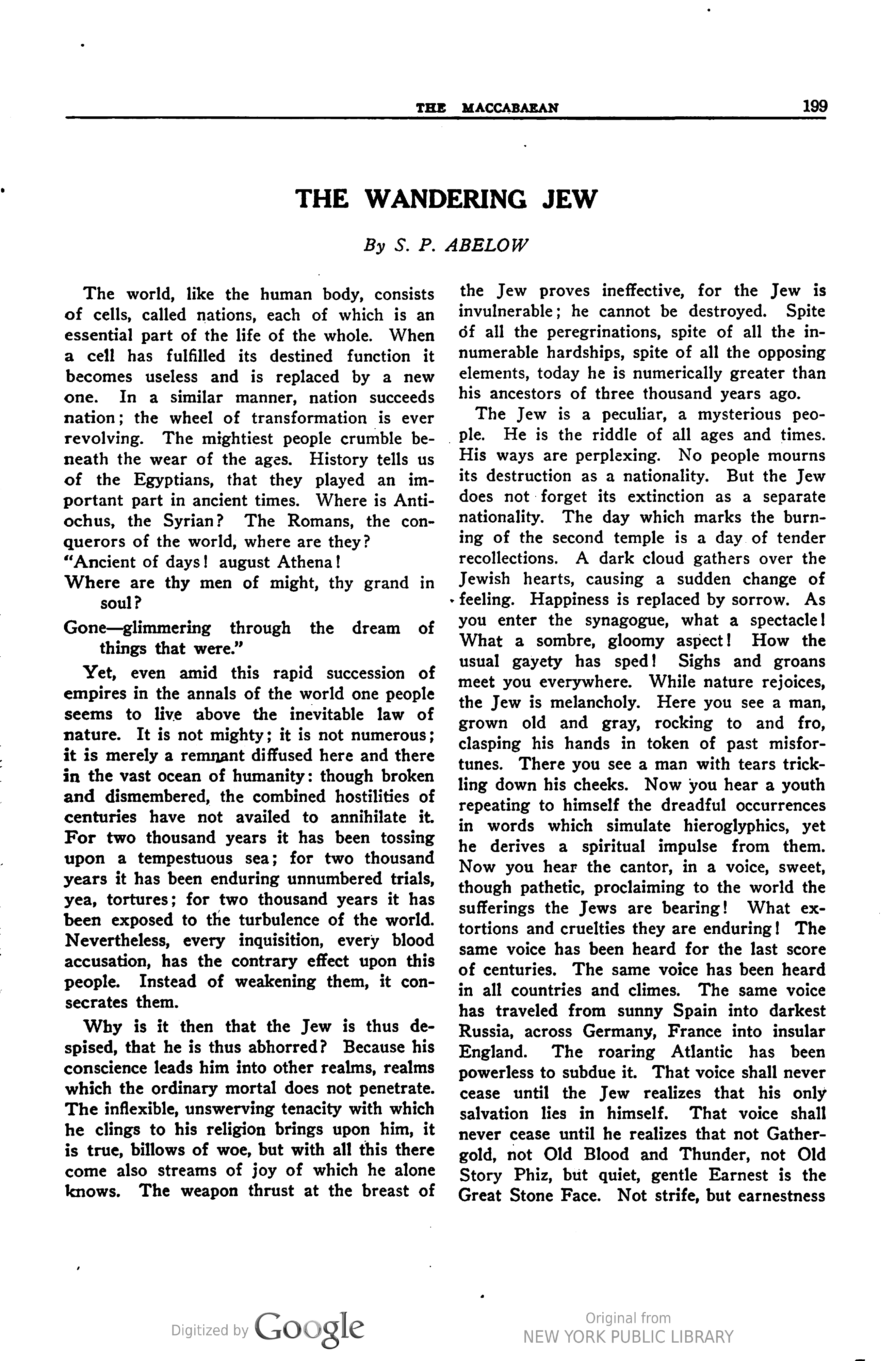
The world, like the human body, consists of cells, called nations, each of which is an essential part of the life of the whole. When a cell has fulfilled its destined function it becomes useless and is replaced by a new one. In a similar manner, nation succeeds nation; the wheel of transformation is ever revolving. The mightiest people crumble beneath the wear of the ages. History tells us of the Egyptians, that they played an important part in ancient times. Where is Antiochus, the Syrian? The Romans, the conquerors of the world, where are they?
"Ancient of days! august Athena!
Where are thy men of might, thy grand in soul?
Gone—glimmering through the dream of things that were."
Yet, even amid this rapid succession of empires in the annals of the world one people seems to live above the inevitable law of nature. It is not mighty; it is not numerous; it is merely a remnant diffused here and there in the vast ocean of humanity: though broken and dismembered, the combined hostilities of centuries have not availed to annihilate it. For two thousand years it has been tossing upon a tempestuous sea; for two thousand years it has been enduring unnumbered trials, yea, tortures; for two thousand years it has been exposed to the turbulence of the world. Nevertheless, every inquisition, every blood accusation, has the contrary effect upon this people. Instead of weakening them, it consecrates them.
Why is it then that the Jew is thus despised, that he is thus abhorred? Because his conscience leads him into other realms, realms which the ordinary mortal does not penetrate. The inflexible, unswerving tenacity with which he clings to his religion brings upon him, it is true, billows of woe, but with all this there come also streams of joy of which he alone knows. The weapon thrust at the breast of
the Jew proves ineffective, for the Jew is invulnerable; he cannot be destroyed. Spite of all the peregrinations, spite of all the innumerable hardships, spite of all the opposing elements, today he is numerically greater than his ancestors of three thousand years ago.
The Jew is a peculiar, a mysterious people. He is the riddle of all ages and times. His ways are perplexing. No people mourns its destruction as a nationality. But the Jew does not forget its extinction as a separate nationality. The day which marks the burning of the second temple is a day of tender recollections. A dark cloud gathers over the Jewish hearts, causing a sudden change of feeling. Happiness is replaced by sorrow. As you enter the synagogue, what a spectacle! What a sombre, gloomy aspect! How the usual gayety has sped! Sighs and groans meet you everywhere. While nature rejoices, the Jew is melancholy. Here you see a man, grown old and gray, rocking to and fro, clasping his hands in token of past misfortunes. There you see a man with tears trickling down his cheeks. Now you hear a youth repeating to himself the dreadful occurrences in words which simulate hieroglyphics, yet he derives a spiritual impulse from them. Now you hear the cantor, in a voice, sweet, though pathetic, proclaiming to the world the sufferings the Jews are bearing! What extortions and cruelties they are enduring! The same voice has been heard for the last score of centuries. The same voice has been heard in all countries and climes. The same voice has traveled from sunny Spain into darkest Russia, across Germany, France into insular England. The roaring Atlantic has been powerless to subdue it. That voice shall never cease until the Jew realizes that his only salvation lies in himself. That voice shall never cease until he realizes that not Gathergold, not Old Blood and Thunder, not Old Story Phiz, but quiet, gentle Earnest is the Great Stone Face. Not strife, but earnestness