COMMUNICATIONS
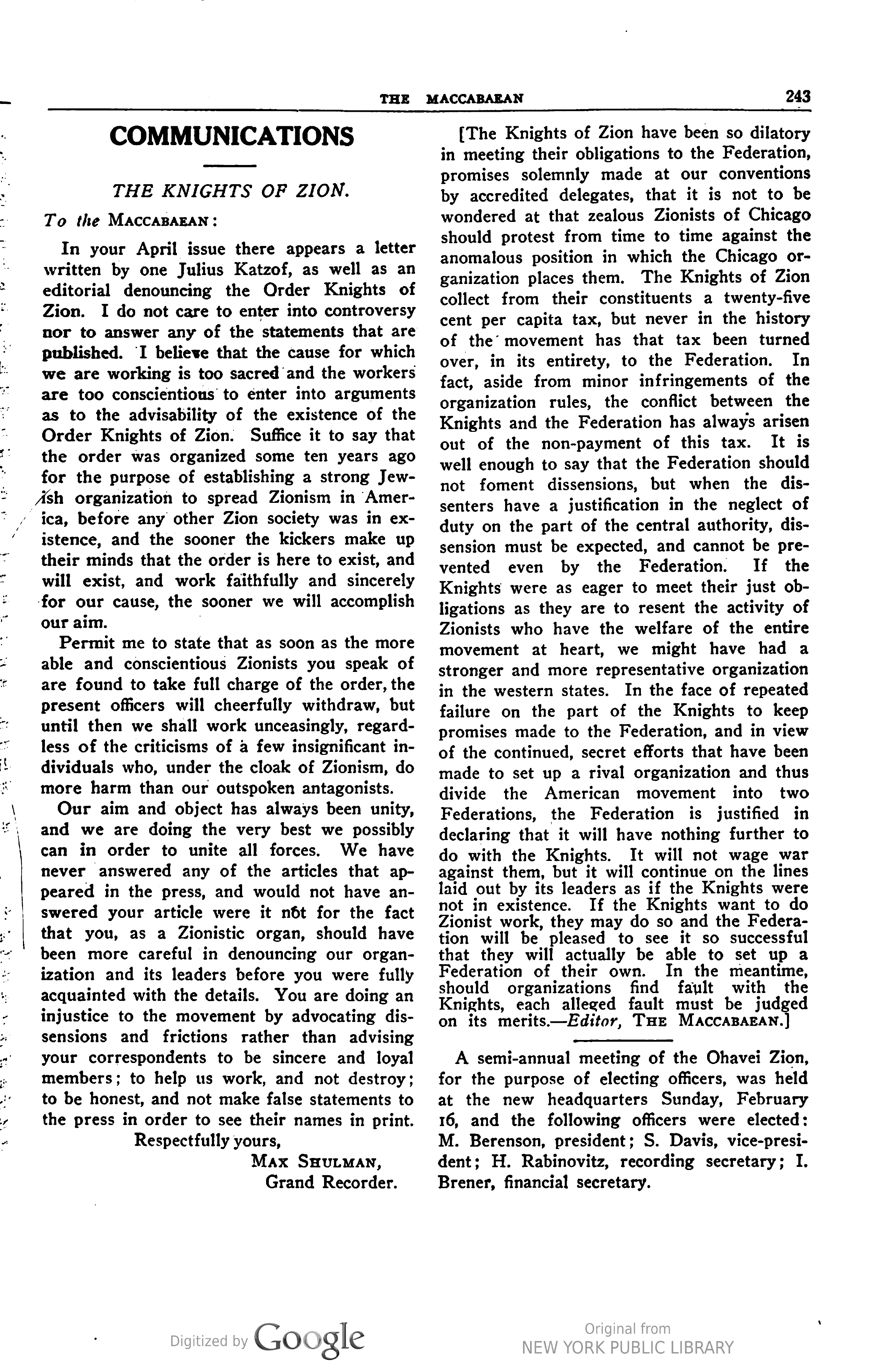
THE KNIGHTS OF ZION.
To the MACCABAEAN:
In your April issue there appears a letter written by one Julius Katzof, as well as an editorial denouncing the Order Knights of Zion. I do not care to enter into controversy nor to answer any of the statements that are published. I believe that the cause for which we are working is too sacred and the workers are too conscientious to enter into arguments as to the advisability of the existence of the Order Knights of Zion. Suffce it to say that the order was organized some ten years ago for the purpose of establishing a strong Jew- Äsh organization to spread Zionism in America, before any other Zion society was in existence, and the sooner the kickers make up their minds that the order is here to exist, and will exist, and work faithfully and sincerely for our cause, the sooner we will accomplish our aim. j
Permit me to state that as soon as the more able and conscientious Zionists you speak of are found to take full charge of the order, the present officers will cheerfully withdraw, but until then we shall work unceasingly, regardless of the criticisms of a few insignificant individuals who, under the cloak of Zionism, do more harm than our outspoken antagonists.
Our aim and object has always been unity, and we are doing the very best we possibly can in order to unite all forces. We have never answered any of the articles that appeared in the press, and would not have answered your article were it ndt for the fact that you, as a Zionistic organ, should have been more careful in denouncing our organization and its leaders before you were fully acquainted with the details. You are doing an injustice to the movement by advocating dissensions and frictions rather than advising your correspondents to be sincere and loyal members; to help us work, and not destroy; to be honest, and not make false statements to the press in order to see their names in print.
Respectfully yours,
[The Knights of Zion have been so dilatory in meeting their obligations to the Federation, promises solemniy made at our conventions by accredited delegates, that it is not to be wondered at that zealous Zionists of Chicago should protest from time to time against the anomalous position in which the Chicago organization places them. The Knights of Zion collect from their constituents a twenty-five cent per capita tax, but never in the history of the’ movement has that tax been turned over, in its entirety, to the Federation. In fact, aside from minor infringements of the organization rules, the conflict between the Knights and the Federation has always arisen out of the non-payment of this tax. It is well enough to say that the Federation should not foment dissensions, but when the dis- senters have a justification in the neglect of duty on the part of the central authority, dissension must be expected, and cannot be prevented even by the Federation. If the Knights were as eager to meet their just obligations as they are to resent the activity of Zionists who have the welfare of the entire movement at heart, we might have had a stronger and more representative organization in the western states. In the face of repeated failure on the part of the Knights to keep promises made to the Federation, and in view of the continued, secret efforts that have been made to set up a rival organization and thus divide the American movement into two Federations, the Federation is justified in declaring that it will have nothing further to do with the Knights. It will not wage war against them, but it will continue on the lines laid out by its leaders as if the Knights were not in existence. If the Knights want to do Zionist work, they may do so and the Federation will be pleased to see it so successful that they will actually be able to set up a Federation of their own. In the meantime, should organizations find fault with the Knights, each alleged fault must be judged on its merits.—Editor, THE MACCABAEAN.]
A semi-annual meeting of the Ohavei Zion, for the purpose of electing officers, was held at the new headquarters Sunday, February 16, and the following officers were elected: M. Berenson, president; S. Davis, vice-presi-dent; H. Rabinovitz, recording secretary; I. Brener, financial secretary.