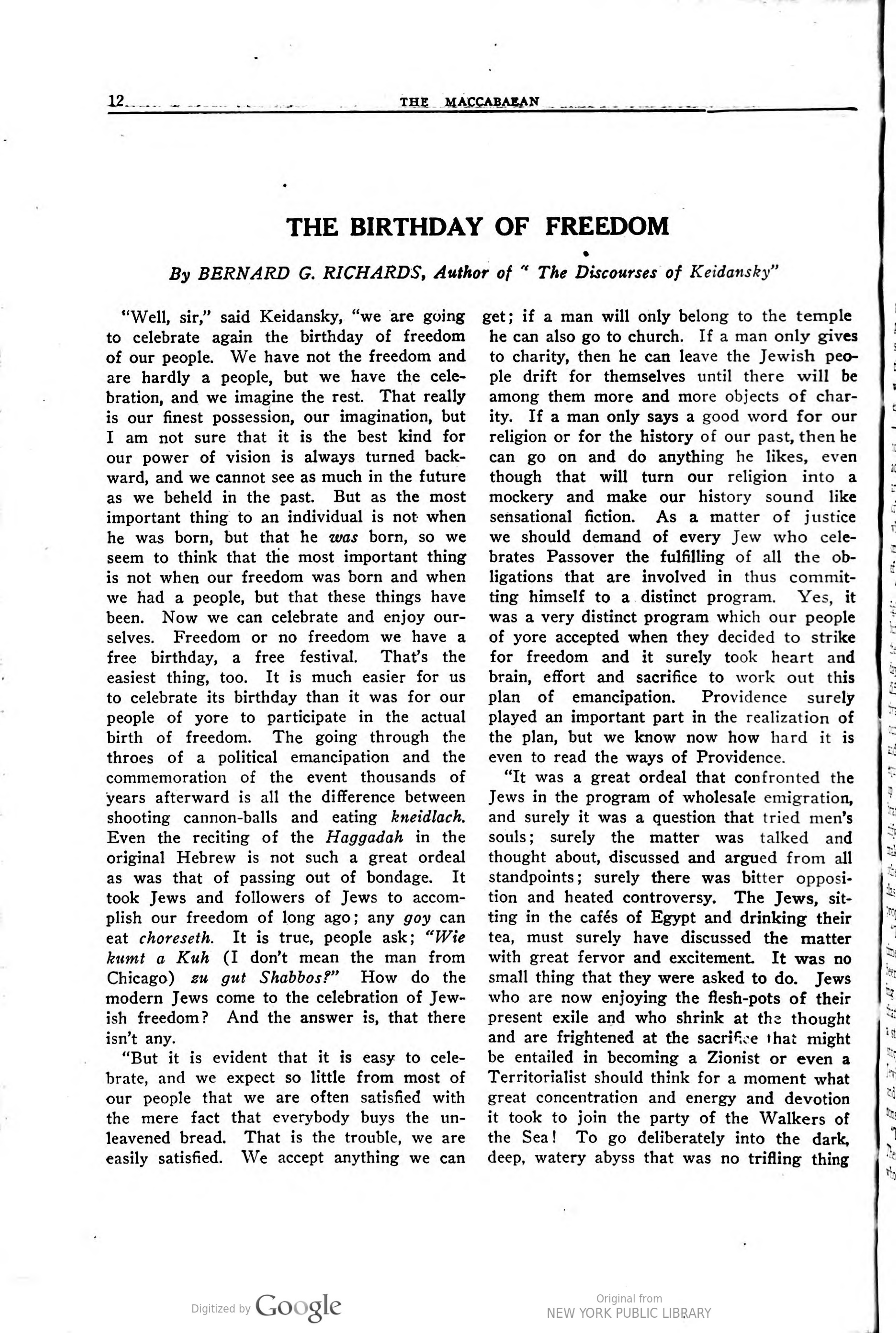
THE BIRTHDAY OF FREEDOM
By BERNARD G. RICHARDS, Author of "The Discourses of Keidansky"
“Well, sir,” said Keidansky, “we are going to celebrate again the birthday of freedom of our people. We have not the freedom and are hardly a people, but we have the celebration, and we imagine the rest. That really is our finest possession, our imagination, but I am not sure that it is the best kind for our power of vision is always turned backward, and we cannot see as much in the future as we beheld in the past. But as the most important thing to an individual is not: when he was born, but that he was born, so we seem to think that the most important thing is not when our freedom was born and when we had a people, but that these things have been. Now we can celebrate and enjoy ourselves. Freedom or no freedom we have a free birthday, a free festival. That’s the easiest thing, too. It is much easier for us to celebrate its birthday than it was for our people of yore to participate in the actual birth of freedom. The going through the throes of a political emancipation and the commemoration of the event thousands of years afterward is all the difference between shooting cannon-balls and eating kneidlach. Even the reciting of the Haggadah in the original Hebrew is not such a great ordeal as was that of passing out of bondage. It took Jews and followers of Jews to accomplish our freedom of long ago; any goy can eat choreseth. It is true, people ask; “Wie kumt a Kuh (I don’t mean the man from Chicago) zu gut Shabbos?” How do the modern Jews come to the celebration of Jewish freedom? And the answer is, that there isn't any.
"But it is evident that it is easy to celebrate, and we expect so little from most of our people that we are often satisfied with the mere fact that everybody buys the unleavened bread. That is the trouble, we are easily satisfied. We accept anything we can
get; if a man will only belong to the temple he can also go to church. If a man only gives to charity, then he can leave the Jewish people drift for themselves until there will be among them more and more objects of charity. If a man only says a good word for our religion or for the history of our past, then he can go on and do anything he likes, even though that will turn our religion into a mockery and make our history sound like sensational fiction. As a matter of justice we should demand of every Jew who celebrates Passover the fulfilling of all the obligations that are involved in thus committing himself to a distinct program. Yes, it was a very distinct program which our people of yore accepted when they decided to strike for freedom and it surely took heart and brain, effort and sacrifice to work out this plan of emancipation. Providence surely played an important part in the realization of the plan, but we know now how hard it is even to read the wavs of Providence.
“It was a great ordeal that confronted the Jews in the program of wholesale emigration, and surely it was a question that tried men’s souls; surely the matter was talked and thought about, discussed and argued from all standpoints; surely there was bitter opposition and heated controversy. The Jews, sitting in the cafes of Egypt and drinking their tea, must surely have discussed the matter with great fervor and excitement. It was no small thing that they were asked to do. Jews who are now enjoying the flesh-pots of their present exile and who shrink at thz thought and are frightened at the sacrifice that might be entailed in becoming a Zionist or even a Territorialist should think for a moment what great concentration and energy and devotion it took to join the party of the Walkers of the Sea! To go deliberately into the dark, deep, watery abyss that was no trifling thing