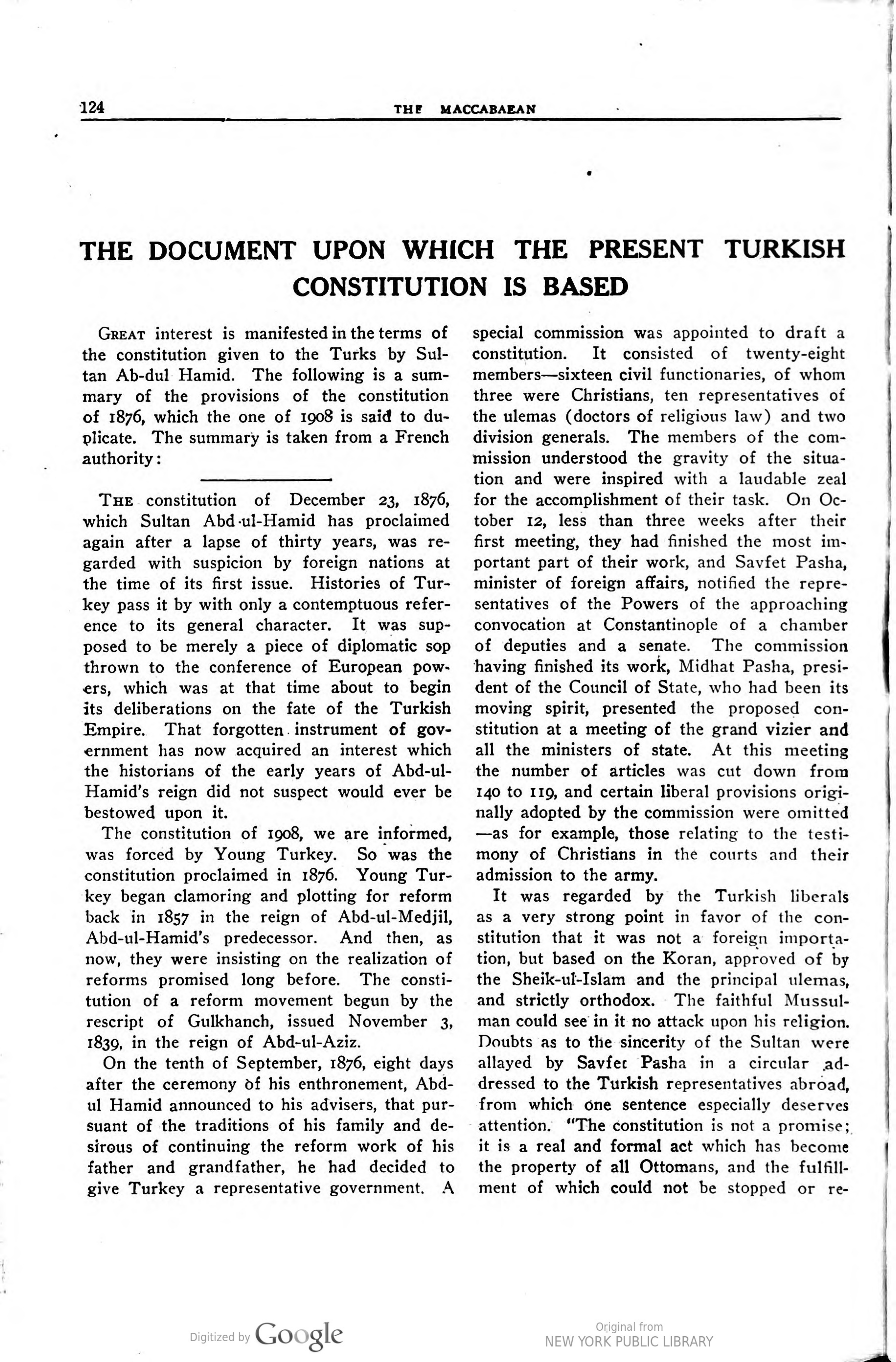
THE DOCUMENT UPON WHICH THE PRESENT TURKISH CONSTITUTION IS BASED
GREAT interest is manifested in the terms of the constitution given to the Turks by Sultan Abdul Hamid. The following is a summary of the provisions of the constitution of 1876, which the one of 1908 is said to duplicate. The summary is taken from a French authority:
THE constitution of December 23, 1876, which Sultan Abdul-Hamid has proclaimed again after a lapse of thirty years, was regarded with suspicion by foreign nations at the time of its first issue. Histories of Turkey pass it by with only a contemptuous reference to its general character. It was supposed to be merely a piece of diplomatic sop thrown to the conference of European powers, which was at that time about to begin its deliberations on the fate of the Turkish Empire. That forgotten instrument of government has now acquired an interest which the historians of the early years of Abdul-Hamid's reign did not suspect would ever be bestowed upon it.
The constitution of 1908, we are informed, was forced by Young Turkey. So was the constitution proclaimed in 1876. Young Turkey began clamoring and plotting for reform back in 1857 in the reign of Abdul-Medjil, Abdul-Hamid's predecessor. And then, as now, they were insisting on the realization of reforms promised long before. The constitution of a reform movement begun by the rescript of Gulkhanch, issued November 3, 1839, in the reign of Abdul-Aziz.
On the tenth of September, 1876, eight days after the ceremony of his enthronement, Abdul Hamid announced to his advisers, that pursuant of the traditions of his family and desirous of continuing the reform work of his father and grandfather, he had decided to give Turkey a representative government. A
special commission was appointed to draft a constitution. It consisted of twenty-eight members —sixteen civil functionaries, of whom three were Christians, ten representatives of the ulemas (doctors of religious law) and two division generals. The members of the commission understood the gravity of the situation and were inspired with a laudable zeal for the accomplishment of their task. On October 12, less than three weeks after their first meeting, they had finished the most important part of their work, and Savfet Pasha, minister of foreign affairs, notified the representatives of the Powers of the approaching convocation at Constantinople of a chamber of deputies and a senate. The commission having finished its work, Midhat Pasha, president of the Council of State, who had been its moving spirit, presented the proposed constitution at a meeting of the grand vizier and all the ministers of state. At this meeting the number of articles was cut down from 140 to 119, and certain liberal provisions originally adopted by the commission were omitted—as for example, those relating to the testimony of Christians in the courts and their admission to the army.
It was regarded by the Turkish liberals as a very strong point in favor of the constitution that it was not a foreign importation, but based on the Koran, approved of by the Sheik-ul-Islam and the principal ulemas, and strictly orthodox. The faithful Mussulman could see in it no attack upon his religion. Doubts as to the sincerity of the Sultan were allayed by Savfet Pasha in a circular addressed to the Turkish representatives abroad, from which one sentence especially deserves attention. "The constitution is not a promise; it is a real and formal act which has become the property of all Ottomans, and the fulfillment of which could not be stopped or re-