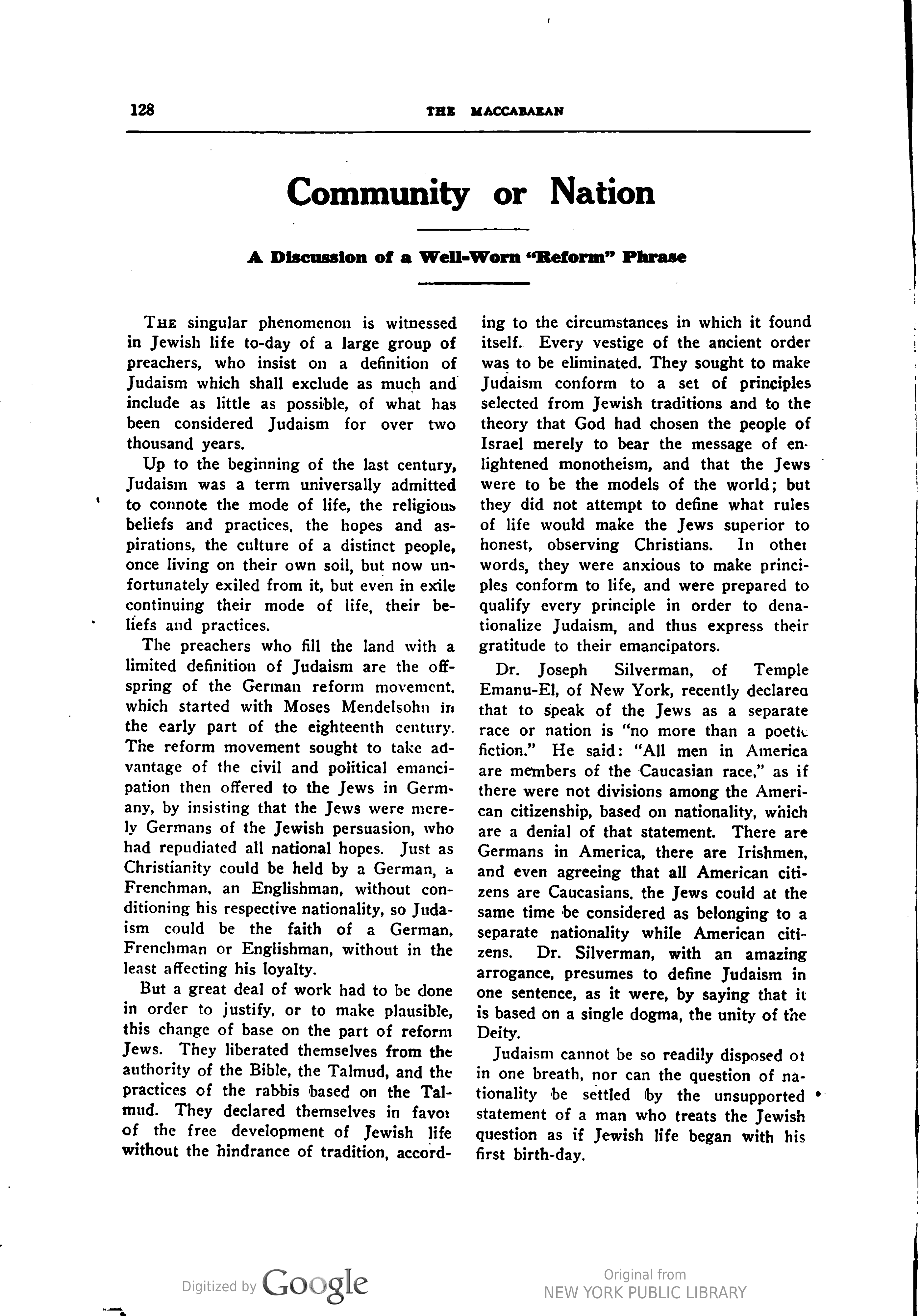
Community or Nation
A Discussion of a Well-Worn "Reform" Phrase
THE singular phenomenon is witnessed in Jewish life to-day of a large group of preachers, who insist on a definition of Judaism which shall exclude as much and include as little as possible, of what has been considered Judaism for over two thousand years.
Up to the beginning of the last century, Judaism was a term universally admitted to connote the mode of life, the religious beliefs and practices, the hopes and aspirations, the culture of a distinct people, once living on their own soil, but now unfortunately exiled from it, but even in exile continuing their mode of life, their beliefs and practices.
The preachers who fill the land with a limited definition of Judaism are the offspring of the German reform movement, which started with Moses Mendelsohn in the early part of the eighteenth century. The reform movement sought to take advantage of the civil and political emancipation then offered to the Jews in Germany, by insisting that the Jews were merely Germans of the Jewish persuasion, who had repudiated all national hopes. Just as Christianity could be held by a German, a Frenchman, an Englishman, without conditioning his respective nationality, so Judaism could be the faith of a German, Frenchman or Englishman, without in the least affecting his loyalty.
But a great deal of work had to be done in order to justify, or to make plausible, this change of base on the part of reform Jews. They liberated themselves from the authority of the Bible, the Talmud, and the practices of the rabbis based on the Talmud. They declared themselves in favor of the free development of Jewish life without the hindrance of tradition, accord-
ing to the circumstances in which it founditself. Every vestige of the ancient orderwas to be eliminated. They sought to makeJudaism conform to a set of principlesselected from Jewish traditions and to thetheory that God had chosen the people ofIsrael merely to bear the message of enlightened monotheism, and that the Jewswere to be the models of the world; butthey did not attempt to define what rulesof life would make the Jews superior tohonest, observing Christians. In otherwords, they were anxious to make principles conform to life, and were prepared toqualify every principle in order to denationalize Judaism, and thus express theirgratitude to their emancipators.
Dr. Joseph Silverman, of Temple Emanu-El, of New York, recently declared that to speak of the Jews as a separate race or nation is "no more than a poetic fiction." He said: "All men in America are members of the Caucasian race," as if there were not divisions among the American citizenship, based on nationality, which are a denial of that statement. There are Germans in America, there are Irishmen, and even agreeing that all American citizens are Caucasians, the Jews could at the same time be considered as belonging to a separate nationality while American citizens. Dr. Silverman, with an amazing arrogance, presumes to define Judaism in one sentence, as it were, by saying that it is based on a single dogma, the unity of the Deity.
Judaism cannot be so readily disposed of in one breath, nor can the question of nationality be settled by the unsupported statement of a man who treats the Jewish question as if Jewish life began with his first birthday.