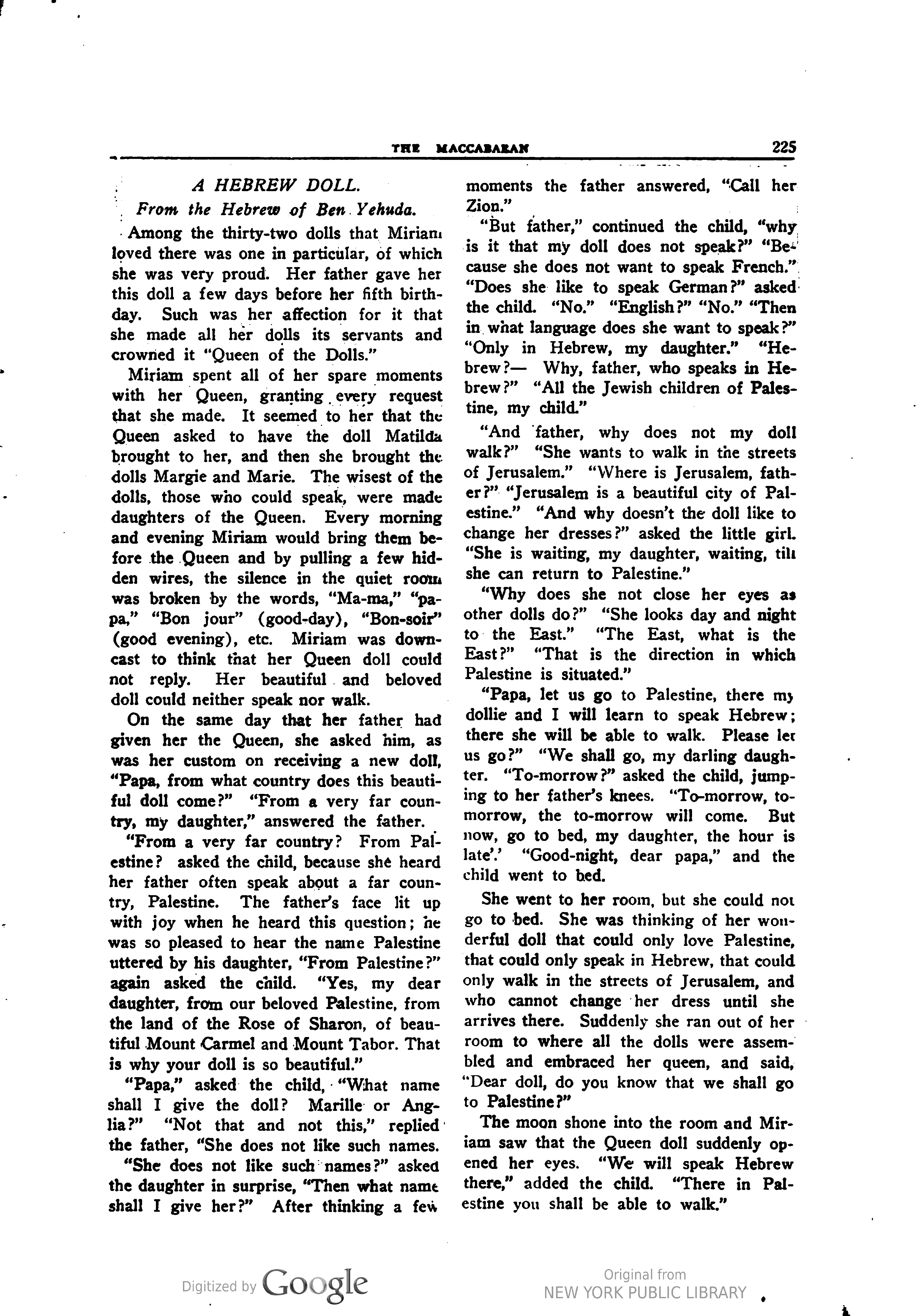
A HEBREW DOLL.
Among the thirty-two dolls that Miriam loved there was one in particular, of which she was very proud. Her father gave her this doll a few days before her fifth birthday. Such was her affection for it that she made all her dolls its servants and crowned it "Queen of the Dolls."
crowned it Queen of the Dolls.Miriam spent all of her spare momentswith her Queen, granting every requestthat she made. It seemed to her that theQueen asked to have the doll Matildabrought to her, and then she brought thedolls Margie and Marie. The wisest of thedolls, those who could speak, were madedaughters of the Queen. Every morningand evening Miriam would bring them before the Queen and by pulling a few hidden wires, the silence in the quiet roomwas broken by the words, “Ma-ma,” “papa,” “Bon jour” (good-day), “Bon-soir”(good evening), etc. Miriam was downcast to think that her Queen doll couldnot reply. Her beautiful and beloveddoll could neither speak nor walk.
On the same day that her father had given her the Queen, she asked him, as was her custom on receiving a new doll, "Papa, from what country does this beautiful doll come?" "From a very far country, my daughter," answered the father.
“From a very far country? From Palestine? asked the child, because she heard her father often speak about a far country, Palestine. The father's face lit up with joy when he heard this question; he was so pleased to hear the name Palestine uttered by his daughter, "From Palestine?" again asked the child. "Yes, my dear daughter, from our beloved Palestine, from the land of the Rose of Sharon, of beautiful Mount Carmel and Mount Tabor. That is why your doll is so beautiful.”
"Papa," asked the child, "What name shall I give the doll? Marille or Anglia?" "Not that and not this," replied the father, "She does not like such names.
"She does not like such names?" asked the daughter in surprise, "Then what name shall I give her?" After thinking a few
moments the father answered, "Call her Zion."
Zion. “But father,” continued the child, “why is it that my doll does not speak?” “Because she does not want to speak French.” “Does she like to speak German?” asked the child. “No.” “English?” “No.” “Then in what language does she want to speak?” “Only in Hebrew, my daughter.” “Hebrew?— Why, father, who speaks in Hebrew?” “All the Jewish children of Palestine, my child.”
“And ‘father, why does not my doll walk?” “She wants to walk in the streets of Jerusalem.” “Where is Jerusalem, father?” “Jerusalem is a beautiful city of Palestine.” “And why doesn’t the doll like to change her dresses?” asked the little girl. “She is waiting, my daughter, waiting, till she can return to Palestine.”
"Why does she not close her eyes as other dolls do?" "She looks day and night to the East." "The East, what is the East?" "That is the direction in which Palestine is situated."
"Papa, let us go to Palestine, there my dollie and I will learn to speak Hebrew; there she will be able to walk. Please let us go?" "We shall go, my darling daughter. "To-morrow?" asked the child, jumping to her father's knees. "To-morrow, to morrow, the to-morrow will come. But now, go to bed, my daughter, the hour is late." "Good-night, dear papa," and the child went to bed.
She went to her room, but she could not go to bed. She was thinking of her wonderful doll that could only love Palestine, that could only speak in Hebrew, that could only walk in the streets of Jerusalem, and who cannot change her dress until she arrives there. Suddenly she ran out of her room to where all the dolls were assembled and embraced her queen, and said, "Dear doll, do you know that we shall go to Palestine?"
The moon shone into the room and Miriam saw that the Queen doll suddenly opened her eyes. "We will speak Hebrew there," added the child. "There in Palestine you shall be able to walk."