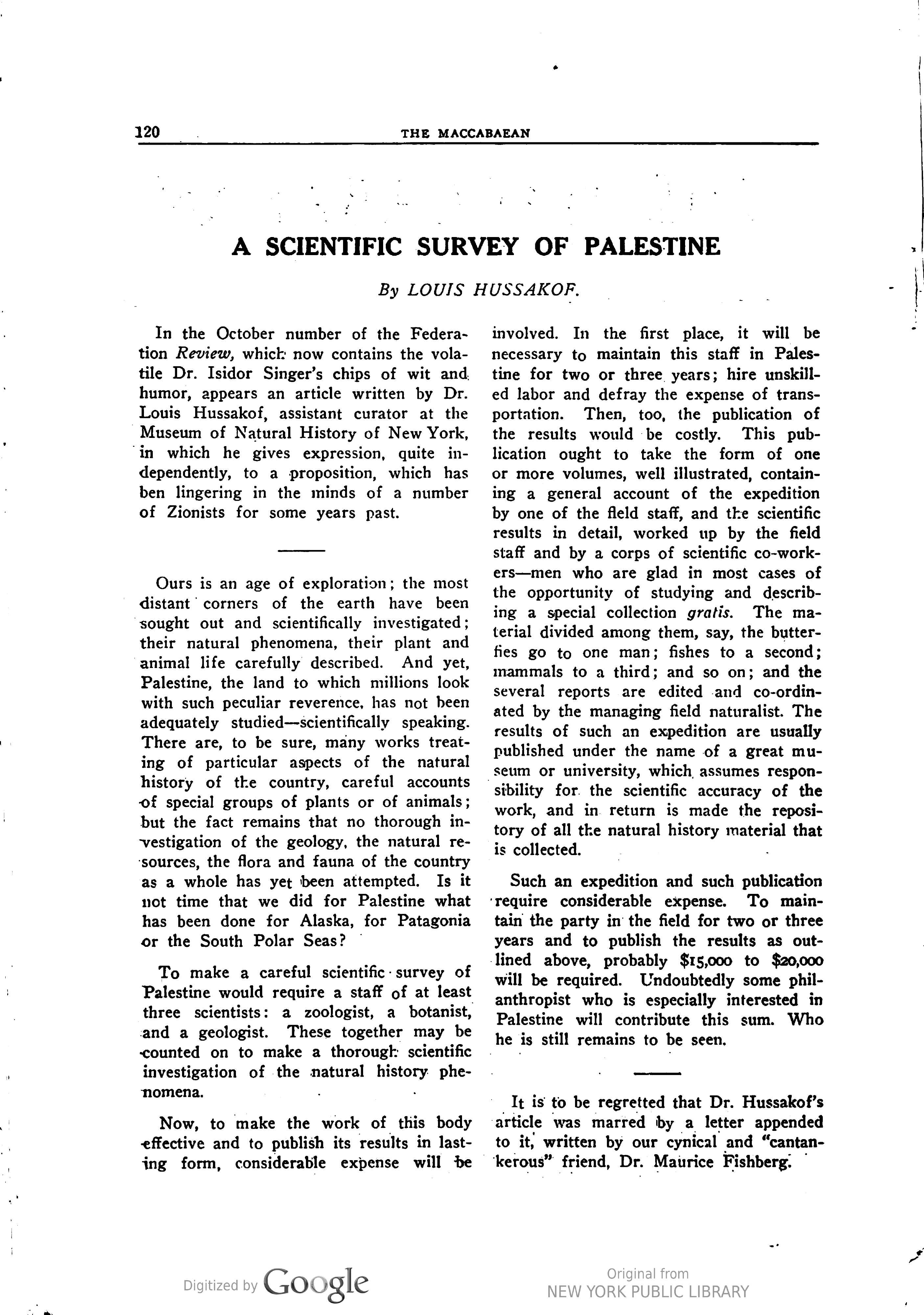
A SCIENTIFIC SURVEY OF PALESTINE
In the October number of the Federation Review, which now contains the volatile Dr. Isidor Singer's chips of wit and humor, appears an article written by Dr. Louis Hussakof, assistant curator at the Museum of Natural History of New York, in which he gives expression, quite independently, to a proposition, which has ben lingering in the minds of a number of Zionists for some years past.
Ours is an age of exploration; the most distant corners of the earth have been sought out and scientifically investigated; their natural phenomena, their plant and animal life carefully described. And yet, Palestine, the land to which millions look with such peculiar reverence, has not been adequately studied—scientifically speaking. There are, to be sure, many works treating of particular aspects of the natural history of the country, careful accounts of special groups of plants or of animals; but the fact remains that no thorough investigation of the geology, the natural resources, the flora and fauna of the country as a whole has yet been attempted. Is it not time that we did for Palestine what has been done for Alaska, for Patagonia or the South Polar Seas?
To make a careful scientific survey of Palestine would require a staff of at least three scientists: a zoologist, a botanist, and a geologist. These together may be counted on to make a thorough scientific investigation of the natural history phenomena.
Now, to make the work of this body effective and to publish its results in lasting form, considerable expense will be
involved. In the first place, it will be necessary to maintain this staff in Palestine for two or three years; hire unskilled labor and defray the expense of transportation. Then, too, the publication of the results would be costly. This publication ought to take the form of one or more volumes, well illustrated, containing a general account of the expedition by one of the field staff, and the scientific results in detail, worked up by the field staff and by a corps of scientific co-workers—men who are glad in most cases of the opportunity of studying and describing a special collection gratis. The material divided among them, say, the butterflies go to one man; fishes to a second; mammals to a third; and so on; and the several reports are edited and co-ordinated by the managing field naturalist. The results of such an expedition are usually published under the name of a great museum or university, which assumes responsibility for the scientific accuracy of the work, and in return is made the repository of all the natural history material that is collected.
Such an expedition and such publication require considerable expense. To maintain the party in the field for two or three years and to publish the results as outlined above, probably $15,000 to $20,000 will be required. Undoubtedly some philanthropist who is especially interested in Palestine will contribute this sum. Who he is still remains to be seen.
It is to be regretted that Dr. Hussakof's article was marred by a letter appended to it, written by our cynical and "cantankerous" friend, Dr. Maurice Fishberg.