THE MASTER OF "THE HOPE"
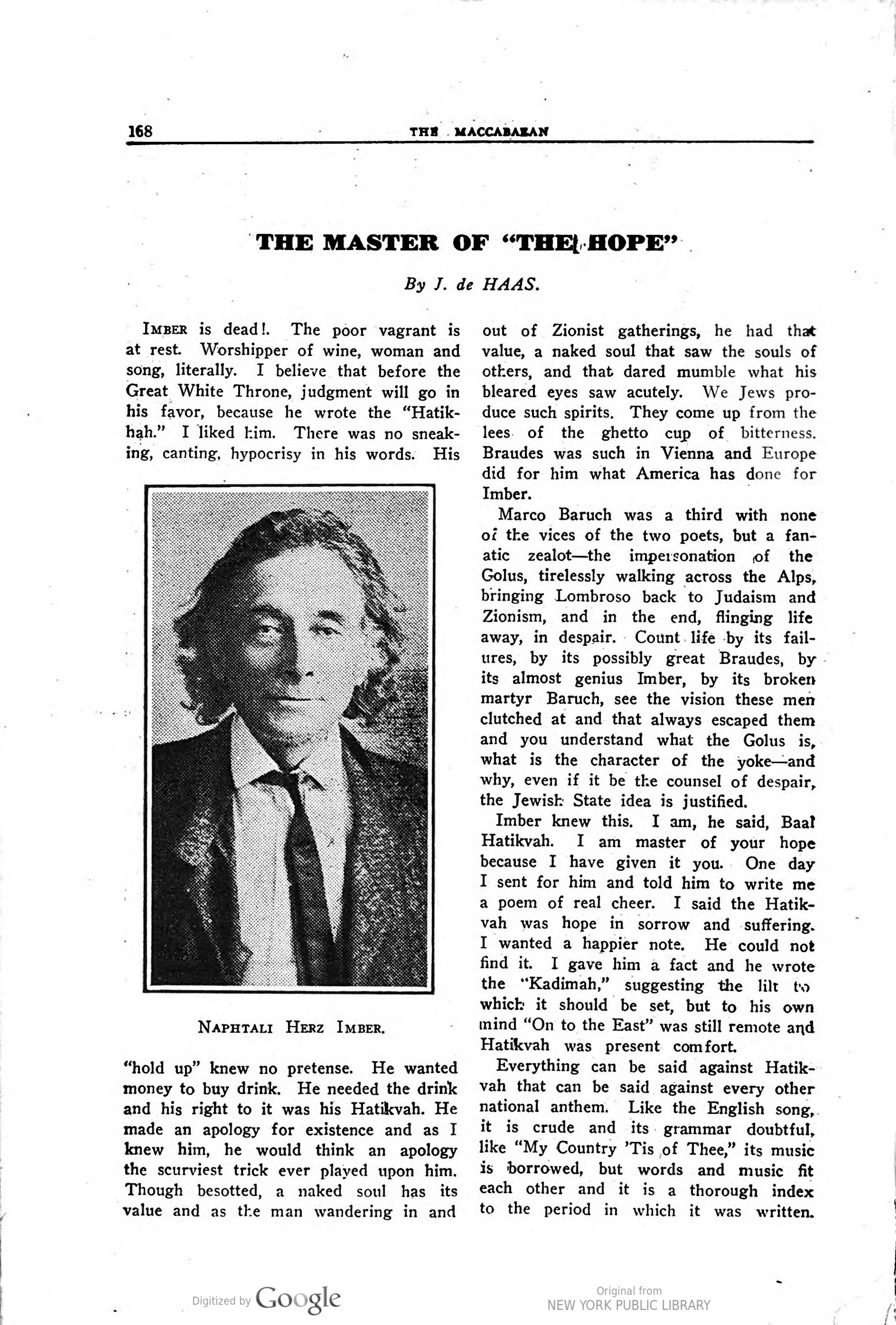
IMBER is dead!. The poor vagrant is at rest. Worshipper of wine, woman and song, literally. I believe that before the Great White Throne, judgment will go in his favor, because he wrote the "Hatik-hah." I liked him. There was no sneaking, canting, hypocrisy in his words. His
"hold up" knew no pretense. He wanted money to buy drink. He needed the drink and his right to it was his Hatikvah. He made an apology for existence and as I knew him, he would think an apology the scurviest trick ever played upon him. Though besotted, a naked soul has its value and as the man wandering in and
out of Zionist gatherings, he had that value, a naked soul that saw the souls of others, and that dared mumble what his bleared eyes saw acutely. We Jews produce such spirits. They come up from the lees of the ghetto cup of bitterness. Braudes was such in Vienna and Europe did for him what America has done for Imber.
Marco Baruch was a third with none of the vices of the two poets, but a fanatic zealot—the impersonation of the Golus, tirelessly walking across the Alps, bringing Lombroso back to Judaism and Zionism, and in the end, flinging life away, in despair. Count life by its failures, by its possibly great Braudes, by its almost genius Imber, by its broken martyr Baruch, see the vision these men clutched at and that always escaped them and you understand what the Golus is, what is the character of the yoke—and why, even if it be the counsel of despair, the Jewish State idea is justified.
Imber knew this. I am, he said, Baal Hatikvah. I am master of your hope because I have given it you. One day I sent for him and told him to write me a poem of real cheer. I said the Hatikvah was hope in sorrow and suffering. I wanted a happier note. He could not find it. I gave him a fact and he wrote the "Kadimah," suggesting the lilt to which it should be set, but to his own mind "On to the East" was still remote and Hatikvah was present comfort.
Everything can be said against Hatikvah that can be said against every other national anthem. Like the English song, it is crude and its grammar doubtful, like "My Country Tis of Thee," its music is borrowed, but words and music fit each other and it is a thorough index to the period in which it was written.