MOSES LOEB LILIENBLUM, PIONEER ZIONISTAND HEBREW WRITER
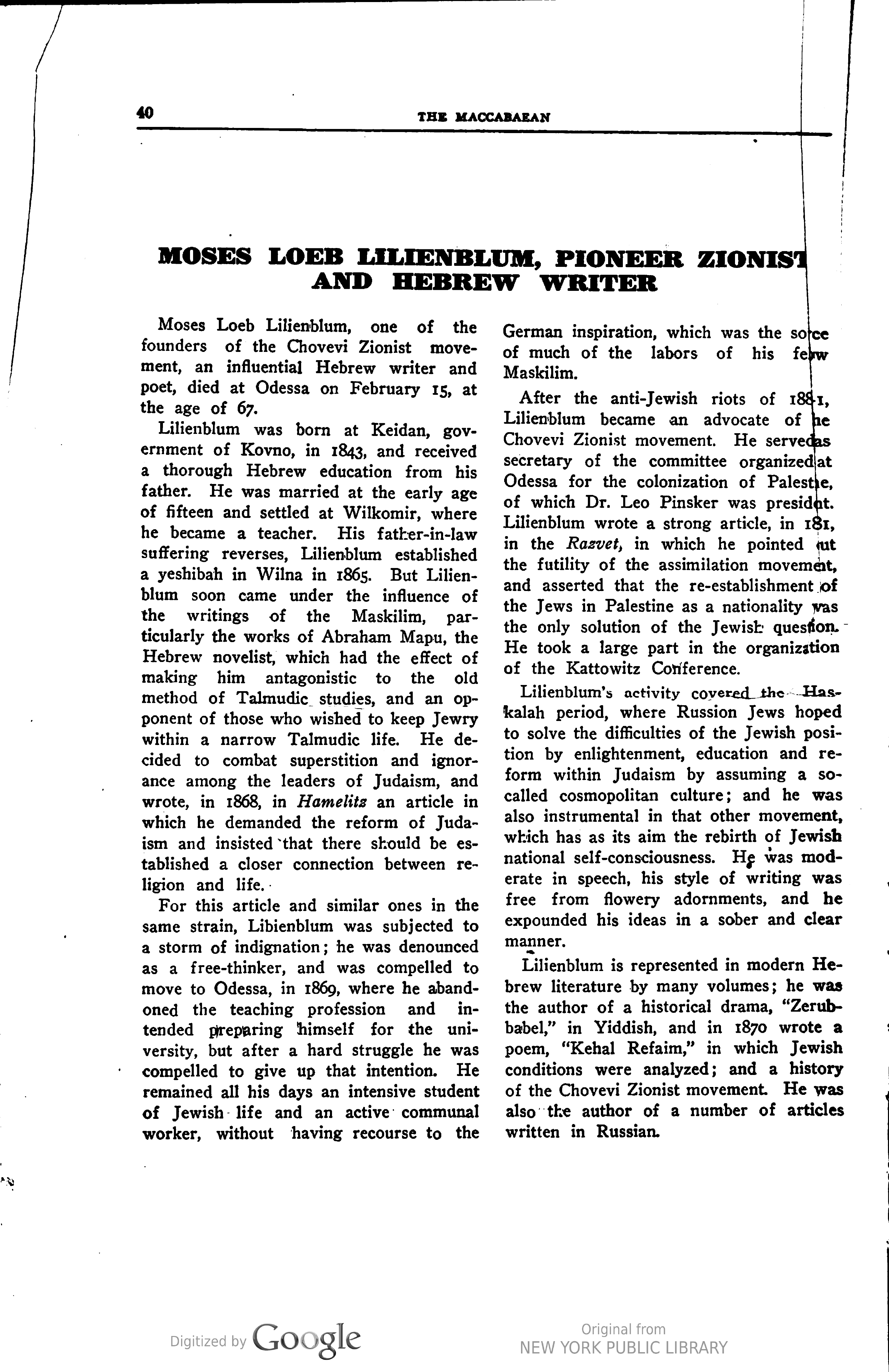
Moses Loeb Lilienblum, one of the founders of the Chovevi Zionist movement, an influential Hebrew writer and poet, died at Odessa on February 15, at the age of 67.
Lilienblum was born at Keidan, government of Kovno, in 1843, and received a thorough Hebrew education from his father. He was married at the early age of fifteen and settled at Wilkomir, where he became a teacher. His father-in-law suffering reverses, Lilienblum established a yeshibah in Wilna in 1865. But Lilienblum soon came under the influence of the writings of the Maskilim, particularly the works of Abraham Mapu, the Hebrew novelist, which had the effect of making him antagonistic to the old method of Talmudic studies, and an opponent of those who wished to keep Jewry within a narrow Talmudic life. He decided to combat superstition and ignorance among the leaders of Judaism, and wrote, in 1868, in Hamelits an article in which he demanded the reform of Judaism and insisted that there should be established a closer connection between religion and life.
For this article and similar ones in the same strain, Libienblum was subjected to a storm of indignation; he was denounced as a free-thinker, and was compelled to move to Odessa, in 1869, where he abandoned the teaching profession and intended preparing himself for the university, but after a hard struggle he was compelled to give up that intention. He remained all his days an intensive student of Jewishlife and an active communal worker, without having recourse to the
German inspiration, which was the source of much of the labors of his fellow Maskilim
After the anti-Jewish riots of 1881, Lilienblum became an advocate of the Chovevi Zionist movement. He served as secretary of the committee organized at Odessa for the colonization of Palestine, of which Dr. Leo Pinsker was president. Lilienblum wrote a strong article, in 1881, in the Razvet, in which he pointed out the futility of the assimilation movement, and asserted that the re-establishment of the Jews in Palestine as a nationality was the only solution of the Jewish question. He took a large part in the organization of the Kattowitz Conference.
Lilienblum's activity covered the Haskalah period, where Russion Jews hoped to solve the difficulties of the Jewish position by enlightenment, education and reform within Judaism by assuming a so-called cosmopolitan culture; and he was also instrumental in that other movement, which has as its aim the rebirth of Jewish national self-consciousness. He was moderate in speech, his style of writing was free from flowery adornments, and he expounded his ideas in a sober and clear manner.
Lilienblum is represented in modern Hebrew literature by many volumes; he was the author of a historical drama, "Zerubbabel," in Yiddish, and in 1870 wrote a poem, "Kehal Refaim," in which Jewish conditions were analyzed; and a history of the Chovevi Zionist movement. He was also the author of a number of articles written in Russian.