THE MACCABAEAN
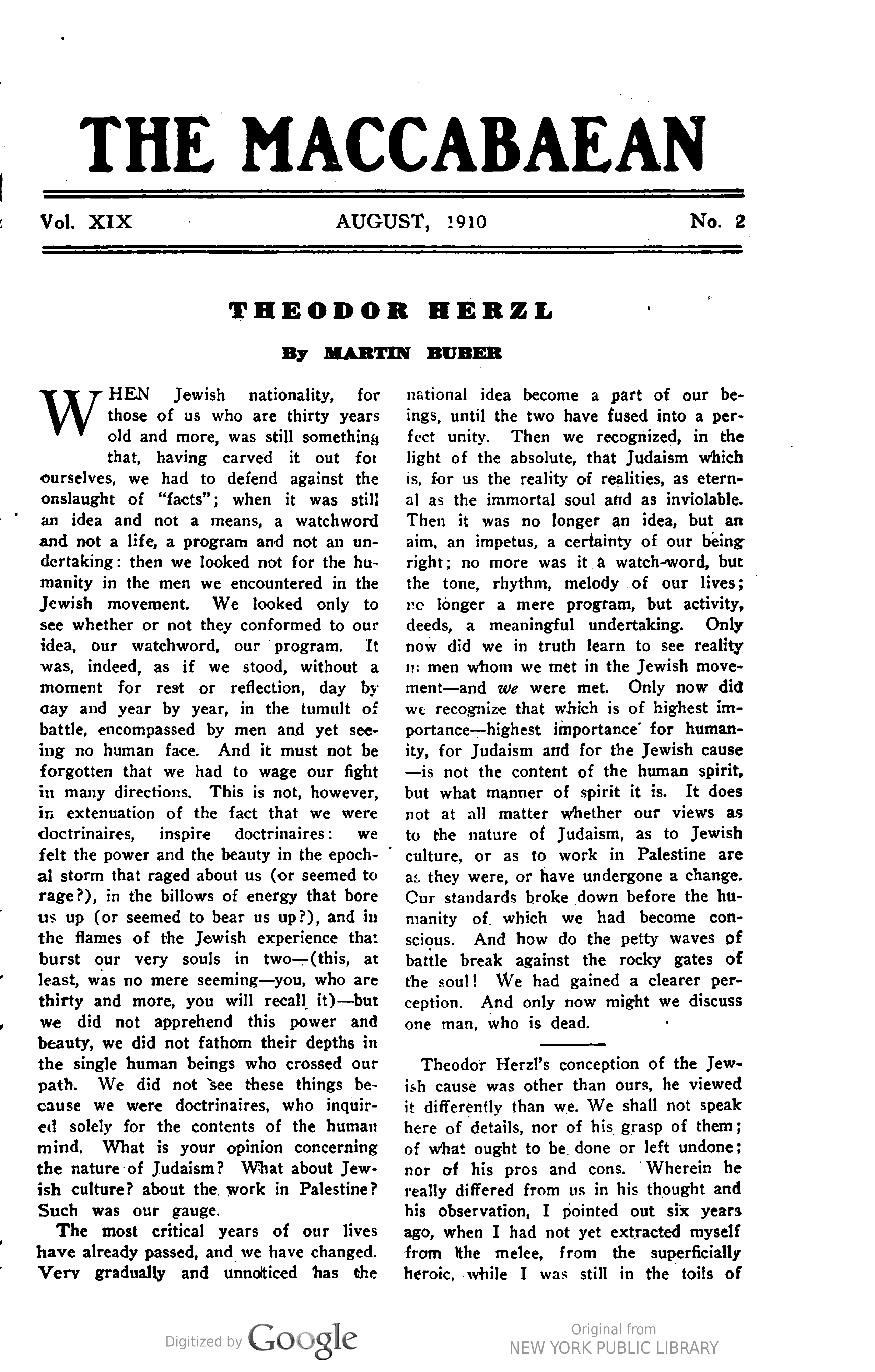
WHEN Jewish nationality, for those of us who are thirty years old and more, was still something that, having carved it out for ourselves, we had to defend against the onslaught of "facts"; when it was still an idea and not a means, a watchword and not a life, a program and not an undertaking: then we looked not for the humanity in the men we encountered in the Jewish movement. We looked only to see whether or not they conformed to our idea, our watchword, our program. It was, indeed, as if we stood, without a moment for rest or reflection, day by day and year by year, in the tumult of battle, encompassed by men and yet seeing no human face. And it must not be forgotten that we had to wage our fight in many directions. This is not, however, in extenuation of the fact that we were doctrinaires, inspire doctrinaires: we felt the power and the beauty in the epochal storm that raged about us (or seemed to rage?), in the billows of energy that bore us up (or seemed to bear us up?), and in the flames of the Jewish experience that burst our very souls in two—(this, at least, was no mere seeming—you, who are thirty and more, you will recall it)—but we did not apprehend this power and beauty, we did not fathom their depths in the single human beings who crossed our path. We did not see these things because we were doctrinaires, who inquired solely for the contents of the human mind. What is your opinion concerning the nature of Judaism? What about Jewish culture? about the work in Palestine? Such was our gauge.
The most critical years of our lives have already passed, and we have changed. Very gradually and unnoticed has the
national idea become a part of our beings, until the two have fused into a perfect unity. Then we recognized, in the light of the absolute, that Judaism which is, for us the reality of realities, as eternal as the immortal soul and as inviolable. Then it was no longer an idea, but an aim, an impetus, a certainty of our being right; no more was it a watchword, but the tone, rhythm, melody of our lives; no longer a mere program, but activity, deeds, a meaningful undertaking. Only now did we in truth learn to see reality in men whom we met in the Jewish movement —and we were met. Only now did we recognize that which is of highest importance—highest importance for humanity, for Judaism and for the Jewish cause —is not the content of the human spirit, but what manner of spirit it is. It does not at all matter whether our views as to the nature of Judaism, as to Jewish culture, or as to work in Palestine are as they were, or have undergone a change. Our standards broke down before the humanity of which we had become conscious. And how do the petty waves of battle break against the rocky gates of the soul! We had gained a clearer perception. And only now might we discuss one man, who is dead.
Theodor Herzl's conception of the Jewish cause was other than ours, he viewed it differently than we. We shall not speak here of details, nor of his grasp of them; of what ought to be done or left undone; nor of his pros and cons. Wherein he really differed from us in his thought and his observation, I pointed out six years ago, when I had not yet extracted myself from the melee, from the superficially heroic, while I was still in the toils of