The Need of the Day
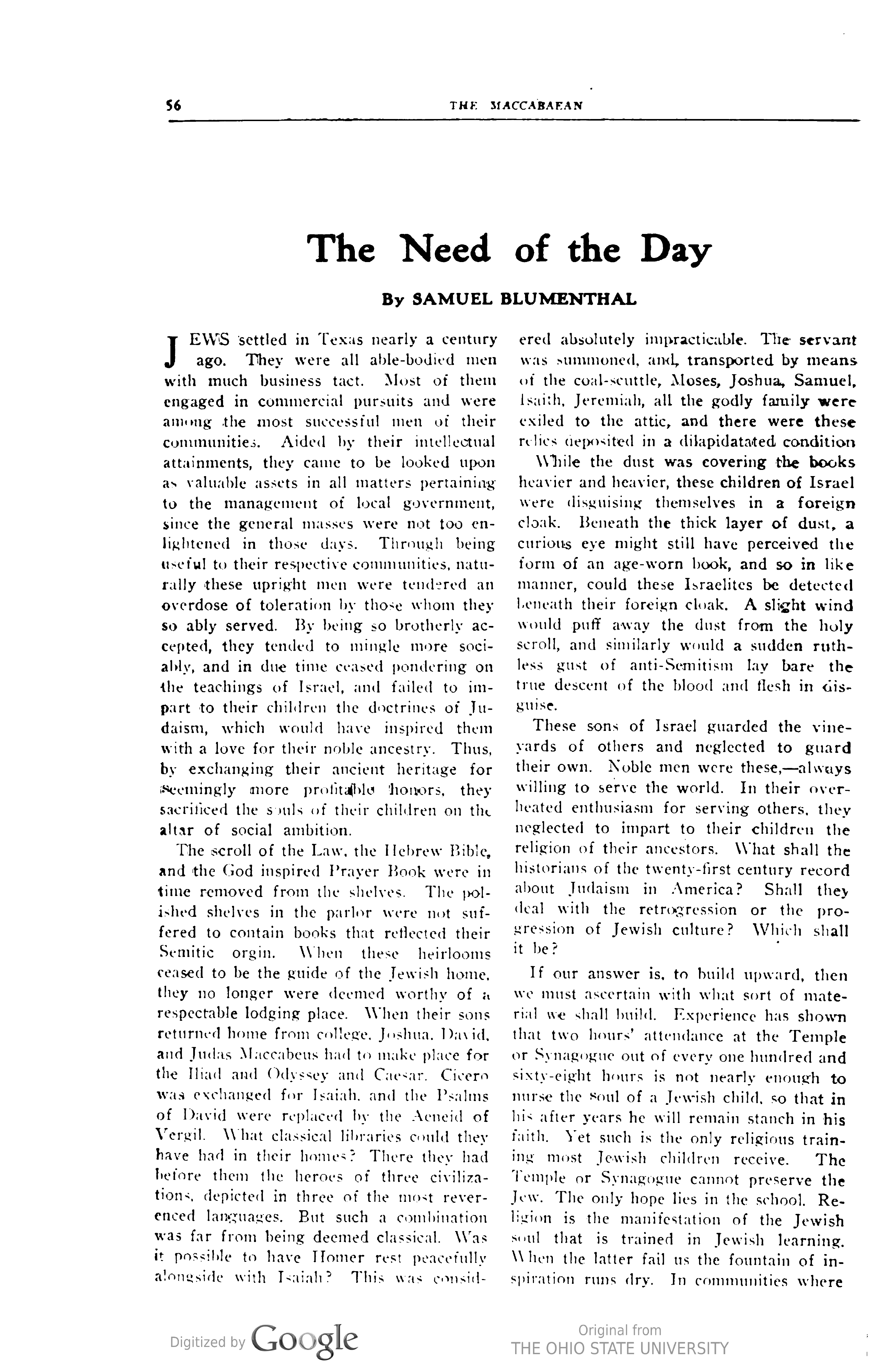
JEWS settled in Texas nearly a century ago. They were all able-bodied men with much business tact. Most of them engaged in commercial pursuits and were among the most successful men of their communities. Aided by their intellectual attainments, they came to be looked upon as valuable assets in all matters pertaining to the management of local government, since the general masses were not too enlightened in those days. Through being useful to their respective communities, naturally these upright men were tendered an overdose of toleration by those whom they so ably served. By being so brotherly accepted, they tended to mingle more sociably, and in due time ceased pondering on the teachings of Israel, and failed to impart to their children the doctrines of Judaism, which would have inspired them with a love for their noble ancestry. Thus, by exchanging their ancient heritage for seemingly more profitable honors, they sacrificed the souls of their children on the altar of social ambition.
The scroll of the Law, the Hebrew Bible, and the God inspired Prayer Book were in time removed from the shelves. The polished shelves in the parlor were not suffered to contain books that reflected their Semitic orgin. When these heirlooms ceased to be the guide of the Jewish home, they no longer were deemed worthy of a respectable lodging place. When their sons returned home from college. Joshua. David, and Judas Maccabeus had to make place for the Iliad and Odyssey and Caesar. Cicero was exchanged for Isaiah. and the Psalms of David were replaced by the Aeneid of Vergil. What classical libraries could they have had in their homes? There they had before them the heroes of three civilizations, depicted in three of the most rever- enced languages. But such a combination was far from being deemed classical. Was it possible to have Homer rest peacefully alongside with Isaiah? This was consid-
ered absolutely impracticable. The servant was summoned, and, transported by means of the coal-scuttle, Moses, Joshua, Samuel, Isaith, Jeremiah, all the godly family were exiled to the attic, and there were these relics deposited in a dilapidated condition.
While the dust was covering the books heavier and heavier, these children of Israel were disguising themselves in a foreign cloak. Beneath the thick layer of dust, a curious eye might still have perceived the form of an age-worn book, and so in like manner, could these Israelites be detected beneath their foreign cloak. A slight wind would puff away the dust from the holy scroll, and similarly would a sudden ruthless gust of anti-Semitism lay bare the true descent of the blood and flesh in disguise.
These sons of Israel guarded the vineyards of others and neglected to guard their own. Noble men were these,—always willing to serve the world. In their over- heated enthusiasm for serving others, they neglected to impart to their children the religion of their ancestors. What shall the historians of the twenty-first century record about Judaism in America? Shall they deal with the retrogression or the progression of Jewish culture? Which shall it be?
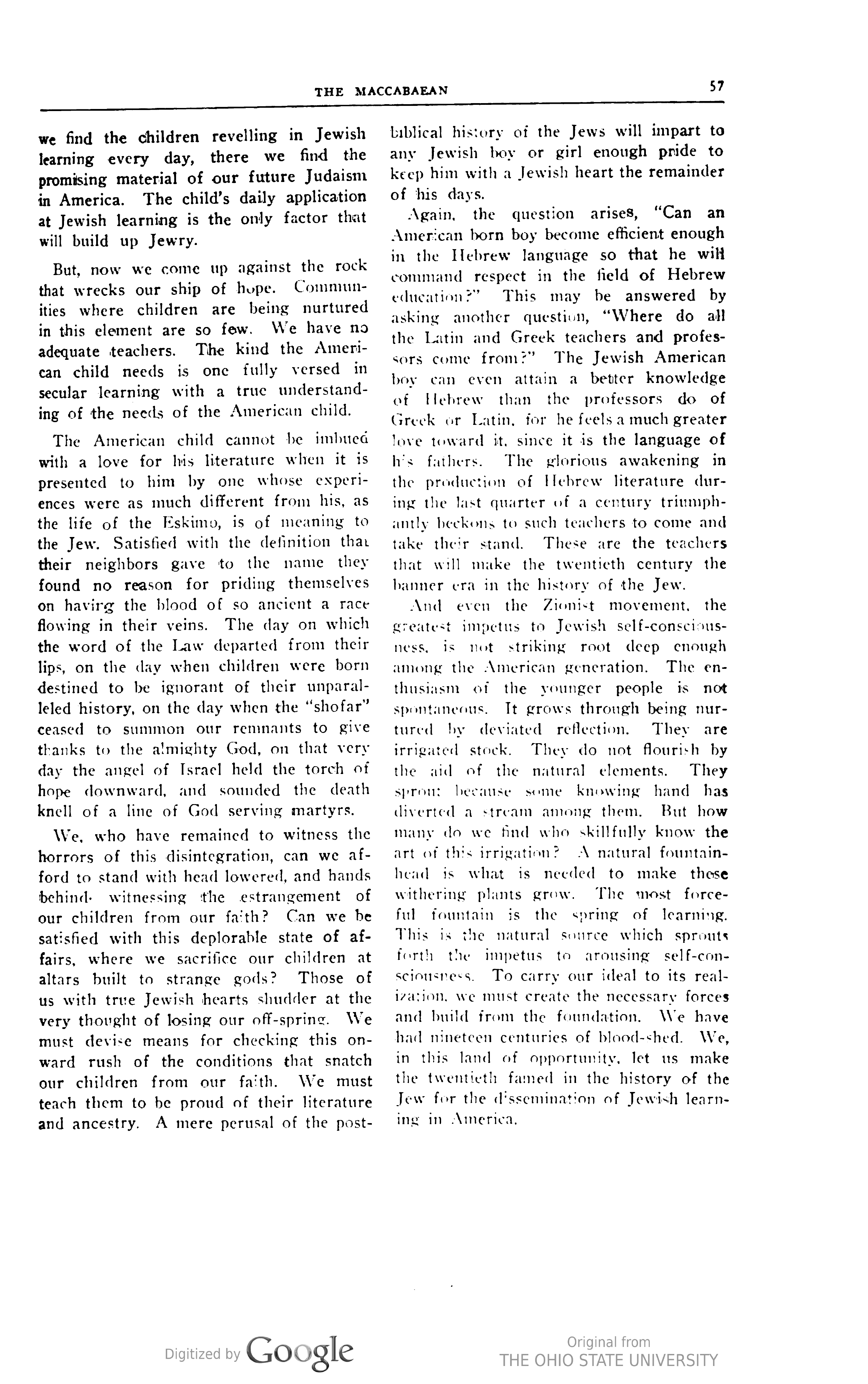
If our answer is, to build upward, then we must ascertain with what sort of material we shall build. Experience has shown that two hours’ attendance at the Temple or Synagogue out of every one hundred and sixty-eight hours is not nearly enough to nurse the Soul of a Jewish child, so that in luis after years he will remain stanch in his faith. Yet such is the only religious training most Jewish children receive. The Temple or Synagogue cannot preserve the Jew. The only hope lies in the school, Religion is the manifestation of the Jewish soul that is trained in Jewish learning. When the latter fail us the fountain of inspiration runs dry. In communities where