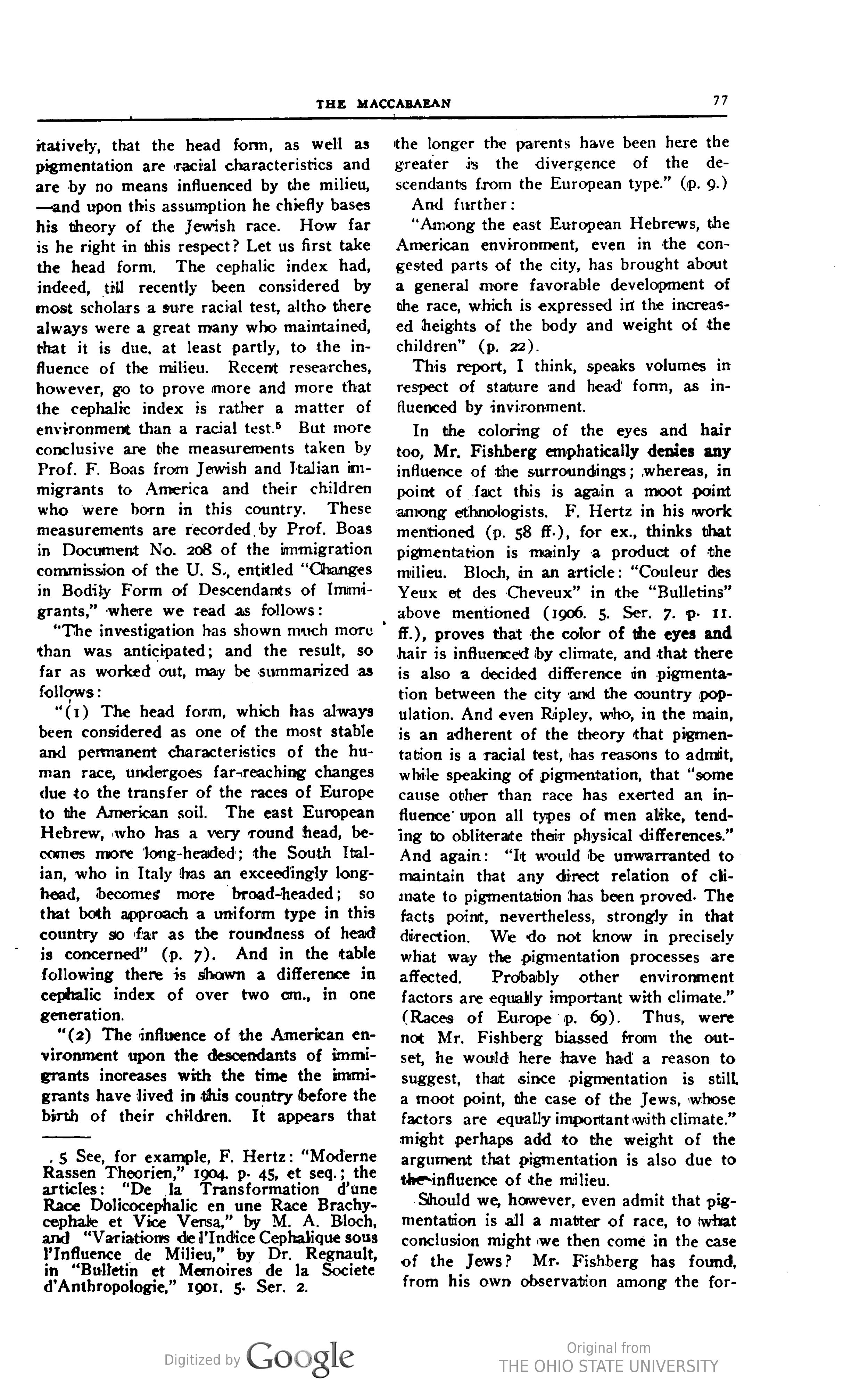
itatively, that the head form, as well as pigmentation are racial characteristics and are by no means influenced by the milieu, —and upon this assumption he chiefly bases his theory of the Jewish race. How far is he right in this respect? Let us first take the head form. The cephalic index had, indeed, till recently been considered by most scholars a sure racial test, altho there always were a great many who maintained, that it is due, at least partly, to the influence of the milieu. Recent researches, however, go to prove more and more that the cephalic index is rather a matter of environment than a racial test.5 But more conclusive are the measurements taken by Prof. F. Boas from Jewish and Italian immigrants to America and their children who were born in this country. These measurements are recorded. by Prof. Boas in Document No. 208 of the immigration commission of the U. S., entitled “Changes in Bodily Form of Descendants of Immigrants.” ‘where we read as follows:
"The investigation has shown much more than was anticipated; and the result, so far as worked out, may be summarized as follows:
"(1) The head form, which has always been considered as one of the most stable and permanent characteristics of the human race, undergoes far-reaching changes due to the transfer of the races of Europe to the American soil. The east European Hebrew, who has a very round head, becomes more long-headed; the South Italian, who in Italy has an exceedingly long-head, becomes more broad-headed; so that both approach a uniform type in this country so far as the roundness of head is concerned" (p. 7). And in the table following there is shown a difference in cephalic index of over two cm., in one generation.
"(2) The influence of the American environment upon the descendants of immigrants increases with the time the immigrants have lived in this country before the birth of their children. It appears that
. 5 See, for example, F. Hertz: "Moderne Rassen Theorien," 1904. p. 45, et seq.; the articles: "De la Transformation d'une Race Dolicocephalic en une Race Brachy-cephale et Vice Versa," by M. A. Bloch, and "Variations de l'Indice Cephalique sous l'Influence de Milieu," by Dr. Regnault, in "Bulletin et Memoires de la Societe d'Anthropologie," 1901. 5. Ser. 2.
the longer the parents have been here the greater is the divergence of the descendants from the European type." (p. 9.)
And further:
And further. "Among the east European Hebrews, the American environment, even in the congested parts of the city, has brought about a general more favorable development of the race, which is expressed in the increased heights of the body and weight of the children" (p. 22).
This report, I think, speaks volumes in respect of stature and head form, as influenced by environment.
In the coloring of the eyes and hair too, Mr. Fishberg emphatically denies any influence of the surroundings; whereas, in point of fact this is again a moot point among ethnologists. F. Hertz in his work mentioned (p. 58 ff.), for ex., thinks that pigmentation is mainly a product of the milieu. Bloch, in an article: "Couleur des Yeux et des Cheveux" in the "Bulletins" above mentioned (1906. 5. Ser. 7. p. 11. ff.), proves that the color of the eyes and hair is influenced by climate, and that there is also a decided difference in pigmentation between the city and the country population. And even Ripley, who, in the main, is an adherent of the theory that pigmentation is a racial test, has reasons to admit, while speaking of pigmentation, that "some cause other than race has exerted an influence' upon all types of men alike, tending to obliterate their physical differences." And again: "It would be unwarranted to maintain that any direct relation of climate to pigmentation has been proved. The facts point, nevertheless, strongly in that direction. We do not know in precisely what way the pigmentation processes are affected. Probably other environment factors are equally important with climate." (Races of Europe p. 69). Thus, were not Mr. Fishberg biassed from the outset, he would here have had a reason to suggest, that since pigmentation is still a moot point, the case of the Jews, whose factors are equally important with climate," might perhaps add to the weight of the argument that pigmentation is also due to the influence of the milieu.
Should we, however, even admit that pigmentation is all a matter of race, to what conclusion might we then come in the case of the Jews? Mr. Fishberg has found, from his own observation among the for-