SOME UNPUBLISHED LETTERS OF DR. MANDELSTAMM
(Translated by MISS L. OLLENDORF in the London Jewish Review)
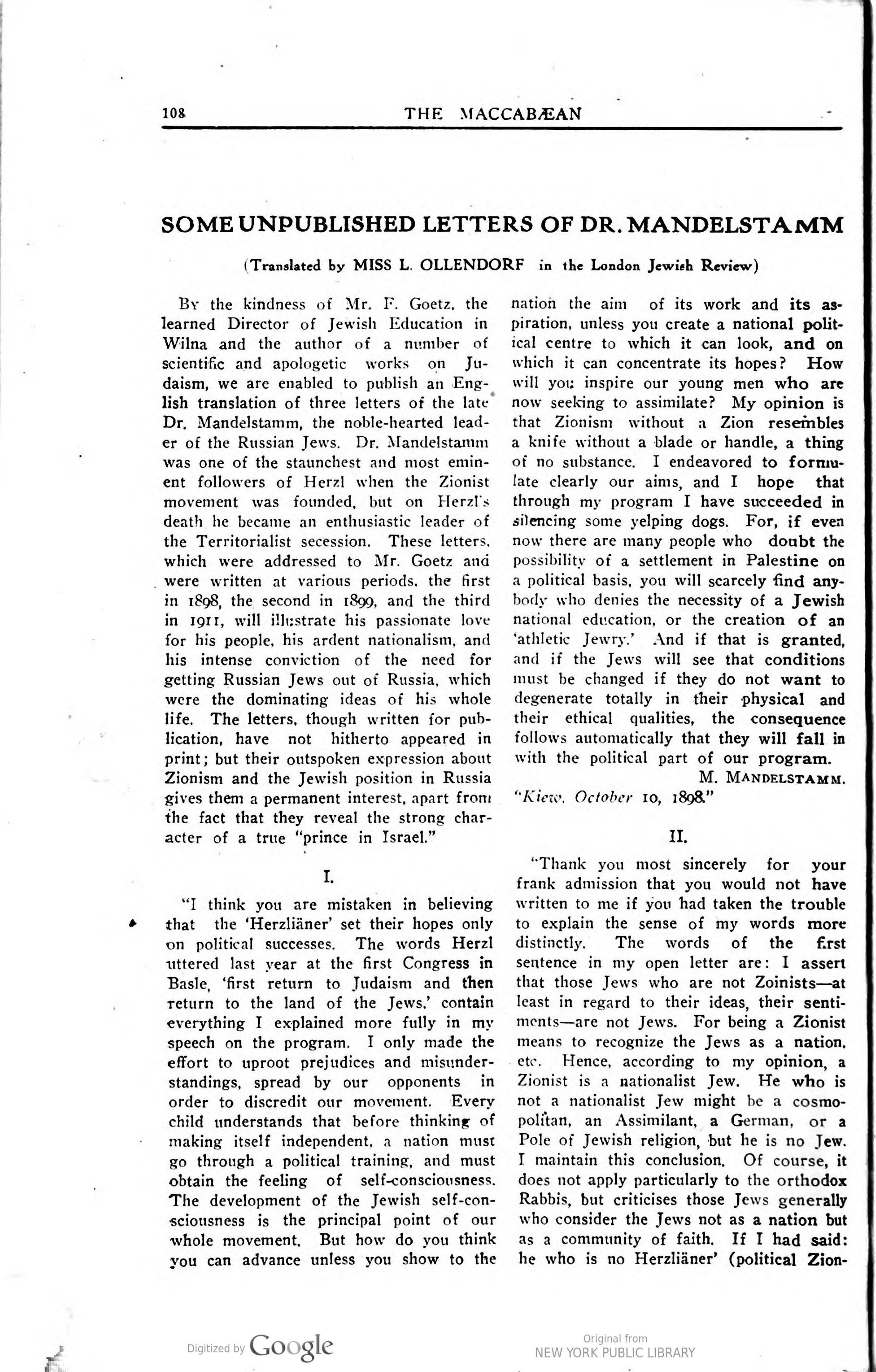
By the kindness of Mr. F. Goetz, the learned Director of Jewish Education in Wilna and the author of a number of scientific and apologetic works on Judaism, we are enabled to publish an English translation of three letters of the late Dr. Mandelstamm, the noble-hearted leader of the Russian Jews. Dr. Mandelstamm was one of the staunchest and most eminent followers of Herzl when the Zionist movement was founded, but on Herzl's death he became an enthusiastic leader of the Territorialist secession. These letters, which were addressed to Mr. Goetz and were written at various periods, the first in 1898, the second in 1899, and the third in 1911, will illustrate his passionate love for his people, his ardent nationalism, and his intense conviction of the need for getting Russian Jews out of Russia, which were the dominating ideas of his whole life. The letters, though written for publication, have not hitherto appeared in print; but their outspoken expression about Zionism and the Jewish position in Russia gives them a permanent interest, apart from the fact that they reveal the strong character of a true "prince in Israel."
I.
"I think you are mistaken in believing that the 'Herzliäner' set their hopes only on political successes. The words Herzl uttered last year at the first Congress in Basle, 'first return to Judaism and then return to the land of the Jews,' contain everything I explained more fully in my speech on the program. I only made the effort to uproot prejudices and misunderstandings, spread by our opponents in order to discredit our movement. Every child understands that before thinking of making itself independent, a nation must go through a political training, and must obtain the feeling of self-consciousness. The development of the Jewish self-consciousness is the principal point of our whole movement. But how do you think you can advance unless you show to the
nation the aim of its work and its aspiration, unless you create a national political centre to which it can look, and on which it can concentrate its hopes? How will you inspire our young men who are now seeking to assimilate? My opinion is that Zionism without a Zion resembles a knife without a blade or handle, a thing of no substance. I endeavored to formulate clearly our aims, and I hope that through my program I have succeeded in silencing some yelping dogs. For, if even now there are many people who doubt the possibility of a settlement in Palestine on a political basis, you will scarcely find anybody who denies the necessity of a Jewish national education, or the creation of an 'athletic Jewry.' And if that is granted, and if the Jews will see that conditions must be changed if they do not want to degenerate totally in their physical and their ethical qualities, the consequence follows automatically that they will fall in with the political part of our program.
M. MANDELSTAMM.
"Kiew, October 10, 1898."
II.
"Thank you most sincerely for your frank admission that you would not have written to me if you had taken the trouble to explain the sense of my words more distinctly. The words of the first sentence in my open letter are: I assert that those Jews who are not Zionists—at least in regard to their ideas, their sentiments—are not Jews. For being a Zionist means to recognize the Jews as a nation, etc. Hence, according to my opinion, a Zionist is a nationalist Jew. He who is not a nationalist Jew might be a cosmopolitan, an Assimilant, a German, or a Pole of Jewish religion, but he is no Jew. I maintain this conclusion. Of course, it does not apply particularly to the orthodox Rabbis, but criticises those Jews generally who consider the Jews not as a nation but as a community of faith. If I had said: he who is no Herzliäner' (political Zion-