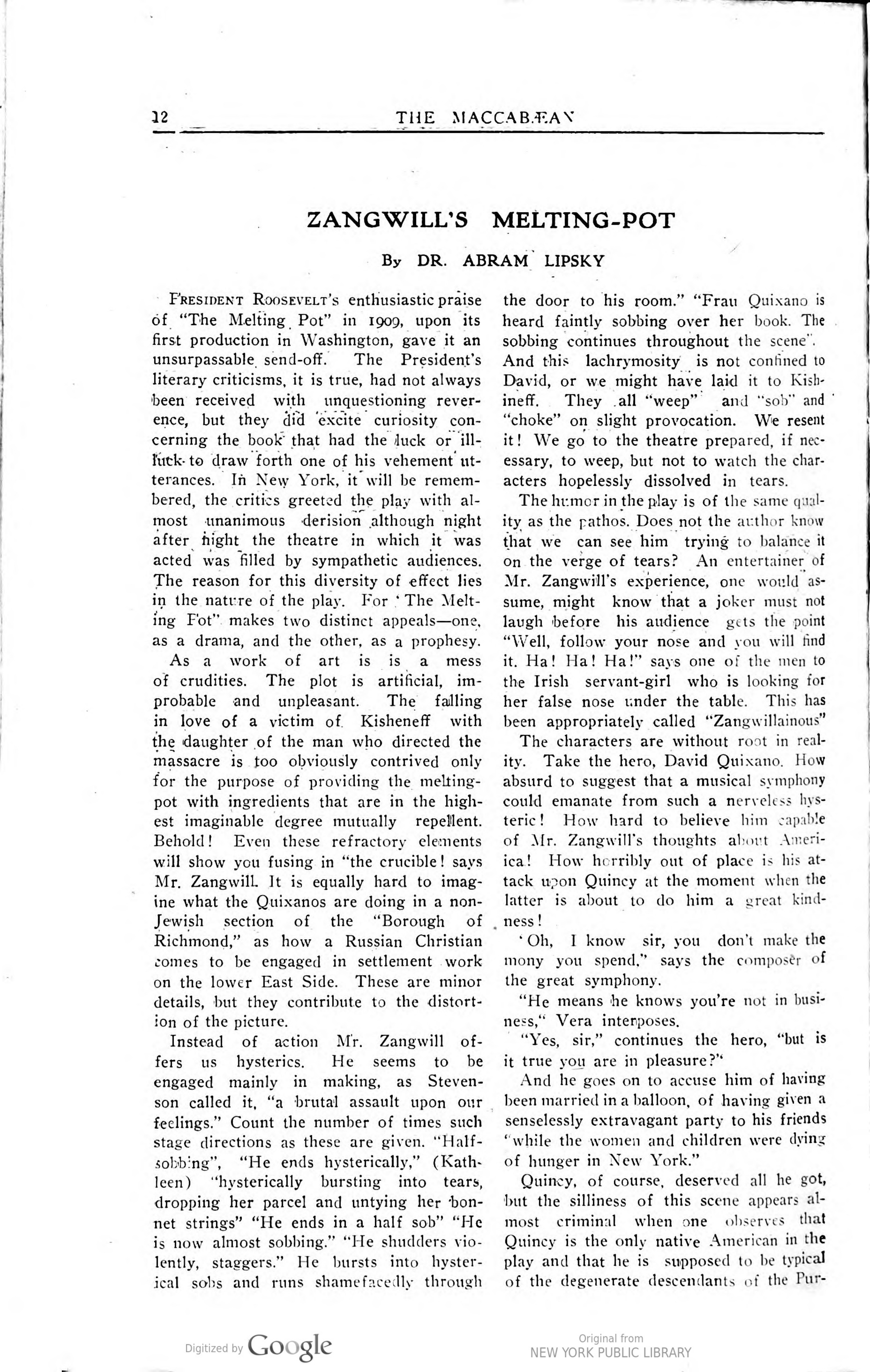
ZANGWILL'S MELTING-POT
PRESIDENT ROOSEVELT'S enthusiastic praise of "The Melting Pot" in 1909, upon its first production in Washington, gave it an unsurpassable send-off. The President's literary criticisms, it is true, had not always been received with unquestioning reverence, but they did excite curiosity concerning the book that had the luck or ill-luck to draw forth one of his vehement utterances. In New York, it will be remembered, the critics greeted the play with almost unanimous derision although night after night the theatre in which it was acted was filled by sympathetic audiences. The reason for this diversity of effect lies in the nature of the play. For 'The Melting Pot' makes two distinct appeals—one, as a drama, and the other, as a prophesy.
As a work of art is is a mess of cerudities. The plot is artificial, improbable and unpleasant. The falling in love of a vietim of. Kisheneff with the daughter of the man who directed the massacre is too obviously contrived only for the purpose of providing the melting-pot with ingredients that are in the highest imaginable degree mutually repellent. Behold! Even these refractory elements will show you fusing in “the crucible! says Mr. Zangwill. It is equally hard to imagine what the Quixanos are doing in a non-Jewish section of the “Borough of Richmond,” as how a Russian Christian comes to be engaged in settlement ‚work on the lower East Side. These are minor details, but they contribute to the distortion of the picture.
Instead of action Mr. Zangwill offers us hysterics. He seems to be engaged mainly in making, as Stevenson called it, “a brutal assault upon our feelings.” Count the number of times such stage directions as these are given. "Half-sobb'ng”, “He ends hysterically,” (Kathleen) ‘hysterically bursting into tears, dropping her parcel and untying her 'bonnet strings” “He ends in a half sob” “He is now almost sobbing.” “He shudders violently, staggers.” He bursts into hysterical sobs and runs shamefacedly through
the door to his room." "Frau Quixano is heard faintly sobbing over her book. The sobbing continues throughout the scene". And this lachrymosity is not confined to David, or we might have laid it to Kishineff. They all "weep" and "sob" and "choke" on slight provocation. We resent it! We go to the theatre prepared, if necessary, to weep, but not to watch the characters hopelessly dissolved in tears.
The humor in the play is of the same quality as the pathos. Does not the author know that we can see him trying to balance it on the verge of tears? An entertainer of Mr. Zangwill's experience, one would assume, might know that a joker must not laugh before his audience gets the point "Well, follow your nose and you will find it. Ha! Ha! Ha!" says one of the men to the Irish servant-girl who is looking for her false nose under the table. This has been appropriately called "Zangwillainous"
The characters are without root in reality. Take the hero, David Quixano. How absurd to suggest that a musical symphony could emanate from such a nerveless hysteric! How hard to believe him zapable of Mr. Zangwill's thoughts about Ameri- ica! How horribly out of place is his attack u>on Quincey at the moment when the latter is about to do him a great kindness!
'Oh, I know sir, you don't make the mony you spend," says the composer of the great symphony.
"He means he knows you're not in business," Vera interposes.
"Yes, sir," continues the hero, "but is it true you are in pleasure?"
And he goes on to accuse him of having been married in a balloon, of having given a senselessly extravagant party to his friends "while the women and children were dying of hunger in New York."
Quincy, of course, deserved all he got, but the silliness of this scene appears almost criminal when one observes that Quincy is the only native American in the play and that he is supposed to be typical of the degenerate descendants of the Pur-