THE RESULTS OF THE ELEVENTH CONGRESS
I.
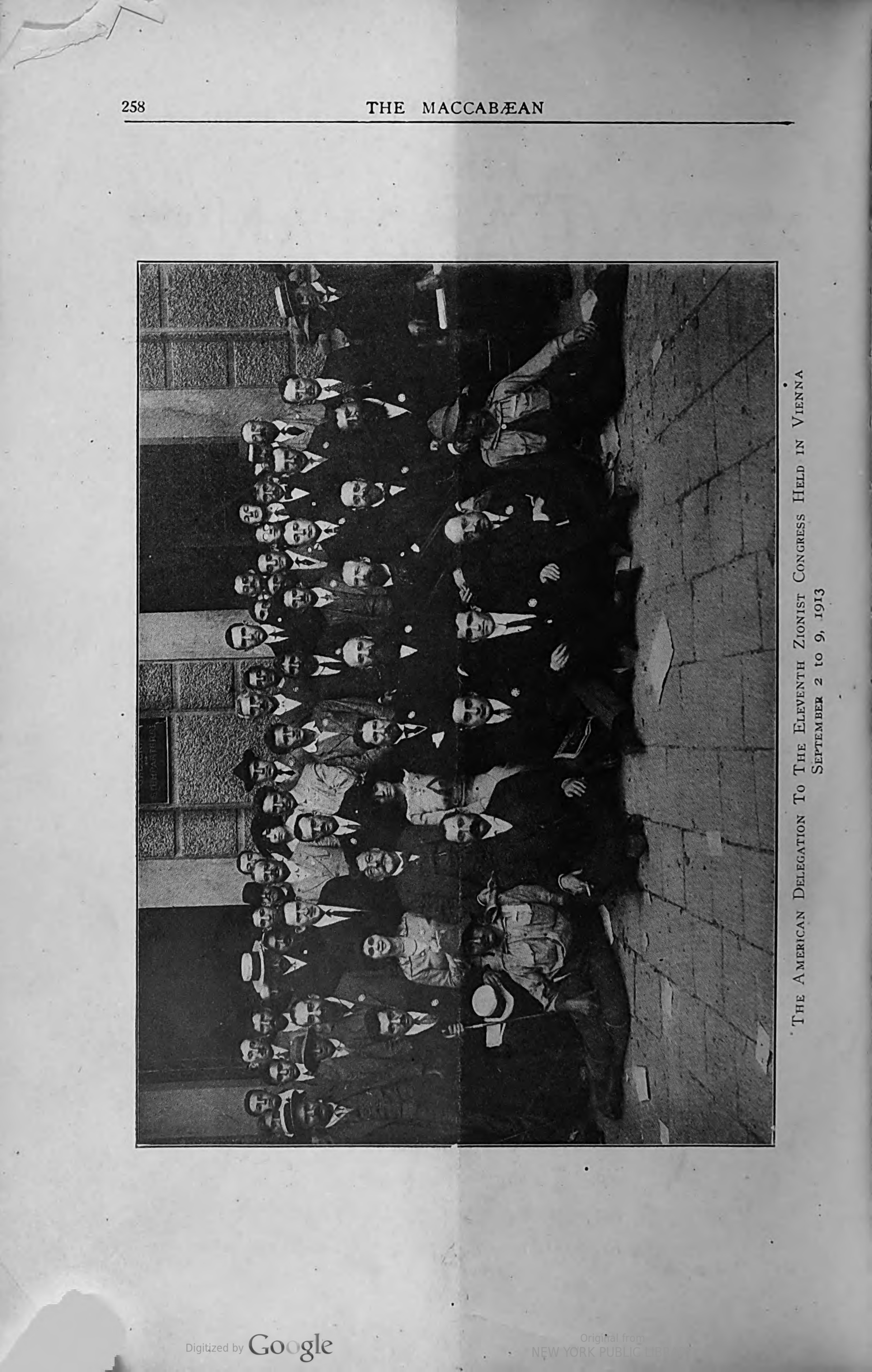
Our Congresses have all been, to a large extent, demonstrations. The First was the declaration of an awakened determination of a large element of the Jewish people to renew, on a large scale, on the world stage, the national life of the Jews, which had been held in check for centuries. The Eleventh Congress was a demonstration of the remarkable progress made by that race conscious group.
All that precedes the Vienna Congress may be regarded as preliminary, experimental, as, in a large measure, the record of the struggle of the national ideal to obtain place for itself. The work. ot organization went hand in hand with the “political” activity of the first leader; the organization was fed by that activity, which, in turn, received its stimulus from the re sponsiveness of the masses to thc Zionist appeal. Palestine lay in the distance, as yet unrelated to the plans of the organization; it was, in effect, merely an incident in the theoretical bases of the Zionist phit- osophy.
When the revolution in Turkey displaced the autocratic government, it also forced a change in Zionist policy. This change involved not only the abandonment of the Herzlian method, but compelled a new attitude toward Palestine. In Herzl’s day our national claims were to be laid before an ın- ternational court, where Turkey was to be summoned as An interested party; the conscience of the world, as it were, was to be summoned to the bar. to answer: our complaints. After the ' revolution, the Zionist movement had to deal with the Ottoman government .as
the master of the land we hoped to conquer. The issue was precipitated into Palestine, where it belonged, and the circle of interest was limited, as far as it could be limited, to the power controlling the destiny of the Land of Promise. The movement became more real. You could not deal with a government for the possession of a territory without having a visible and material stake in it. Palestine work thus became an inevitable requirement; Zionism could not continue without it. How this work was to be prosecuted—whether by individuals or by the organization; on a large scale or in a desultory fashion—that was not the point. Jewish influence had to pour into the land. Zionism could not remain at the port of Jaffa. It had to put its foot on the soil, whatever the hazard, and justify its claims to the land.
There are many who deplore this illogical. turn of affairs. Inasmuch as Zionism was to be the solution of the national problem of the Jews, the acquisition of political corpor- eality was of the essence of the first step. The idea was not to enter the land until this recognition had been obtained; we were not to put ourselves at the mercy of another government and entering in calm weather take the risk of a squall breaking at any moment, to find ourselves again in Golus. But there are forces in life that mock formal logic. After having rejected Uganda, our national polity would have become burlesque if we 'had not cast precaution to the winds, and plunged into Palestine with all its legal discolorations.
At any rate, without going into this point much further—after all, it is irrelevant here—colonization