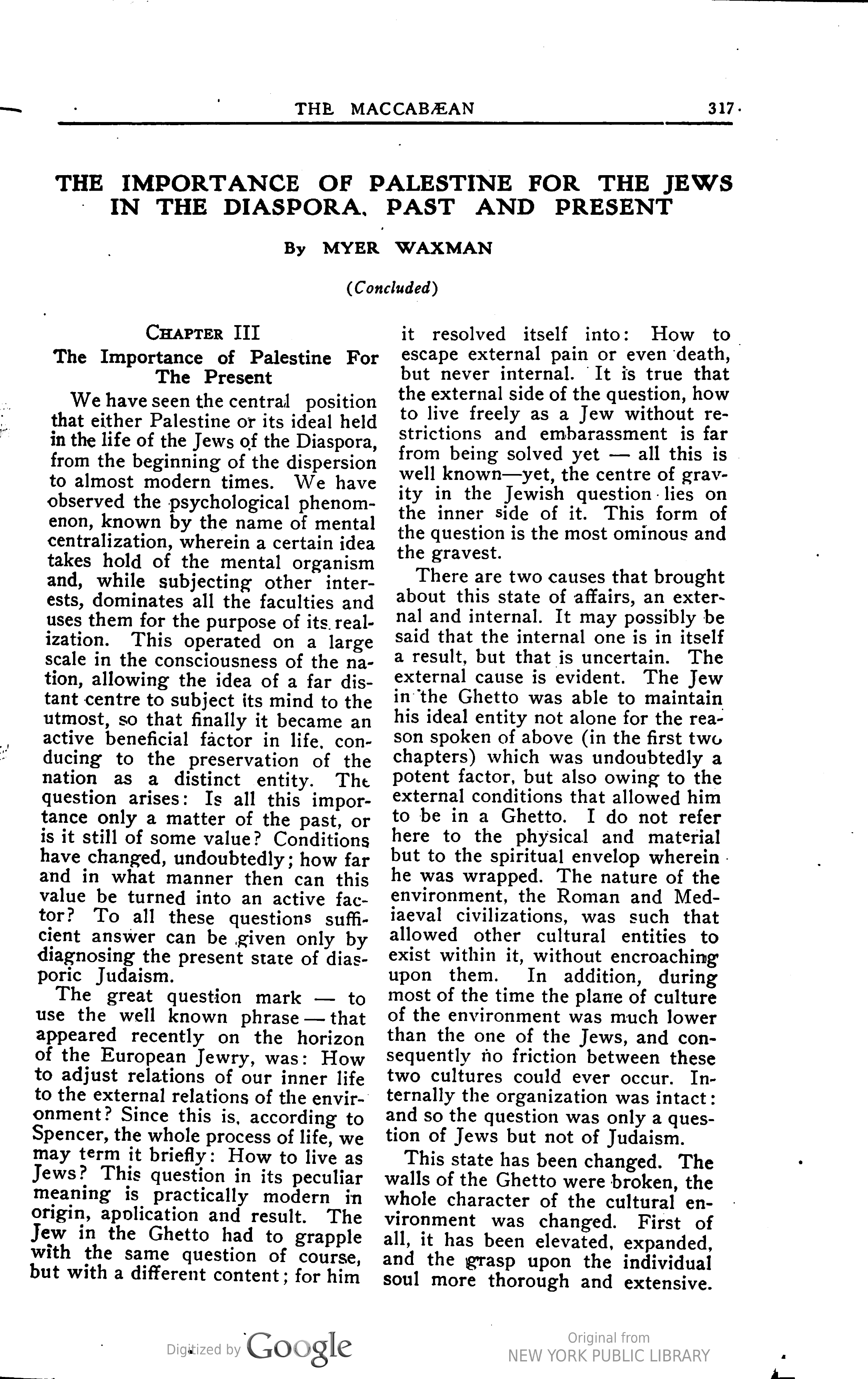
THE IMPORTANCE OF PALESTINE FOR THE JEWSIN THE DIASPORA. PAST AND PRESENT
CHAPTER III
The Importance of Palestine For The Present
We have seen the central position that either Palestine or its ideal held in the life of the Jews of the Diaspora, from the beginning of the dispersion to almost modern times. We have observed the psychological phenomenon, known by the name of mental centralization, wherein a certain idea takes hold of the mental organism and, while subjecting other interests, dominates all the faculties and uses them for the purpose of its realization. This operated on a large scale in the consciousness of the nation, allowing the idea of a far distant centre to subject its mind to the utmost, so that finally it became an active beneficial factor in life, con- ducing to the preservation of the nation as a distinct entity. The question arises: Is all this importance only a matter of the past, or is it still of some value? Conditions have changed, undoubtedly; how far and in what manner then can this value be turned into an an active factor? To all these questions sufficient answer can be given only by diagnosing the present state of diasporic Judaism.
The great question mark — to use the well known phrase — that appeared recently on the horizon of the European Jewry, was: How to adjust relations of our inner life to the external relations of the environment? Since this is, according to Spencer, the whole process of life, we may term it briefly: How to live as Jews? This question in its peculiar meaning is practically modern in origin, apolication and result. The Jew in the Ghetto had to grapple with the same question of course, but with a different content; for him
(Concluded)
it resolved itself into: How to escape external pain or even death, but never internal. It is true that the external side of the question, how to live freely as a Jew without restrictions and embarassment is far from being solved yet — all this is well known—.yet, the centre of gravity in the Jewish question lies on the inner side of it. This form of the question is the most ominous and the gravest.
There are two causes that brought about this state of affairs, an external and internal. It may possibly be said that the internal one is in itself a result, but that is uncertain. The external cause is evident. The Jew in“the Ghetto was able to maintain his ideal entity not alone for the reason spoken of above (in the first two chapters) which was undoubtedly a potent factor, but also owing to the external conditions that allowed him to be in a Ghetto. I do not refer here to the physical and material but to the spiritual envelop wherein - he was wrapped. The nature of the environment, the Roman and Mediaeval civilizations, was such that allowed other cultural entities to exist within it, without encroaching upon them. In addition, during most of the time the plane of culture of the environment was much lower than the one of the Jews, and consequently no friction between these two cultures could ever occur. Internally the organization was intact: and so the question was only a question of Jews but not of Judaism.
This state has been changed. The walls of the Ghetto were broken, the whole character of the cultural environment was changed. First of all, it has been elevated, expanded, and the grasp upon the individual soul more thorough and extensive.