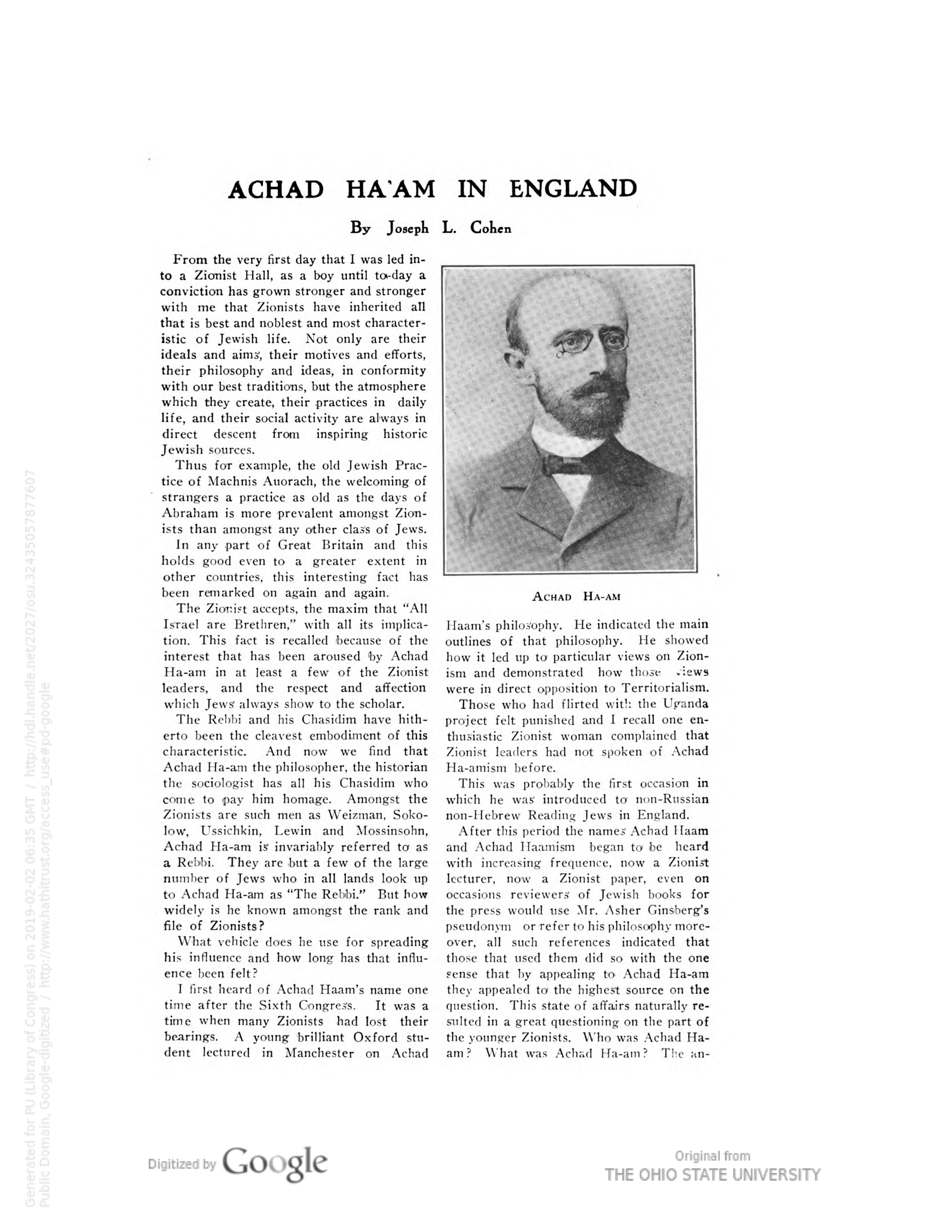
ACHAD HA’AM IN ENGLAND
From the very first day that I was led into a Zionist Hall, as a boy until to-day a conviction has grown stronger and stronger with me that Zionists have inherited all that is best and noblest and most characteristic of Jewish life. Not only are their ideals and aims, their motives and efforts, their philosophy and ideas, in conformity with our best traditions, but the atmosphere which they create, their practices in daily life, and their social activity are always in direct descent from inspiring historic Jewish sources.
Thus for example, the old Jewish Practice of Machnis Auorach, the welcoming of strangers a practice as old as the days of Abraham is more prevalent amongst Zionists than amongst any other class of Jews.
In any part of Great Britain and this holds good even to a greater extent in other countries, this interesting fact has been remarked on again and again.
The Zionist accepts, the maxim that "All Israel are Brethren," with all its implication. This fact is recalled because of the interest that has been aroused by Achad Ha-am in at least a few of the Zionist leaders, and the respect and affection which Jews always show to the scholar.
The Rebbi and his Chasidim have hitherto been the cleavest embodiment of this characteristic. And now we find that Achad Ha-am the philosopher, the historian the sociologist has all his Chasidim who come to pay him homage. Amongst the Zionists are such men as Weizman, Sokolow, Ussichkin, Lewin and Mossinsohn, Achad Ha-am is invariably referred to as a Rebbi. They are but a few of the large number of Jews who in all lands look up to Achad Ha-am as "The Rebbi." But how widely is he known amongst the rank and file of Zionists?
What vehicle does he use for spreading his influence and how long has that influence been felt?
I first heard of Achad Haam's name one time after the Sixth Congress. It was a time when many Zionists had lost their bearings. A young brilliant Oxford student lectured in Manchester on Achad
Haam's philosophy. He indicated the main outlines of that philosophy. He showed how it led up to particular views on Zionism and demonstrated how those views were in direct opposition to Territorialism.
Those who had flirted with the Uganda project felt punished and I recall one enthusiastic Zionist woman complained that Zionist leaders had not spoken of Achad Ha-amism before.
This was probably the first occasion in which he was introduced to non-Russian non-Hebrew Reading Jews in England.
After this period the names Achad Haam and Achad Haamism began to be heard with increasing frequence, now a Zionist lecturer, now a Zionist paper, even on occasions reviewers of Jewish books for the press would use Mr. Asher Ginsberg's pseudonym or refer to his philosophy moreover, all such references indicated that those that used them did so with the one sense that by appealing to Achad Ha-am they appealed to the highest source on the question. This state of affairs naturally resulted in a great questioning on the part of the younger Zionists. Who was Achad Ha-am? What was Achad Ha-am? The an-