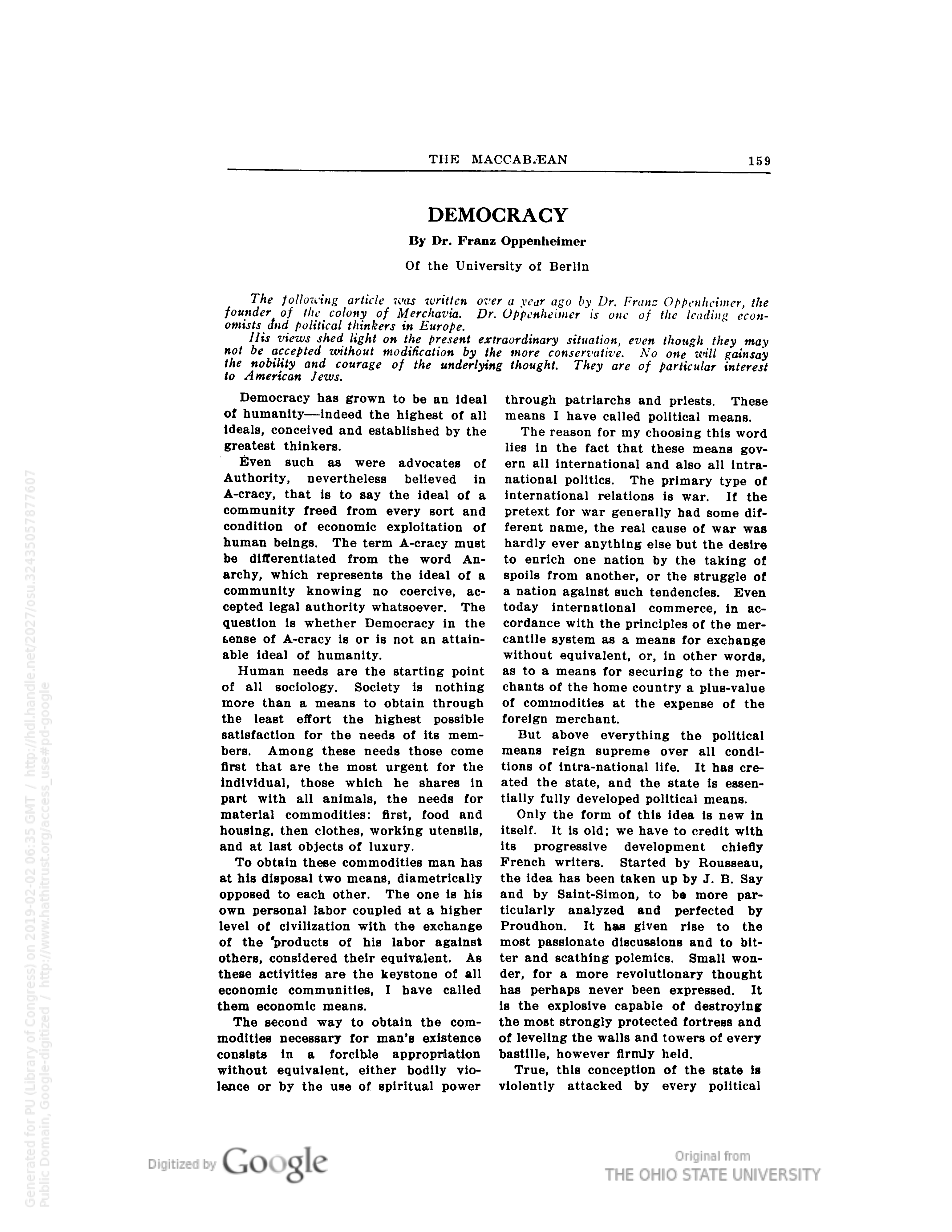
DEMOCRACY
The following article was written over a year ago by Dr. Franz Oppenheimer, the founder of the colony of Merchavia. Dr. Oppenheimer is one of the leading economists and political thinkers in Europe.
His views shed light on the present extraordinary situation, even though they may not be accepted without modification by the more conservative. No one will gainsay the nobility and courage of the underlying thought. They are of particular interest to American Jews.
Democracy has grown to be an ideal of humanity—indeed the highest of all ideals, conceived and established by the greatest thinkers.
Even such as were advocates of Authority, nevertheless believed in A-cracy, that is to say the ideal of a community freed from every sort and condition of economic exploitation of human beings. The term A-cracy must be differentiated from the word Anarchy, which represents the ideal of a community knowing no coercive, accepted legal authority whatsoever. The question is whether Democracy in the sense of A-cracy is or is not an attainable ideal of humanity.
Human needs are the starting point of all sociology. Society is nothing more than a means to obtain through the least effort the highest possible satisfaction for the needs of its members. Among these needs those come first that are the most urgent for the individual, those which he shares in part with all animals, the needs for material commodities: first, food and housing, then clothes, working utensils, and at last objects of luxury.
To obtain these commodities man has at his disposal two means, diametrically opposed to each other. The one is his own personal labor coupled at a higher level of civilization with the exchange of the products of his labor against others, considered their equivalent. As these activities are the keystone of all economic communities, I have called them economic means.
The second way to obtain the commodities necessary for man's existence consists in a forcible appropriation without equivalent, either bodily violence or by the use of spiritual power
through patriarchs and priests. These means I have called political means.
The reason for my choosing this word lies in the fact that these means govern all international and also all intranational politics. The primary type of international relations is war. If the pretext for war generally had some different name, the real cause of war was hardly ever anything else but the desire to enrich one nation by the taking of spoils from another, or the struggle of a nation against such tendencies. Even today international commerce, in accordance with the principles of the mercantile system as a means for exchange without equivalent, or, in other words, as to a means for securing to the merchants of the home country a plus-value of commodities at the expense of the foreign merchant.
But above everything the political means reign supreme over all conditions of intra-national life. It has created the state, and the state is essentially fully developed political means.
Only the form of this idea is new in itself. It is old; we have to credit with its progressive development chiefly French writers. Started by Rousseau, the idea has been taken up by J. B. Say and by Saint-Simon, to be more particularly analyzed and perfected by Proudhon. It has given rise to the most passionate discussions and to bitter and scathing polemics. Small wonder, for a more revolutionary thought has perhaps never been expressed. It is the explosive capable of destroying the most strongly protected fortress and of leveling the walls and towers of every bastille, however firmly held.
True, this conception of the state is violently attacked by every political