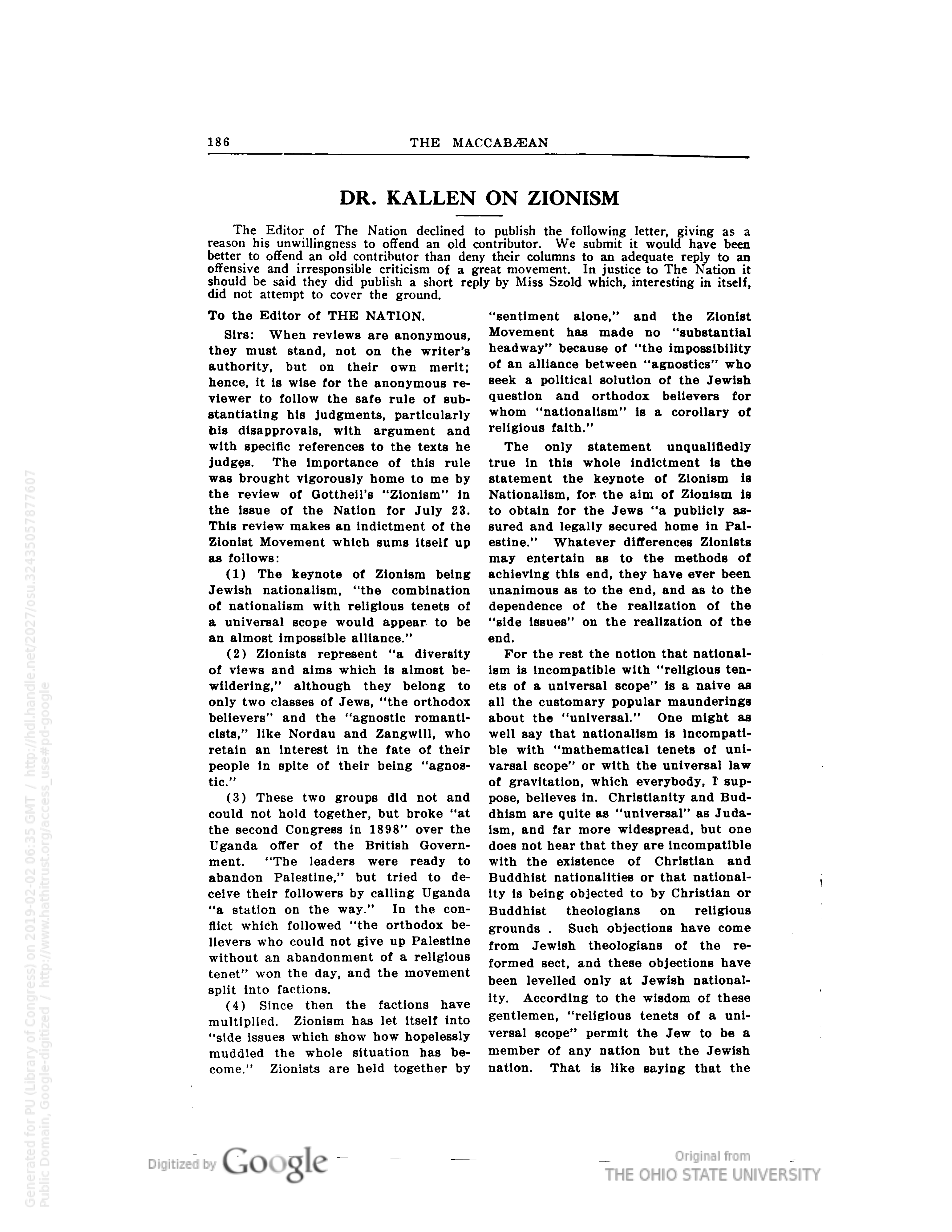
DR. KALLEN ON ZIONISM
The Editor of The Nation declined to publish the following letter, giving as a reason his unwillingness to offend an old contributor. We submit it would have been better to offend an old contributor than deny their columns to an adequate reply to an offensive and irresponsible criticism of a great movement. In justice to The Nation it should be said they did publish a short reply by Miss Szold which, interesting in itself, did not attempt to cover the ground.
Sirs: When reviews are anonymous, they must stand, not on the writer's authority, but on their own merit; hence, it is wise for the anonymous reviewer to follow the safe rule of substantiating his judgments, particularly his disapprovals, with argument and with specific references to the texts he judges. The importance of this rule was brought vigorously home to me by the review of Gottheil's "Zionism" in the issue of the Nation for July 23. This review makes an indictment of the Zionist Movement which sums itself up as follows:
(1) The keynote of Zionism being Jewish nationalism, "the combination of nationalism with religious tenets of a universal scope would appear to be an almost impossible alliance."
(2) Zionists represent "a diversity of views and aims which is almost bewildering," although they belong to only two classes of Jews, "the orthodox believers" and the "agnostic romanticists," like Nordau and Zangwill, who retain an interest in the fate of their people in spite of their being "agnostic."
(3) These two groups did not and could not hold together, but broke "at the second Congress in 1898" over the Uganda offer of the British Government. "The leaders were ready to abandon Palestine," but tried to deceive their followers by calling Uganda "a station on the way." In the conflict which followed "the orthodox believers who could not give up Palestine without an abandonment of a religious tenet" won the day, and the movement split into factions.
(4) Since then the factions have multiplied. Zionism has let itself into "side issues which show how hopelessly muddled the whole situation has become." Zionists are held together by
"sentiment alone," and the Zionist Movement has made no "substantial headway" because of "the impossibility of an alliance between "agnostics" who seek a political solution of the Jewish question and orthodox believers for whom "nationalism" is a corollary of religious faith."
The only statement unqualifiedly true in this whole indictment is the statement the keynote of Zionism is Nationalism, for the aim of Zionism is to obtain for the Jews "a publicly assured and legally secured home in Palestine." Whatever differences Zionists may entertain as to the methods of achieving this end, they have ever been unanimous as to the end, and as to the dependence of the realization of the "side issues" on the realization of the end.
For the rest the notion that nationalism is incompatible with "religious tenets of a universal scope" is a naive as all the customary popular maunderings about the "universal." One might as well say that nationalism is incompatible with "mathematical tenets of universal scope" or with the universal law of gravitation, which everybody, I suppose, believes in. Christianity and Buddhism are quite as "universal" as Judaism and far more widespread, but one does not hear that they are incompatible with the existence of Christian and Buddhist nationalities or that nationalism is being objected to by Christian or Buddhist theologians on religious grounds. Such objections have come from Jewish theologians of the reformed sect, and these objections have been levelled only at Jewish nationality. According to the wisdom of these gentlemen, "religious tenets of a universal scope" permit the Jew to be a member of any nation but the Jewish nation. That is like saying that the