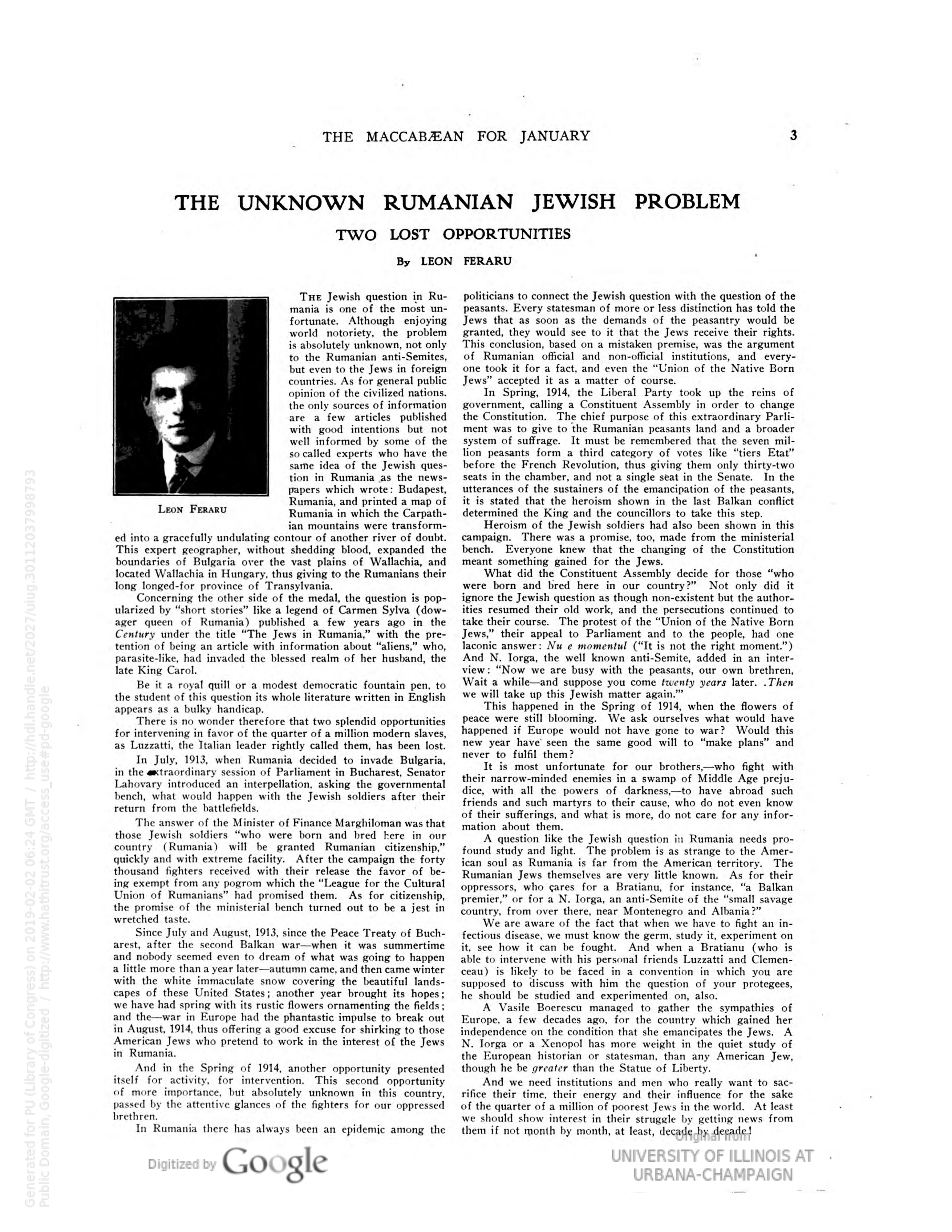
THE UNKNOWN RUMANIAN JEWISH PROBLEM
TWO LOST OPPORTUNITIES
THE Jewish question in Rumania is one of the most unfortunate. Although enjoying world notoriety, the problem is absolutely unknown, not only to the Rumanian anti-Semites, but even to the Jews in foreign countries. As for general public opinion of the civilized nations. the only sources of information are a few articles published with good intentions but not well informed by some of the so called experts who have the same idea of the Jewish question in Rumania as the newspapers which wrote: Budapest, Rumania, and printed a map of Rumania in which the Carpathian mountains were transform-
ed into a gracefully undulating contour of another river of doubt. This expert geographer, without shedding blood, expanded the boundaries of Bulgaria over the vast plains of Wallachia, and located Wallachia in Hungary, thus giving to the Rumanians their long longed-for province of Transylvania.
Concerning the other side of the medal, the question is popularized by “short stories” like a legend of Carmen Sylva (dow- ager queen of Rumania) published a few years ago in the Century under the title “The Jews in Rumania,” with the pretention of being an article with information about “aliens,” who, parasite-like, had invaded the blessed realm of her husband, the late King Carol.
Be it a royal quill or a modest democratic fountain pen, to the student of this question its whole literature written in English appears as a bulky handicap.
There is no wonder therefore that two splendid opportunities for intervening in favor of the quarter of a million modern slaves, as Luzzatti, the Italian leader rightly called them, has been lost.
In July, 1913, when Rumania decided to invade Bulgaria, in the extraordinary session of Parliament in Bucharest, Senator Lahovary introduced an interpellation, asking the governmental bench, what would happen with the Jewish soldiers after their return from the battlefields.
The answer of the Minister of Finance Marghiloman was that those Jewish soldiers “who were born and bred tere in our country (Rumania) will be granted Rumanian_ citizenship,” quickly and with extreme facility. After the campaign the forty thousand fighters received with their release the favor of being exempt from any pogrom which the “League for the Cultural Union of Rumanians” had promised them. As for citizenship, the promise of the ministerial bench turned out to be a jest in wretched taste.
Since July and August, 1913, since the Peace Treaty of Bucharest, after the second Balkan war— when it was summertime and nobody seemed even to dream of what was going to happen a little more thana year later—autumn came, and then came winter with the white immaculate snow covering the beautiful landscapes of these United States; another year brought its hopes; we have had spring with its rustic flowers ornamenting the fields; and the—war in Europe had the phantastic impulse to break out in August, 1914, thus offering a good excuse for shirking to those American Jews who pretend to work in the interest of the Jews in Rumania.
And in the Spring of 1914, another opportunity presented itself for activity, for intervention. This second opportunity of more importance, but absolutely unknown in this country, passed by the attentive glances of the fighters for our oppressed hrethren.
In Rumania there has always been an epidemic among the
politicians to connect the Jewish question with the question of the peasants. Every statesman of more or less distinction has told the Jews that as soon as the demands of the peasantry would be granted, they would see to it that the Jews receive their rights. This conclusion, based on a mistaken premise, was the argument of Rumanian official and non-official institutions, and everyone took it for a fact, and even the "Union of the Native Born Jews" accepted it as a matter of course.
In Spring, 1914, the Liberal Party took up the reins of government, calling a Constituent Assembly in order to change the Constitution. The chief purpose of this extraordinary Parliment was to give to the Rumanian peasants land and a broader system of suffrage. It must be remembered that the seven million peasants form a third category of votes like “tiers Etat” before the French Revolution, thus giving them only thirty-two seats in the chamber, and not a single seat in the Senate. In the utterances of the sustainers of the emancipation of the peasants, it is stated that the heroism shown in the last Balkan conflict determined the King and the councillors to take this step.
Heroism of the Jewish soldiers had also been shown in this campaign. There was a promise, too, made from the ministerial bench. Everyone knew that the changing of the Constitution meant something gained for the Jews.
What did the Constituent Assembly decide for those "who were born and bred here in our country?" Not only did it ignore the Jewish question as though non-existent but the authorities resumed their old work, and the persecutions continued to take their course. The old protest of the "Union of the Native Born Jews," their appeal to Parliament and to the people, had one laconic answer: Nu e momentul ("It is not the right moment.") And N. Iorga, the well known anti-Semite, added in an interview: "Now we are busy with the peasants, our own brethren, Wait a while and suppose you come twenty years later. .Then we will take up this Jewish matter again.""
This happened in the Spring of 1914, when the flowers of peace were still blooming. We ask ourselves what would have happened if Europe would not have gone to war? Would this new year have seen the same good will to "make plans" and never to fulfil them?
It is most unfortunate for our brothers,—who fight with their narrow-minded enemies in a swamp of Middle Age prejudice, with all the powers of darkness,—to have abroad such friends and such martyrs to their cause, who do not even know of their sufferings, and what is more, do not care for any information about them.
A question like the Jewish question in Rumania needs profound study and light. The problem is as strange to the American soul as Rumania is far from the American territory. The Rumanian Jews themselves are very little known. As for their oppressors, who gares for a Bratianu, for instance, “a Balkan premier,” or for aN. lorga, an anti-Semite of the “small savage country, from over there, near Montenegro and Albania ?”
We are aware of the fact that when we have to fight an infectious disease, we must know the germ, study it, experiment on it, see how it can be found. And when a Bratianu (who is able to intervene with his personal friends Luzzatti and Clemenceau) is likely to be faced in a convention in which you are supposed to discuss with him the question of your protegees, he should be studied and experimented on, also.
A Vasile Boerescu managed to gather the sympathies of Europe, a few decades ago, for the country which gained her independence on the condition that she emancipates the Jews. A N. Iorga or a Xenopol has more weight in the quiet study of the European historian or statesman, than any American Jew, though he be greater than the Statue of Liberty.
And we need institutions and men who really want to sacrifice their time, their energy and their influence for the sake of the quarter of a million of poorest Jews in the world. At least we should show interest in their struggle by getting news from them if not month by month, at least, decade by decade!