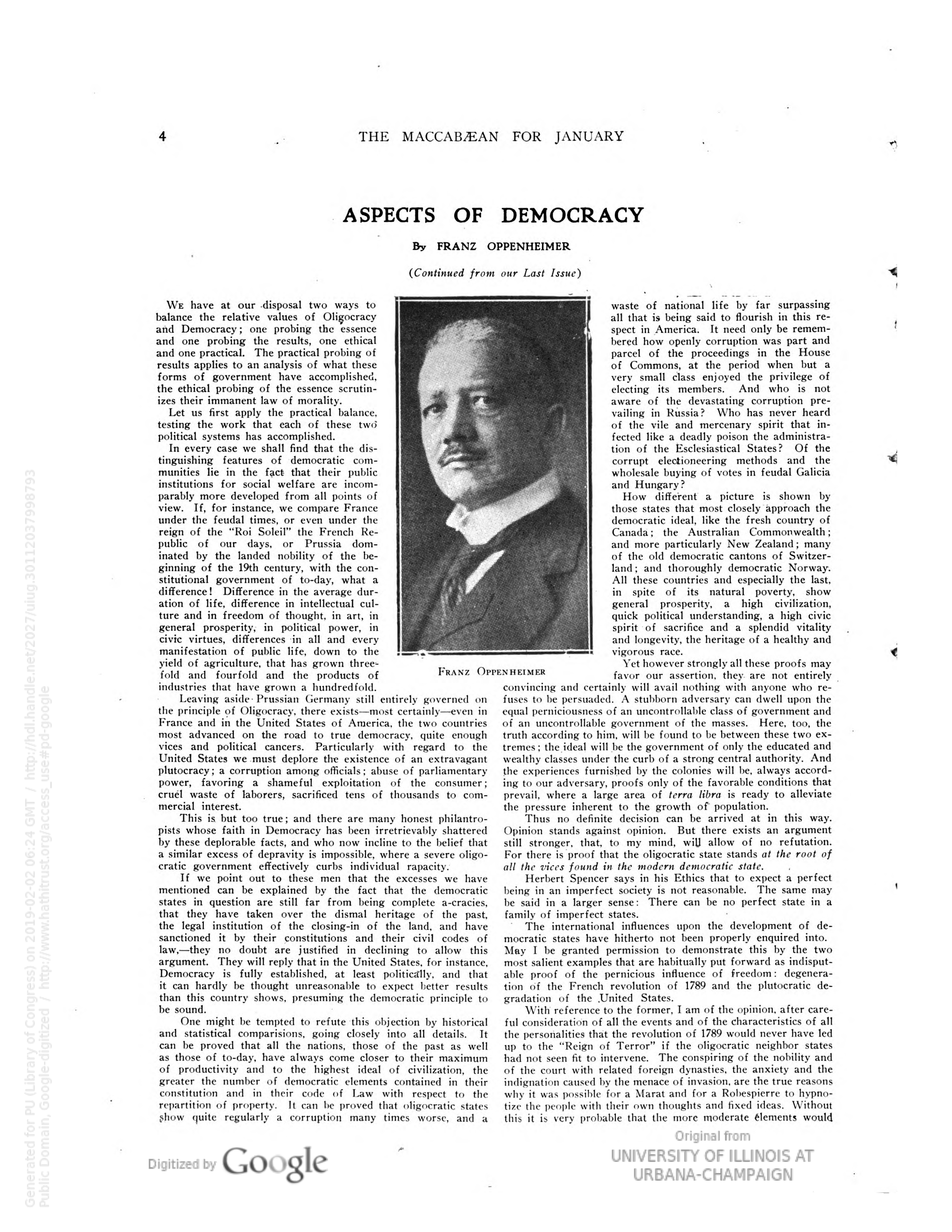
ASPECTS OF DEMOCRACY
We have at our disposal two ways to balance the relative values of Oligocracy and Democracy; one probing the essence and one probing the results, one ethical and one practical. The practical probing of results applies to an analysis of what these forms of government have accomplished, the ethical probing of the essence scrutinizes their immanent law of morality.
Let us first apply the practical balance, testing the work that each of these two political systems has accomplished.
In every case we shall find that the distinguishing features of democratic communities lie in the fact that their public institutions for social welfare are incomparably more developed from all points of view. If, for instance, we compare France under the feudal times, or even under the reign of the “Roi Soleil” the French Republic of our days, or Prussia dominated by the landed nobility of the beginning of the 19th century, with the constitutional government of to-day, what a difference! Difference in the average duration of life, difference in intellectual culture and in freedom of thought, in art, in general prosperity, in political power, in civic virtues, differences in all and every manifestation of public life, down to the yield of agriculture, that has grown threefold and fourfold and the products of industries that have grown a hundredfold.
Leaving aside Prussian Germany still entirely governed on the principle of Oligocracy, there exists—most certainly—even in France and in the United States of America, the two countries most advanced on the road to true democracy, quite enough vices and political cancers. Particularly with regard to the United States we must deplore the existence of an extravagant plutocracy; a corruption among officials; abuse of parliamentary power, favoring a shameful exploitation of the consumer; cruel waste of laborers, sacrificed tens of thousands to commercial interest.
This is but too true; and there are many honest philantro- pists whose faith in Democracy has been irretrievably shattered by these deplorable facts, and who now incline to the belief that a similar excess of depravity is impossible, where a severe oligocratic government effectively curbs individual rapacitv.
If we point out to these men that the excesses we have mentioned can be explained by the fact that the democratic states in question are still far from being complete a-cracies, that they have taken over the dismal heritage of the past, the legal institution of the closing-in of the land, and have sanctioned it by their constitutions and their civil codes of law,—they no doubt are justified in declining to allow this argument. They will reply that in the United States, for instance, Democracy is fully established, at least politically, and that it can hardly be thought unreasonable to expect better results than this country shows, presuming the democratic principle to be sound.
One might be tempted to refute this objection by historical and statistical comparisons, going closely into all details. It can be proved that all the nations, those of the past as well as those of to-day, have always come closer to their maximum of productivity and to the highest ideal of civilization, the greater the number of democratic elements contained in their constitution and in their code of Law with respect to the repartition of property. It can be proved that oligocratic states show quite regularly a corruption many times worse, and a
(Continued from our Last Issue)
waste of national life by far surpassing all that is being said to flourish in this respect in America. It need only be remembered how openly corruption was part and parcel of the proceedings in the House of Commons, at the period when but a very small class enjoyed the privilege of electing its members. And who is not aware of the devastating corruption prevailing in Russia? Who has never heard of the vile and mercenary spirit that infected like a deadly poison the administration of the Esclesiastical States? Of the corrupt electioneering methods and the wholesale buying of votes in feudal Galicia and Hungary?
How different a picture is shown by those states that most closely approach the democratic ideal, like the fresh country of Canada; the Australian Commonwealth; and more particularly New Zealand; many of the old democratic cantons of Switzerland; and thoroughly democratic Norway. All these countries and especially the last, in spite of its natural poverty, show general prosperity, a high _ civilization, quick political understanding, a high civic spirit of sacrifice and a splendid vitality and longevity, the heritage of a healthy and vigorous race.
Yet however strongly all these proofs may favor our assertion, they are not entirely convincing and certainly will avail nothing with anyone who refuses to be persuaded. A stubborn adversary can dwell upon the equal uncontrollable class of government and government of the masses. Here, too, the truth, will be found to be between these two extremes; the ideal will be the government of only the educated and wealthy classes under the curb of a strong central authority. And the experiences furnished by the colonies will be, always according to our adversary, proofs only of the favorable conditions that prevail, where a large area of terra libra is ready to alleviate the pressure inherent to the growth of population.
be en Ge A rn Dt rt ee - ee ee Fe Tat ee te Thus no definite decision can be arrived at in this way. Opinion stands against opinion. But there exists an argument still stronger, that, to my mind, will allow of no refutation. For there is proof that the oligocratic state stands at the root of all the vices found in the modern democratic state. 2
Herbert Spencer says in his Ethics that to expect a perfect being in an imperfect society is not reasonable. The same may be said in a larger sense: There can be no perfect state in a family of imperfect states.
The international influences upon the development of democratic states have hitherto not been properly enquired into. May I be granted permission to demonstrate this by the two most salient examples that are habitually put forward as indisputable proof of the pernicious influence of freedom: degeneration of the French revolution of 1789 and the plutocratic degradation of the United States.
With reference to the former, I am of the opinion, after careful consideration of all the events and of the characteristics of all the personalities that the revolution of 1789 would never have led up to the "Reign of Terror" if the oligocratic neighbor states had not seen fit to intervene. The conspiring of the nobility and of the court with related foreign dynasties, the anxiety and the indignation caused by the menace of invasion, are the true reasons why it was possible for a Marat and for a Robespierre to hypnotize the people with their own thoughts and fixed ideas. Without this it is very probable that the more moderate elements would