THE MACCABAEAN
JERUSALEM AND THE EUROPEAN WAR
This article was written before Turkey declared war against England and Russia. It give in a vivid descriptive manner the effects of war conditions on nationalities living in Jerusalem. The exodus of several thousand Jews of the old Yishub to Alexandria followed Turkey's declaration of war. Miss Cohen lived for one year in New York, where she was engaged in newspaper work. She was subsequently in the Action Comite's offices, and later went to Palestine in connection with Zionist work.
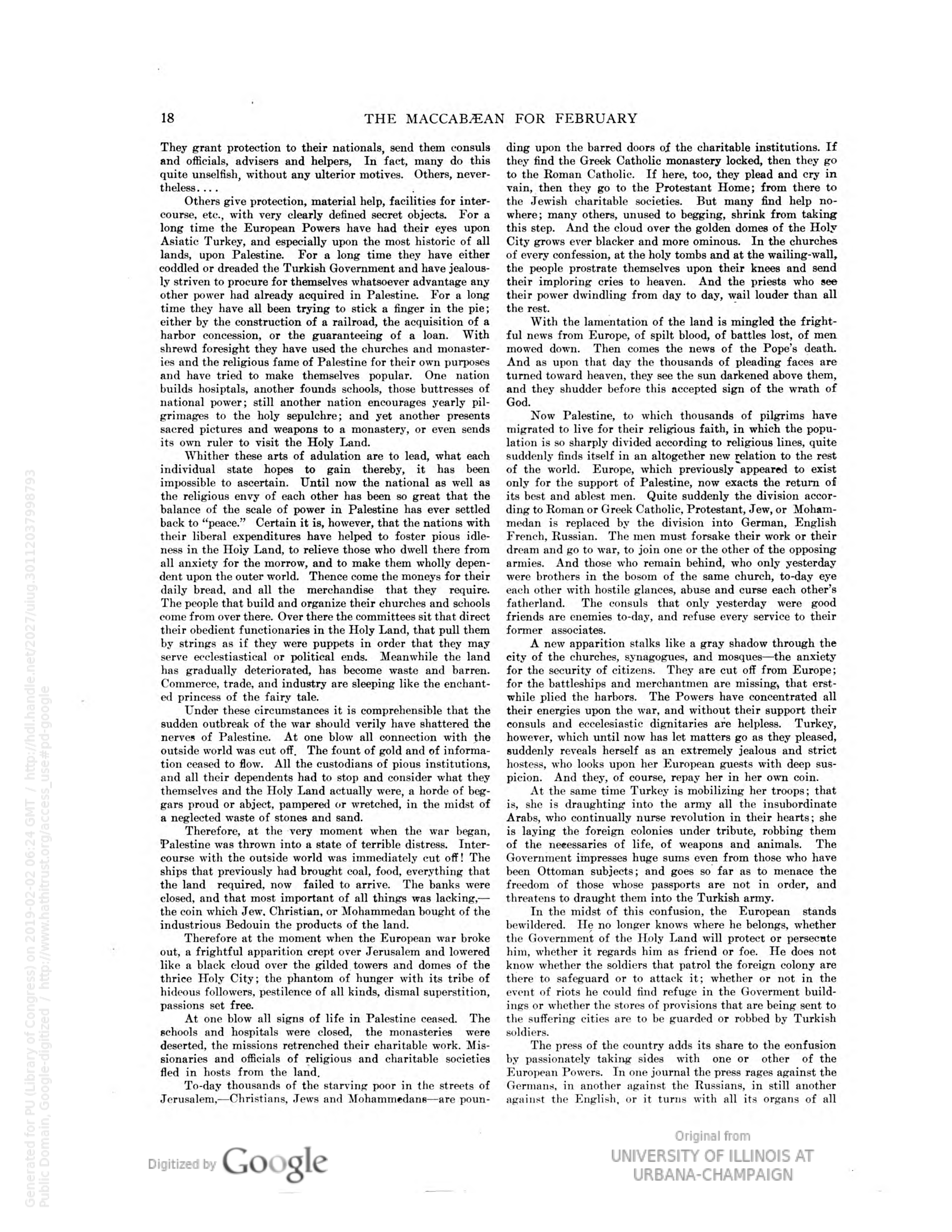
AMONG all the cities of the world there is none other so wonderful as Jerusalem. Every other city on earth belongs to one land, one people, one government and one age —but Jerusalem belongs to one and every one; it belongs to no state, yet all nations have a claim upon its soil; to no church, yet all religions have here their memorials. The City of Jerusalem is not the child of any one age, but all ages have left their marks upon her; traces of the ancient culture of the Hebrews are visible in subterranean sepulchres and enormous pools; the Romans have left fortresses behind them; Christianity of the middle-ages appears in Gothic churches and the pious myths that hover over hill and dale; Mohammedanism, in gorgeously gilded architecture barbaric and beautiful; the Renaissance in the wonder-blossoms of its art; the 19th Century, in religious sects and humanitarian strivings; the national decay of Judaism is seen in its superstition, its lack of aesthetic culture, and its mixture of languages and costumes;—and last of all, modernity itself appears with its practical, sensible organization for human welfare and its programs.
Like a solitary, huge museum the Holy City rises upon its mount. And the thousands of people that inhabit it are like so many curators each one of whom has to administer his own religion or sect, his own nationality, his own scheme for world salvation. These guardians of ideas, ancient or modern, uplifting or revolting, national or religious, stand guard over each other like grim dogs and take care lest any one should wax greater than the others. The fate, present and future, of the city and of all its inhabitants, or even of the land itself,—that does not trouble them. If only no other church becomes greater, if no other foreign colony becomes more influential than their own! With eager attention they guard against this;
to prevent this they build their splendid edifices, they tend their ancient sanctuaries. This is why they feed the poor, heal the sick, teach those that crave learning. That is also why they have gradually changed their convents and monasteries and pilgrims’ hostelries into arsenals. Every priest and monk has become a soldier, every canoness an agitator, and every temple a refuge for the persecuted.
Jerusalem lies in Palestine only geographically; in reality it is at the center of the world. It is the heart of all religious communities, whose ideals, in purest spirituality, almost disembodied, dwell side by side in the Holy City.
And the Turkish Government, to whom this city and all of the Holy Land belongs? The government does not trouble itself about its possession; it lets things go as they please; it allows construction and destruction, it protects no one threatens no one. It seems almost as if there were no government, as if the antagonistic elements held together simply because they were evenly balanced.
And the great communities from without, which send their representative hither: the churches and the nations? The churches also are indifferent to what happens, and strive only to glorify themselves in the Holy City through ever larger and more pompous works, to reach to ever greater spiritual power through their own representatives. They spend, spend liberally and without stint. The servants of all these churches have long since lost the habit of work or worry, and see in Europe, in America, and in all the rest of the world nothing but a fount of gold flowing towards Palestine. Jews, Catholics, Protestants, Mohammedans,—each with their sects,—vegetate, celebrate,—and the rest of the world works for them, maintains them, surrounds their priest with glory and renown.
And the various nations?