THE JEWISH NATION AND THE JEWISH RELIGION
WHAT THE JEW CREATED FOR HIMSELF AND WHAT THE NATIONS OF THE WORLD FOUND READY MADE.
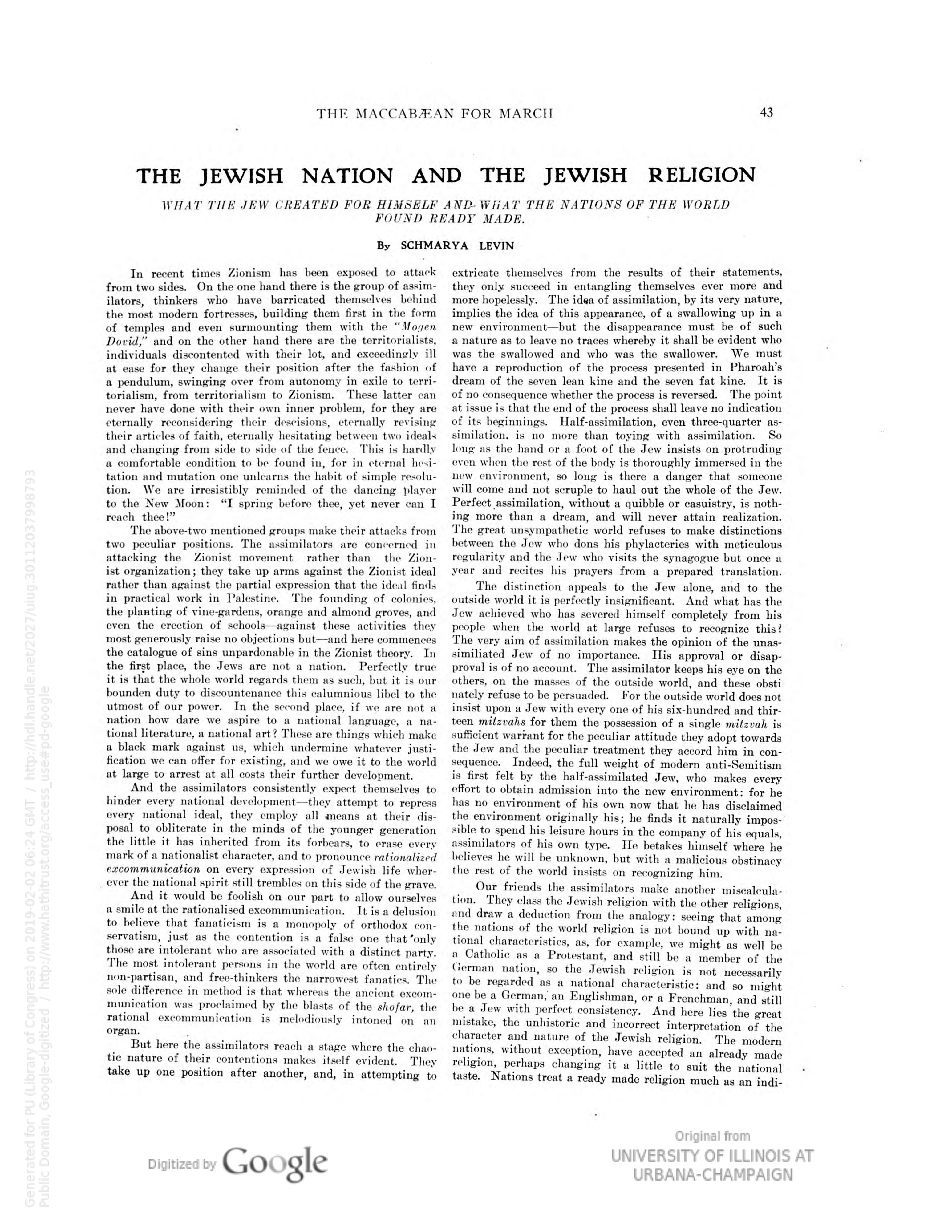
In recent times Zionism has been exposed to attack from two sides. On the one hand there is the group of assimilators, thinkers who have barricated themselves behind the most modern fortresses, building them first in the form of temples and even surmounting them with the "Mogen Dovid," and on the other hand there are the territorialists, individuals discontented with their lot, and exceedingly ill at ease for they change their position after the fashion of a pendulum, swinging over from autonomy in exile to territorialism, from territorialism to Zionism. These latter can never have done with their own inner problem, for they are eternally reconsidering their descisions, eternally revising their articles of faith, eternally hesitating between two ideals and changing from side to side of the fence. This is hardly a comfortable condition to be found in, for in eternal hesitation and mutation one unlearns the habit of simple resolution. We are irresistibly reminded of the dancing player to the New Moon: "I spring before thee, yet never can I reach thee!"
The above-two mentioned groups make their attacks from two peculiar positions. The assimilators are concerned in attacking the Zionist movement rather than the Zionist organization; they take up arms against the Zionist ideal rather than against the partial expression that the ideal finds in practical work in Palestine. The founding of colonies, the planting of vine-gardens, orange and almond groves, and even the erection of schools—against these activities they most generously raise no objections but—and here commences the catalogue of sins unpardonable in the Zionist theory. In the first place, the Jews are not a nation. Perfeetly true it is that the whole world regards them as such, but it is our bounden duty to discountenance this ealumnious libel to the utmost of our power. In the second place, if we are not a nation how dare we aspire to a national language, a national literature, a national art? These are things which make a black mark against us, which undermine whatever justi- fieation we can offer for existing, and we owe it to the world at large to arrest at all costs their further development.
And the assimilators consistently expect themselves to hinder every national development—they attempt to repress every national ideal, they employ all means at their disposal to obliterate in the minds of the younger generation the little it has inherited from its forbears, to erase every mark of a nationalist character, and to pronounce rationalized excommunication on every expression of Jewish life wherever the national spirit still trembles on this side of the grarve.
And it would be foolish on our part to allow ourselves a smile at the rationalised excommunication. Itisa delusion to believe that fanatieism is a monopoly of orthodox conservatism, just as the contention is a false one that "only those are intolerant who are associated with a distinet party. The most intolerant persons in the world are often entirely non-partisan, and free-thinkers the narrowest fanaties. The sole difference in method is that whereas the aneient exeom- munication was proclaimed by the blasts of the shofar, the rational excommunication is melodiously intoned on an orzan.
But here the assimilators reach a stage where the chaotic nature of their contentions makes itself evident. They take up one position after another, and, in attempting to
extricate themselves from the results of their statements, they only succeed in entangling themselves ever more and more hopelessly. The idea of assimilation, by its very nature, implies the idea of this appearance, of a swallowing up in a new environment—but the disappearance must be of such a nature as to leave no traces whereby it shall be evident who was the swallowed and who was the swallower. We must have a reproduction of the process presented in Pharoah’s dream of the seven lean kine and the seven fat kine. It is of no consequence whether the process is reversed. The point at issue is that the end of the process shall leave no indication of its beginnings. Half-assimilation, even three-quarter assimilation, is no more than toying with assimilation. So long as the hand or a foot of the Jew insists on protruding even when the rest of the body is thoroughly immersed in the new environment, so long is there a danger that someone will come and not sceruple to haul out the whole of the Jew. Perfect assimilation, without a quibble or casuistry, is nothing more than a dream, and will never attain realization. The great unsympathetie world refuses to make distinetions between the Jew who dons his phylacteries with meticulous regularity and the Jew who visits the synagogue but once a year and recites his prayers from a prepared translation.
The distinction appeals to the Jew alone, and to the outside world it is perfeetly insignificant. And what has the Jew achieved who has severed himself completely from his people when the world at large refuses to recognize this? The very aim of assimilation makes the opinion of the unas- similiated Jew of no importance. Ilis approval or disapproval is of no account. The assimilator keeps his eye on the others, on the masses of the outside world, and these obsti nately refuse to be persuaded. For the outside world does not insist upon a Jew with every one of his six-hundred and thirteen mitzvahs for them the possession of a single mitzvah is sufficient warrant for the peculiar attitude they adopt towards the Jew and the peculiar treatment they accord him in consequence. Indeed, the full weight of modern anti-Semitism is first felt by the half-assimilated Jew, who makes every effort to obtain admission into the new environment: for he has no environment of his own now that he has disclaimed the environment originally his; he finds it naturally impossible to spend his leisure hours in the company of his equals, assimilators of his own type. IIe betakes himself where he believes he will be unknown, but with a malieious obstinacy the rest of the world insists on recoenizine him.
Our friends the assimilators make another misealeulation. They class the Jewish religion with the other religions, and draw a deduction from the analogy: seeing that among the nations of the world religion is not bound up with national characteristics, as, for example, we might as well be a Catholic as a Protestant, and still be a member of the (ierman nation, so the Jewish religion is not necessarily to be regarded as a national characteristie: and so might one be a German, an Englishman, or a Frenchman, and still be a Jew with perfeet consisteney. And here lies the great mistake, the unhistorie and incorreet interpretation of the character and nature of the Jewish religion. The modern nations, without exception, have accepted an already made religion, perhaps changing it a little to suit the national taste. Nations treat a ready made religion much as an indi-