The Death of Judah L. Perez
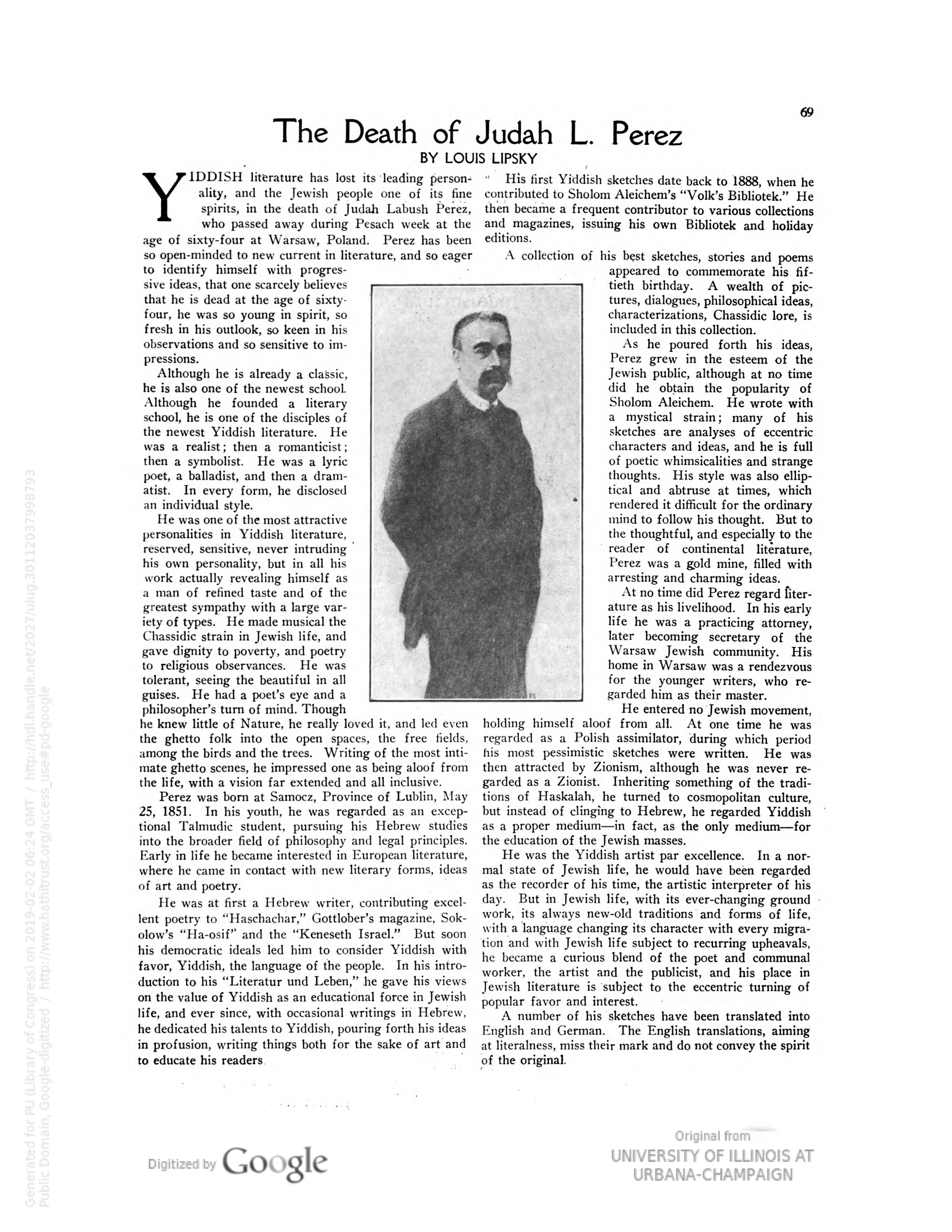
YIDDISH literature has lost its leading personality, and the Jewish people one of its fine spirits, in the death of Judah Labush Perez, who passed away during Pesach week at the age of sixty-four at Warsaw, Poland. Perez has been so open-minded to new current in literature, and so eager to identify himself with progressive ideas, that one scarcely believes that he is dead at the age of sixty-four, he was so young in spirit, so fresh in his outlook, so keen in his observations and so sensitive to impressions.
Although he is already a classic, he is also one of the newest school. Although he founded a literary school, he is one of the disciples of the newest Yiddish literature. He was a realist; then a romanticist; then a symbolist. He was a lyric poet, a balladist, and then a dramatist. In every form, he disclosed an individual style.
He was one of the most attractive personalities in Yiddish literature, reserved, sensitive, never intruding " his own personality, but in all his work actually revealing himself as a man of refined taste and of the greatest sympathy with a large variety of types. He made musical the Chassidic strain in Jewish life, and gave dignity to poverty, and poetry to religious observances. He was tolerant, seeing the beautiful in all guises. He had a poet’s eye and a philosopher’s turn of mind. Though he knew little of Nature, he really loved it, and led even the ghetto folk into the open spaces, the free fields, among the birds and the trees. Writing of the most intimate ghetto scenes, he impressed one as being aloof from the life, with a vision far extended and all inclusive.
Perez was born at Samocz, Province of Lublin, May 25, 1851. In his youth, he was regarded as an exceptional Talmudic student, pursuing his Hebrew studies into the broader field of philosophy and legal principles. Early in life he became interested in European literature, where he came in contact with new literary forms, ideas of art and poetry.
He was at first a Hebrew writer, contributing excellent poetry to “Haschachar,” Gottlober’s magazine, Sokolow’s “Ha-osif” and the “Keneseth Israel” But soon his democratic ideals led him to consider Yiddish with favor, Yiddish, the language of the people. In his introduction to his “Literatur und Leben,” he gave his views on the value of Yiddish as an educational force in Jewish life, and ever since, with occasional writings in Hebrew, he dedicated his talents to Yiddish, pouring forth his ideas in profusion, writing things both for the sake of art and to educate his readers :
His first Yiddish sketches date back to 1888, when he contributed to Sholom Aleichem's "Volk's Bibliotek." He then became a frequent contributor to various collections and magazines, issuing his own Bibliotek and holiday editions.
A collection of his best sketches, stories and poems appeared to commemorate his fiftieth birthday. A wealth of pictures, dialogues, philosophical ideas, characterizations, Chassidic lore, is included in this collection.
As he poured forth his ideas, Perez grew in the esteem of the Jewish public, although at no time did he obtain the popularity of Sholom Aleichem. He wrote with a mystical strain; many of his sketches are analyses of eccentric characters and ideas, and he is full of poetic whimsicalities and strange thoughts. His style was also ellip- tical and abtruse at times, which rendered it dificult for the ordinary mind to follow his thought. But to the thoughtful, and especially to the reader of continental literature, Perez was a gold mine, filled with arrestine and charming ideas.
At no time did Perez regard literature as his livelihood. In his early life he was a practicing attorney, later becoming secretary of the Warsaw Jewish community. His home in Warsaw was a rendezvous for the younger writers, who regarded him as their master.
He entered no Jewish movement, holding himself aloof from all. At one time he was regarded as a Polish assimilator, during which period his most pessimistic sketches were written. He was then attracted by Zionism, although he was never regarded as a Zionist. Inheriting something of the traditions of Haskalah, he turned to cosmopolitan culture, but instead of clinging to Hebrew, he regarded Yiddish as a proper medium—in fact, as the only medium—for the education of the Jewish masses.
He was the Yiddish artist par excellence. In a normal state of Jewish life, he would have been regarded as the recorder of his time, the artistic interpreter of his day. But in Jewish life, with its ever-changing ground work, its always new-old traditions and forms of life, with a language changing its character with every migration and with Jewish life subject to recurring upheavals, he became a curious blend of the poet and communal worker, the artist and the publicist, and his place in Jewish literature is subject to the eccentric turning of popular favor and interest.
A number of his sketches have been translated into English and German. The English translations, aiming at literalness, miss their mark and do not convey the spirit of the original.