Georges De Porto-RicheAnd Other French Contemporary Dramatists of Jewish AncestryBY LEON FERARU
WAS it his peculiar name, or the attacks of the French royalists, that made known worldwide Henry Bernstein as a Jewish talent in the French drama?
Henry Bernstein is not the only Jew who creates drama in the City of Light. There are others hiding under an infinite variety of French names, and surpassing them all—Henry Bernstein included,—is Georges de Porto-Riche.
A few decades ago, Alexandre Dumas fils, interested in the first work of a new young playwright, wrote to him, among other criticisms, the following: "I am not quite sure that you are a dramatic author, but I am convinced that you are a dramatic poet." The young man of letters to whom the great dramatist addressed these lines was Georges de Porto-Riche, now one of the greatest living French dramatic authors, the father of the Comedy of Love.
Georges de Porto-Riche marks the end of the so-called "modern theatre," in which only the technical perfections deserve the adjective. As Henry Bernstein writes to Adolphe Brisson, the dramatic critic: "We must grant that the contemporaries of Dumas fils and Augier do not unanimously approve the works of Porto-Riche and Paul Hervieu." The theatre of Georges de Porto-Riche, called the Theatre of Love, Le Theatre d'Amour, is a living and biting satire on contemporary family life.
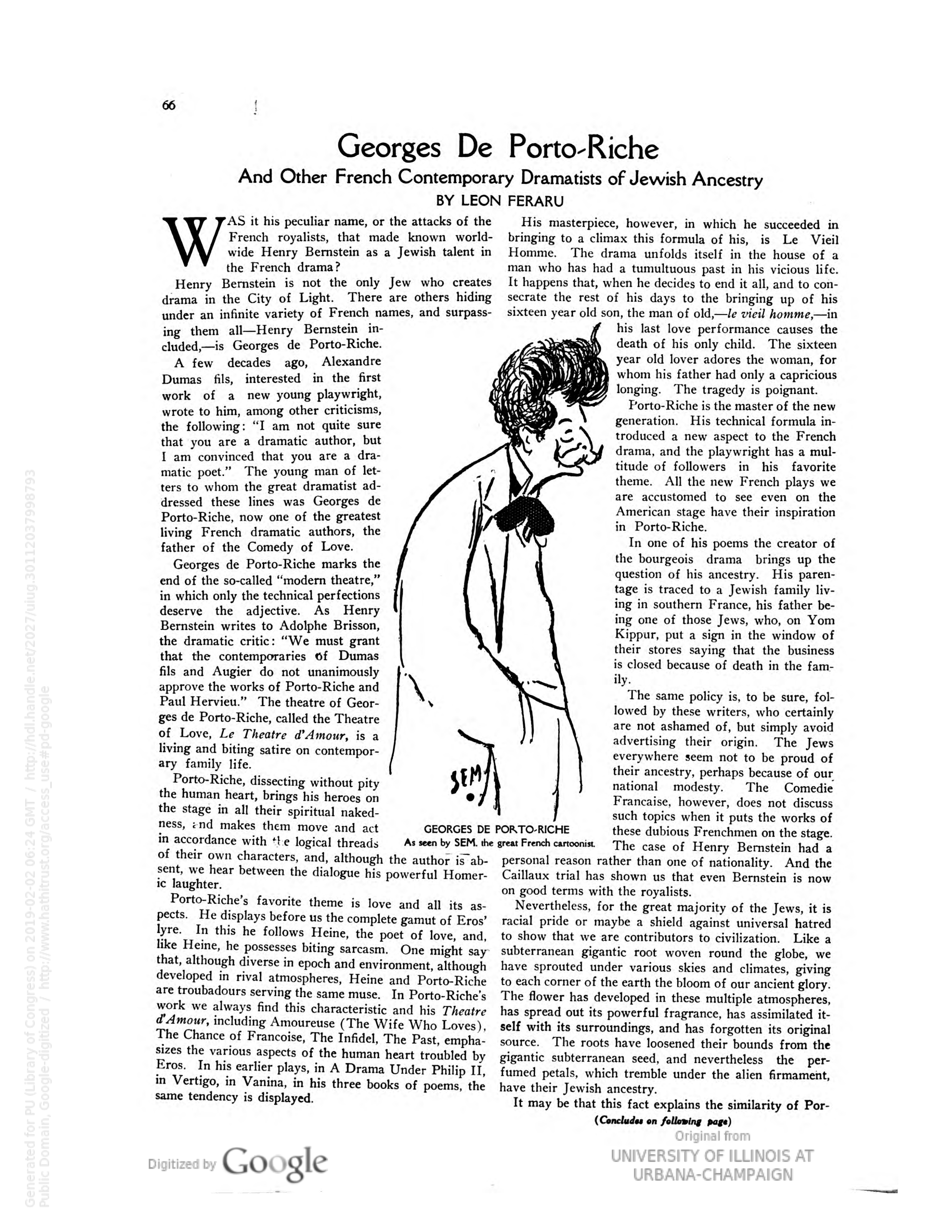
Porto-Riche, dissecting without pity the human heart, brings his heroes on the stage in all their spiritual nakedness, and makes them move and act in accordance with the logical threads of their own characters, and, although the author is absent, we hear between the dialogue his powerful Homeric laughter.GEORGES DEAs seen by SEM. the
Porto-Riche's favorite theme is love and all its aspects. He displays before us the complete gamut of Eros' lyre. In this he follows Heine, the poet of love, and, like Heine, he possesses biting sarcasm. One might say that, although diverse in epoch and environment, although developed in rival atmospheres, Heine and Porto-Riche are troubadours serving the same muse. In Porto-Riche's work we always find this characteristic and his Theatre d'Amour, including Amoureuse (The Wife Who Loves), The Chance of Francoise, The Infidel, The Past, emphasizes the various aspects of the human heart troubled by Eros. In his earlier plays, in A Drama Under Philip II, in Vertigo, in Vanina, in his three books of poems, the same tendency is displayed.
His masterpiece, however, in which he succeeded in bringing to a climax this formula of his, is Le Vieil Homme. The drama unfolds itself in the house of a man who has had a tumultuous past in his vicious life. It happens that, when he decides to end it all, and to consecrate the rest of his days to the bringing up of his sixteen year old son, the man of old,—le vieil homme,—in his last love performance causes the death of his only child. The sixteen year old lover adores the woman, for whom his father had only a capricious longing. The tragedy is poignant.
Porto-Riche is the master of the new generation. His technical formula introduced a new aspect to the French drama, and the playwright has a multitude of followers in his favorite theme. All the new French plays we are accustomed to see even on the American stage have their inspiration in Porto-Riche.
In one of his poems the creator of the bourgeois drama brings up the question of his ancestry. His parentage is traced to a Jewish family living in southern France, his father being one of those Jews, who, on Yom Kippur, put a sign in the window of their stores saying that the business is closed because of death in the family.
The same policy is, to be sure, followed by these writers, who certainly are not ashamed of, but simply avoid advertising their origin. The Jews everywhere seem not to be proud of their ancestry, perhaps because of our national modesty. The Comedie Francaise, however, does not discuss such topics when it puts the works of these dubious Frenchmen on the stage. The case of Henry Bernstein had a personal reason rather than one of nationality. And the Caillaux trial has shown us that even Bernstein is now on good terms with the royalists.
Nevertheless, for the great majority of the Jews, it is racial pride or maybe a shield against universal hatred to show that we are contributors to civilization. Like a subterranean gigantic root woven round the globe, we have sprouted under various skies and climates, giving to each corner of the earth the bloom of our ancient glory. The flower has developed in these multiple atmospheres, has spread out its powerful fragrance, has assimilated itself with its surroundings, and has forgotten its original source. The roots have loosened their bounds from the gigantic subterranean seed, and nevertheless the perfumed petals, which tremble under the alien firmament, have their Jewish ancestry.
It may be that this fact explains the similarity of Porto-Riche
(Concludes on following page)