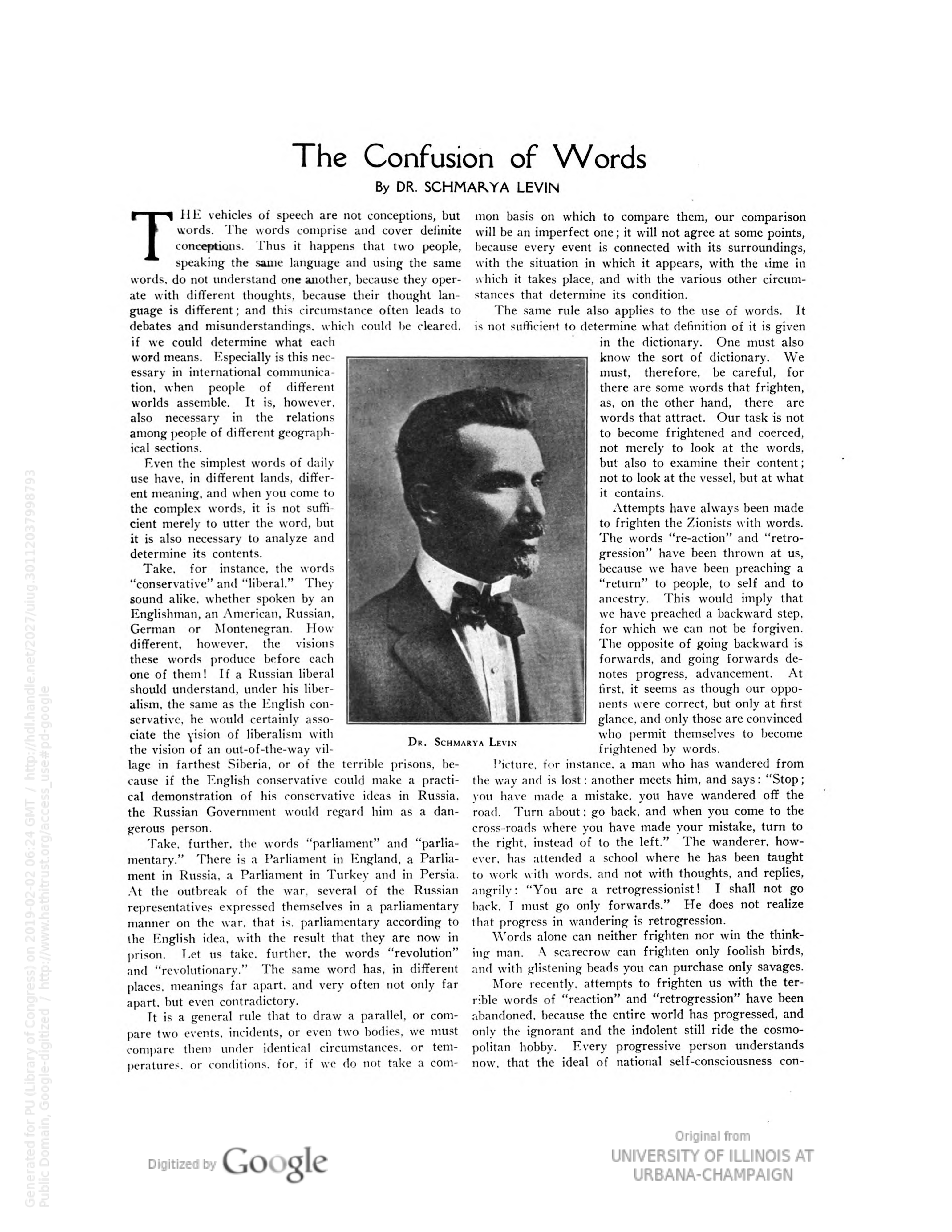
The Confusion of Words
THE vehicles of speech are not conceptions, but words. The words comprise and cover definite conceptions. Thus it happens that two people, speaking the same language and using the same words, do not understand one another, because they operate with different thoughts, because their thought language is different; and this circumstance often leads to debates and misunderstandings, which could be cleared, if we could determine what each word means. Especially is this necessary in international communication, when people of different worlds assemble. It is, however, also necessary in the relations among people of different geographical sections.
Even the simplest words of daily use have, in different lands, different meaning, and when you come to the complex words, it is not sufficient merely to utter the word, but it is also necessary to analyze and determine its contents.
Take, for instance, the words "conservative" and "liberal." They sound alike, whether spoken by an Englishman, an American, Russian, German or Montenegran. How different, however, the visions these words produce before each one of them! If a Russian liberal should understand, under his liberalism, the same as the English conservative, he would certainly associate the vision of liberalism with the vision of an out-of-the-way village in farthest Siberia, or of the terrible prisons, because if the English conservative could make a practical demonstration of his conservative ideas in Russia, the Russian Government would regard him as a dangerous person.
Take, further, the words "parliament" and "parliamentary." There is a Parliament in England, a Parliament in Russia, a Parliament in Turkey and in Persia. At the outbreak of the war, several of the Russian representatives expressed themselves in a parliamentary manner on the war, that is, parliamentary according to the English idea, with the result that they are now in prison. Let us take, further, the words "revolution" and "revolutionary." The same word has, in different places, meanings far apart, and very often not only far apart, but even contradictory.
It is a general rule that to draw a parallel, or compare two events, incidents, or even two bodies, we must compare them under identical circumstances, or temperatures, or conditions. for, if we do not take a com-
mon basis on which to compare them, our comparison will be an imperfect one; it will not agree at some points, because every event is connected with its surroundings, with the situation in which it appears, with the time in which it takes place, and with the various other circumstances that determine its condition.
The same rule also applies to the use of words. It is not sufficient to determine what definition of it is given
in the dietionary. One must also know the sort of dictionary. We must, therefore, be careful, for there are some words that frighten, as, on the other hand, there are words that attract. Our task is not to become frightened and coerced, not merely to look at the words, but also to examine their content; not to look at the vessel, but at what it contains.
Attempts have always been made to frighten the Zionists with words. The words “reaction” and “retrogression” have been thrown at us, because we have been preaching a “return” to people, to self and to ancestry. This would imply that we have preached a backward step, for which we can not be forgiven. The opposite of going backward is forwards, and going forwards denotes progress. advancement. At first, it seems as though our opponents were correct, but only at first glance, and only those are convinced who permit themselves to become {rishtened bv words.
Picture, for instance, a man who has wandered from the way and is lost : another meets him, and says: “Stop; you have made a mistake. you have wandered off the road. Turn about: go back, and when you come to the cross-roads where you have made your mistake, turn to the right, instead of to the left.” The wanderer, however, has attended a school where he has been taught to work with words. and not with thoughts, and replies, angrilv: “You are a retrogressionist! IT shall not go back. I must go only forwards.” He does not realize that progress in wandering is retrogression.
Words alone can neither frighten nor win the thinking man. A scarecrow can frighten only foolish birds, and with glistening beads you can purchase only savages.
More recently, attempts to frighten us with the terrible words of "reaction" and "retrogression" have been abandoned, because the entire world has progressed, and only the ignorant and the indolent still ride the cosmopolitan hobby. Every progressive person understands now, that the ideal of national self-consciousness con-